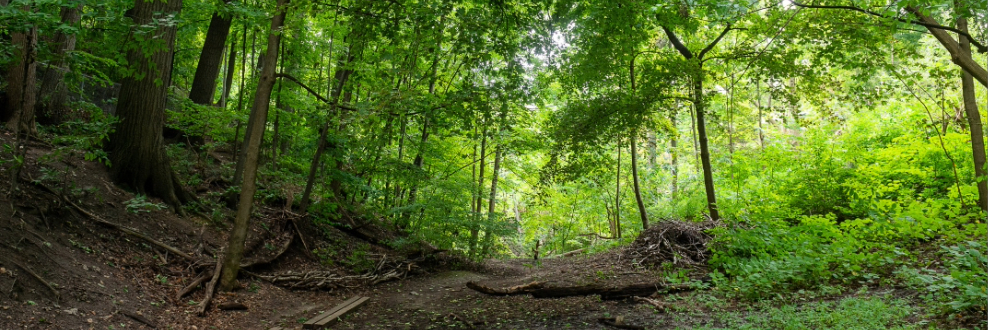
Why the Glen Stewart Ravine needs your help:
Sandy soil and steep slopes make this ravine extremely vulnerable to erosion from off trail usage. The soil in some areas of the slopes has become packed and hard like pavement, and as a result the soil can no longer absorb water. When this soil compaction occurs in a sensitive area like the Glen Stewart ravine, the result is plants that grow on the forest floor, called the forest understory, die off. This causes the trees, in this case, red oaks and red maples, to suffer and leads to tree death which eventually causes forest death. You can help nurture the ravine back to good health by treading lightly. Please, stay on the trails, respect the fencing and keep your dog on a leash.
About the Glen Stewart Ravine
Glen Stewart is an 11 hectare ravine with a wide diversity of plant and bird life. Fed by clean ground water from Ames Creek, the ravine forest is dominated by red oak and red maple. The site is also designated as an Environmentally Significant Area through the City's Official Plan. Several species of birds and plants observed within the area are regionally uncommon.
Ravine Improvements
The City of Toronto and Toronto and Region Conservation Authority have completed infrastructure improvements including the reconstruction of two pedestrian bridges, the Balsam staircase and more than ten slope retaining structures. In addition to these reconstruction projects, a boardwalk has been installed to improve trail conditions in the ravine and to make the site more inclusive and accessible.
All of these improvements will help enhance the forest conditions over time by protecting sensitive plants and soils from off-trail traffic. The majority of the new plantings are small plants and we need your help to avoid trampling damage.
Implementation of this project is part of the Glen Stewart Ravine Management Plan, which was created in consultation with the public in 2008, http://www.schollenandcompany.com/glenstewart.zip/

New elevated boardwalk installed in Glen Stewart Ravine – adjacent areas will be heavily planted with appropriate native species.

New staircase replacement to Balsam Avenue – areas disturbed by construction as well as the former staircase footprint will be restored with native plantings.
The stairs were reconstructed to avoid impacting the slope as much as possible. The stairs are supported by helical piers, so no excavation was required for the supports. Helical piers are screwed into the soil until they meet the appropriate resistance characteristics in the soil required to hold the staircase load.
Both the boardwalk and staircase have hemlock railings which were selected as hemlock is naturally a disease resistant wood.

New Protection Fencing Installation
Eastern white cedar fencing is being installed along the east and south sides of the main trail in the ravine to protect slopes and vegetation from trampling damage. Older fencing on the south part of the trail from Glen Manor Drive has been replaced.
Restoration and Replanting Strategy for Glen Stewart Ravine
Since the drafting of the Glen Stewart Ravine Management Plan in 2008, Urban Forestry has been putting detail plans in place to address management issues and recommendations outlined in this report to improve the ecological integrity of the ravine.
Glen Stewart Ravine Management Issues Include:
- maintaining long-term health of native trees and promoting regeneration
- mitigating soil erosion and compaction around trees
- promoting diversity of vegetation and species
- restoring and enhancing floodplain vegetation
- stabilizing steep and unstable slopes
- managing invasive species
Invasive Species Management Along the Ravine Edge:
While plans were underway to improve infrastructure in the central portion of the ravine Urban Forestry initiated phased management work on the outer forest edge along the upper portion of Glen Manor Drive in 2009 to remove invasive trees, replacing them with native trees and shrubs. The majority of the trees removed were Norway maple and Manitoba maple, both cause excessive shading and competition with native species. These trees have long term negative impacts on ravine sites by creating bare slopes with low species diversity, where native perennials and shrubs and native tree regeneration are inhibited. This leads to erosion where soils are not held in place with dense vegetation cover and root systems. For more information on invasive plants see Forestry Fact Sheet #3. The new plantings in these areas will be allowed to establish before starting the next phases of tree management and replacement.
Last fall, Urban Forestry removed many Norway maple trees along the main trail in Glen Stewart Ravine. The removal of these trees will limit spread of this species and allow better establishment of new plantings. All of the sites where tree removal occurred last fall will be replanted this spring with a variety of native trees and shrubs.
New Plantings:
The total amount of woody plant material planned for this spring includes over 800 trees and shrubs including red maple (top left below), red oak, black cherry, hemlock and yellow birch trees and native shrubs including alternate dogwood, bush honeysuckle, witch hazel (top right), choke cherry and purple-flowering raspberry (bottom right). Some native grasses and wildflowers will also be planted in some of the bare zones including bottlebrush grass (bottom left), foam flower, wild geranium, zig-zag goldenrod (centre), Virginia waterleaf and starry false soloman's seal.
The new plantings in these areas will be given time to become established before Urban Forestry starts the next phases of tree management and replacement. The majority of the new plantings are small plants and easily damaged by foot traffic. Give these plantings the chance to get established. Tread lightly, stay on the trail and keep your dog on a leash.
Retaining Wall:
Part of the infrastructure improvements completed in the ravine was the replacement of approximately 16 retaining walls at 8 different locations in the ravine. The new walls were constructed using a new environmentally sustainable product called Envirolok that is built out of fabric sand bags that will be vegetated to provide additional slope stabilization.
Retaining Wall Planting:
In late spring/early summer this year herbaceous grasses and herb plugs will be planted into the wall structures as per the photo illustration below. The face of the walls will also be seeded with a native seed and soil mix, which includes beneficial bacteria and mycorrhizae. The total number of herbaceous plugs planned for this site is approximately 2500 spread throughout the 16 walls. A mix species were chosen to accommodate the different site conditions throughout the ravine. The plugs and seed mix includes species such as zig-zag goldenrod, large-leaved aster, blue-stemmed goldenrod, bottlebrush grass, Canada wild rye, heath aster, sky-blue aster, riverbank rye, white snakeroot and woodland sunflower. The sites will need to be thoroughly watered throughout the establishment period to ensure good take of the plant material and seed.

Photo of new retaining wall structure. Plant plugs will be planted directly in between soil bag layers as per photo below.

Photo credit: Envirolok Canada
Important Notice:
The Glen Stewart Ravine is not an off-leash location. There are three off-leash areas to choose from in this area: Kew Gardens Beach, Norwood Park and Cassels Playground.
Related Information
|