The Ministry of Health requires each Board of Health in Ontario to follow a standardized process that assesses the conditions of all regulated recreational water facilities including swimming pools, spas (hot tubs), wading pools and splash pads that are open to the public.
Regulation 565, Public Pools under Ontario’s Health Protection and Promotion Act regulates recreational water facilities and sets out the minimum health and safety standards. Toronto Public Health inspects all public recreational water facilities in Toronto.
Inspection Frequency
The Recreational Water Protocol 2019 sets out the inspection frequency as once every 90 days while open.
Additional inspections may be required for the following reasons:
- before reopening a facility that has been altered, repaired or closed for more than four consecutive weeks
- to address non-compliance where crucial or significant infractions have been noted in the inspection report provided by a Public Health Inspector
- in response to complaints
- by request of an operator or owner
Reporting & Disclosure
Every public pool and hot tub in Toronto must prominently display the most recent SwimSafe Disclosure notice at all times, as issued without alteration, at or near the main entrance and before the entrance to the pool/hot tub enclosure.
Toronto Public Health also posts inspection reports on the SwimSafe web page.
SwimSafe Disclosure Notices
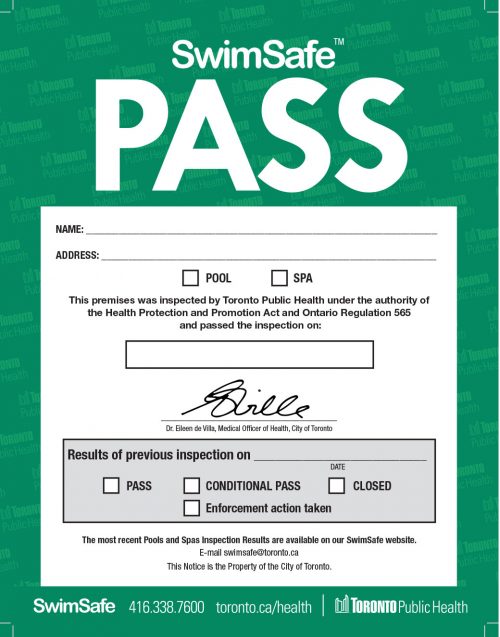
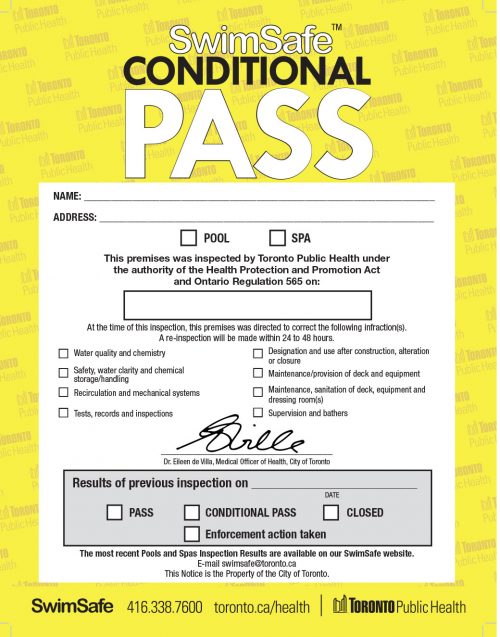
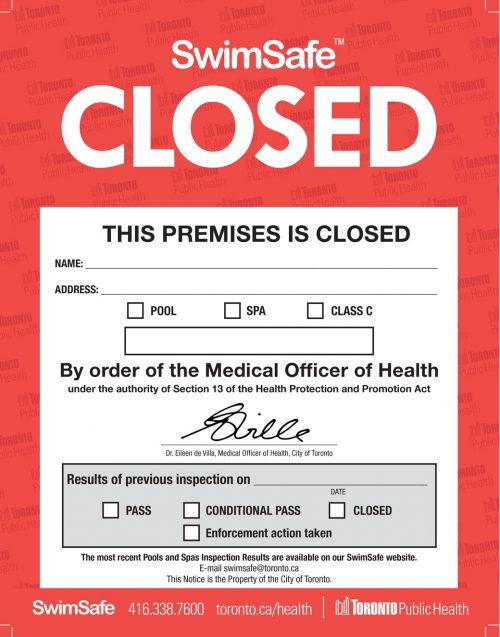
Toronto Public Health has grouped infractions into three simplified notices for reporting under the SwimSafe disclosure system: Pass, Conditional Pass or Closed.
This system meets all legislative requirements. Resource materials are available to help owners and operators comply with regulatory requirements and pass an inspection.
The following table provides examples of infraction types and the associated inspection report:
| Inspection Report |
Notice |
Infraction Examples |
| Pass
Minor infractions:
- Present minimal or no health or safety risk
- Should be corrected by the next mandated inspection
|
 |
- Improperly maintained record book
- Inappropriate font size on signs
- Damaged signs
- Surfaces or equipment needing minor cleaning or repair
|
| Conditional Pass
Significant infractions:
- May potentially present a health or safety hazard
- Presents increased risk of harm the longer the issue remains unresolved
- Must be corrected within 24-48 hours, or extensions can be allowed by the inspector
- Legal action may be taken
|
 |
- Lack adequate supply of disinfecting chemicals on hand
- Surfaces or equipment require major cleaning or repair
- Lack of equipment that is not crucial to safe operation (e.g. skimmer weirs)
- Demarcation lines/signage missing
- Improper cleaning and sanitizing of equipment and surfaces
|
| Closed
Crucial infractions:
- Present an imminent risk of injury and/or fatality, or spread of disease to facility users
- Recreational water facilities that are closed because of a health hazard must be re-inspected by a Public Health Inspector before they can reopen
- Legal action may be taken
|
 |
- Cloudy water – cannot see black disk or other markings used to monitor clarity
- No sanitizer detected in pool/hot tub enclosure and none in the facility
- Sewage back-up or an incident in which a facility user fouls the water or deck area
- Improper, damaged, loose or missing outlet cover(s)
- Lack of safe, potable water
- Inoperable filtration or recirculation system
- Missing/damaged lifesaving equipment
- Missing/damaged safety and personal protective equipment or lack of training where chlorine gas is used
- Lack of sufficient number of lifeguards or lack of proof of lifeguard qualifications
- Inoperable or unavailable emergency phone
|
|
|
|
Health Hazards
To eliminate potential health or safety hazards, a Public Health Inspector may issue a verbal or written Order to the owner or operator to take immediate action. Under the Health Protection and Promotion Act; an Order may include:
- instructing the facility users to leave the facility
- closing the facility for the length of time specified in the Order
- any other action that will reduce or eliminate any hazard and the exposure of facility users to that hazard
Operators are expected to have knowledge and proper training in the operation of the facility, and should never allow a health or safety hazard to develop.
Crucial infractions may lead to enforcement action. In the event an order is issued, either verbally or in writing, and the receiver of that order does not immediately comply, enforcement action is likely to be undertaken by the Public Health Inspector.
Date modified: September 30, 2020

