Hepatitis B Information for Health Care Professionals
Order vaccine online for high-risk clients via Toronto Public Health (TPH). Batch orders are still available for some vaccines. Please read the eligibility criteria before ordering.
Report all suspect or confirmed cases of hepatitis B infection for Toronto residents to Toronto Public Health’s Surveillance Unit at 416-392-7411 during work hours (Monday to Friday, 8:30 a.m. to 4:30 p.m.) or 311 after hours or on statutory holidays.
Hepatitis B (HBV) is a bloodborne liver infection caused by the hepatitis B virus. Infections with HBV that become chronic can lead to liver damage and liver cancer in the long-term, so proactive screening and early detection are critical to prevent serious illness. It is estimated that many people with HBV are not aware of their infections until the disease has progressed.
Hepatitis B affects less than one per cent of Canadians but is more common in some communities who experience disproportionately higher rates because of inequities in access to health care, including newcomers, people who use drugs and Indigenous people. Everyone can be protected from HBV infection by getting vaccinated. In Ontario, children in grade 7 receive the vaccine as part of the publicly funded immunization schedule.
Check the schedule to see if patients who missed HBV vaccination are eligible for free vaccination. People with HBV are eligible for free hepatitis A vaccination. Contacts of people with HBV are eligible for free HBV vaccinations.
Individuals born in areas with HBV prevalence greater than 2 per cent (e.g., Africa, Asia, Eastern & Southern Europe, the Middle East, Asian-Pacific Islands, Indigenous areas, Central and South America, and the Caribbean)
Individuals who have travelled or resided in these areas
Individuals starting immunosuppressive therapy (particularly cancer chemotherapy), or renal dialysis
Individuals with chronically elevated ALT or AST of unknown origin
Children, household and/or sexual contacts of HBsAg-positive individuals or those with a family history of HBV
All pregnant individuals and infants of HbsAg-positive mother/birthing parent
Individuals who have sustained occupational exposure to blood and/or body fluids
Organ transplant and/or blood donation recipients & individuals who have undergone medical procedures in Canada prior to 1970
Individuals infected with hepatitis C (HCV) or HIV
Individuals with higher-risk sexual activity (e.g. unprotected sex, multiple partners, history of STI, MSM)
Individuals who are currently/previously incarcerated
Individuals living in congregate settings, including development disability support facilities
Individuals with current/previous substance use with shared paraphernalia (“Works”)
All adults in Canada who have not yet been screened for HBV (2025 Recommendation from AMMI)
Testing
‘Chronic Hepatitis’ tests HBsAg:
One positive result denotes HBV infection
Two positive results ≥ six months denotes chronic HBV
‘Immune Status/Previous Exposure’ only tests anti-HBs
May be positive from previous infection or from immunization.
Check at least once in individuals with risk factors to rule out chronic HBV infection
Pattern
HBsAg
Anti-HBs
Anti-HBC
Interpretation
Susceptible
(newer infection)
-
-
-
No evidence of past or current infection; not immune
Immune (vaccination)
-
+
-
Vaccine-induced immunity
Immune (past infection)
-
+
+
Resolved prior infection with immunity
AcuteInfection
+
-
+ (IgM+)
Recent infection; high infectivity
ChronicInfection
+
-
+ (IgM-)
Persistent infection >6 months
Isolated anti-HBc
-
-
+
See note below**
**An isolated anti-HBc result (HBsAg-, anti-HBs-, and anti-HBc+) has four possible interpretations:
Resolving acute infection (window period – between HBsAg clearance and anti-HBs appearance)
Remotepastinfection with waned anti-HBs below detectable levels
Low-level chronic infection (occult HBV – HBV DNA may be detectable)
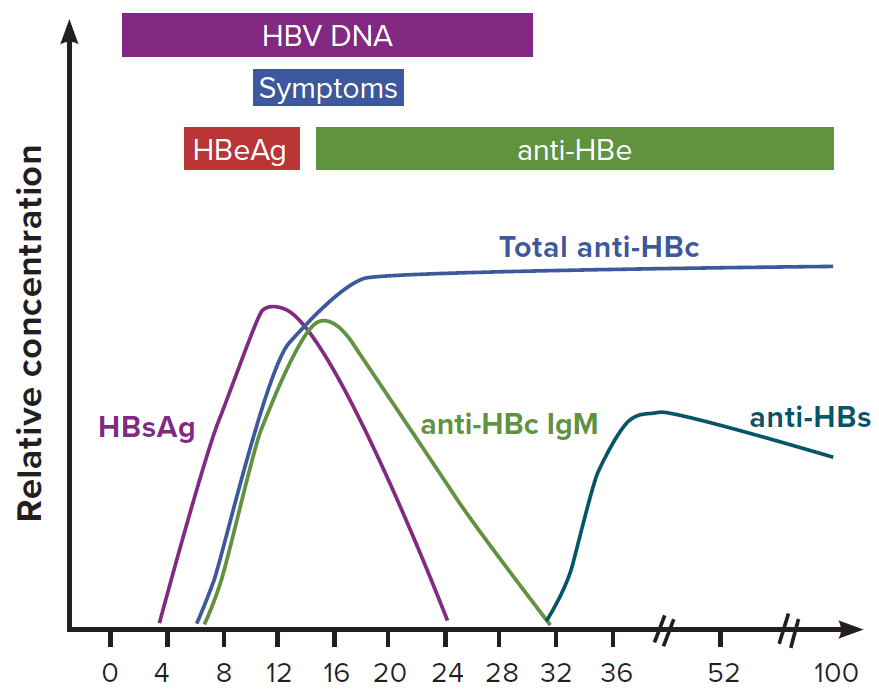
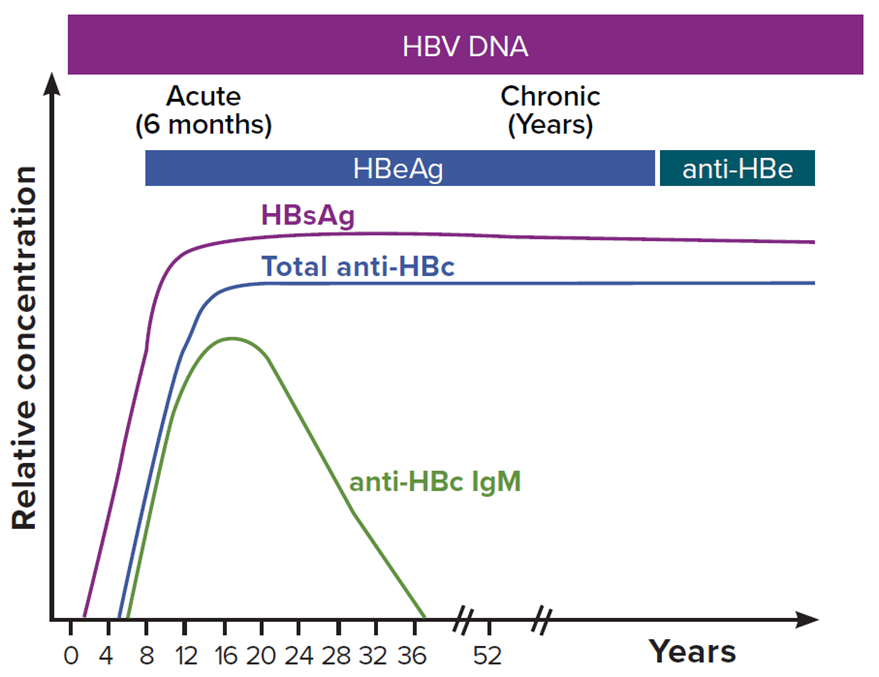
Typical serologic course of acute hepatitis B to recovery. Figure obtained from https://www.cdc.gov/mmwr/preview/mmwrhtml/rr5708a1.htm.Typical serologic course of the progression to chronic hepatitis B. Figure obtained from https://www.cdc.gov/mmwr/preview/mmwrhtml/rr5708a1.htm.
Tests of HBV replication: HBeAg, anti-HBe, HBV DNA viral load
Rule out viral co-infection: hepatitis C (anti-HCV), HIV (HIV serology), hepatitis D (“delta”, anti-HDV)
Screening: abdominal ultrasound
Routine Follow-Up
Counsel on the prevention of HBV transmission
Provide advice to reduce liver damage and medication considerations with cirrhosis
Follow HBV DNA and ALT every six to 12 months
Screening for Hepatocellular Carcinoma (HCC) every six months with abdominal ultrasound: for men >40 years old (>20 years old, if African descent), women >50 years old, any patient with a family history of hepatoma, and those with cirrhosis of any age. HCC may occur in the absence of cirrhosis.
Counselling for High-Risk Contacts
High Risk Contacts (Susceptible sexual, household, occupational)
Contacts: Immunize all susceptible contacts of acute and chronic carriers with HBV vaccine.
Order online vaccine for high-risk clients from Toronto Public Health. Batch orders are still available for some vaccines. Please read the eligibility criteria before ordering vaccine.
HB vaccine is ~95-100 per cent effective when given before exposure.
Children and Infants: Discuss immunization for infants and children <7 years at high risk (e.g., frequent contact with HBV positive person or travel to an endemic country).
Immunize and provide hepatitis B immune globulin (HBIG) to infants at birth where the birthing parent has HBV, with follow up to confirm protection.
Pregnancy and breastfeeding are not contraindications to hepatitis B vaccination or HBIG.
Sexual contacts: Give a single dose of HBIG within 14 days of the last sexual contact with the case.
Advise that protection cannot be ensured until vaccine course completed and antibodies tested (30 days after the final dose of vaccine).
Counsel on use of condoms to reduce, but not eliminate, risk of transmission.
Percutaneous/mucosal injuries/exposure (e.g., Occupational, bites): managed based on immune status of the exposed (injured) person (ideally within 7 days).
Pre & Post Vaccine Counselling
Pre-Immunization Testing (PIT)
If risk factors are present, testing first is indicated, however, do not delay immunization if a contact’s status is unknown in favour of PIT.
Post-Vaccine Serology (PVS)
Indicated only to assess level of protection against a continual known or repeated potential exposure to HBV (e.g., Occupational, household, higher-risk exposures, etc.) and is conducted at least 30 days after last dose.
Immunity through vaccine: when surface antibodies (anti-HBs) level ≥ 10 IU/mL. For vaccinated infants: PVS should be performed when baby is between nine to 18 months of age
For all other vaccinated contacts/exposed (sexual, household, occupational): PVS between 1-6 months after last dose.
Vaccine Non-Responders
For those who fail to show a response to the first series of vaccinations (HBsAb <10 mIU/mL) an additional three-dose series will produce a protective antibody response in 50-70 per cent of recipients.
Individuals who fail to respond to two complete 3 dose series of hepatitis B vaccine are unlikely to benefit from further HBV immunization.
Referral
Reasons for referral to specialty care (by a Hepatologist, GI, ID specialist, or a family physician with experience in HBV management):
If age >40 years old with positive HBV DNA
If elevated ALT (men >30 U/L, women >20 U/L)
If evidence of cirrhosis (e.g., low platelets, splenomegaly, hepatic mass or portal hypertension)
If HBeAg Positive (+)
If HBeAg Negative (-), with HBV DNA viral load > 2,000 IU/ml
Any HBsAg positive patient starting immunosuppressive therapy (even if normal ALT & negative HBV DNA)
Acute HBV: Refer to a specialist urgently if:
Signs of liver failure (e.g., encephalopathy, worsening jaundice)