It is mandatory for all property owners in Toronto to ensure their downspouts are disconnected from the City’s sewer system.
During heavy rain, the sewers can become overloaded, which can increase the risk of basement flooding and release of polluted rainwater into local waterways.
By disconnecting downspouts and directing stormwater onto the property instead, it can minimize the risk of sewer overloads.
Before starting, consider these important guidelines:
Water should flow away from a building’s foundation.
Ensure flow of water will not cause damage to your neighbour’s property, or onto a driveway or sidewalk.
Use a splash pad to help direct the flow of water and protect against erosion.
Avoid creating a tripping hazard; do not add extensions across a walk-way or in front of a gate or doorway.
Water flow may freeze in the winter; do not create dangerous conditions.
Consider using a rain barrel to capture and store rainwater.
During winter months, remove the rain barrel to avoid freezing and breaking.
After removing the rain barrel, add an extension to the downspout to ensure proper drainage away from your home.
Consider extending downspouts under a deck, patio or to a grassed or garden area.
Consider creating a rain garden or removing hard surfaces surfaces, such as concrete pathways or patios to allow water to infiltrate.
Once you’ve disconnected, cap the sewer connection − the open pipe remaining when the downspout is removed. This prevents water and debris from going in and stops animals from falling into the opening.
Proper maintenance of your eavestroughs and downspouts is important to ensure they are working properly.
Clean eavestroughs at least twice a year, and check all elbows and outlets for debris to prevent clogging.
Fix any leaks and repair any low spots or sagging areas along your eavestroughs. Lastly, make sure all parts are securely fastened.
Once you are ready to disconnect, you can decide to do it yourself or hire a contractor. More information is provided below for information on both methods.
Seniors and persons with a disability may qualify for financial assistance to help with downspout disconnection.
Disconnecting Downspouts at Home
When redirecting the rainwater from the disconnected downspout, water should flow onto the ground or run off safely. It is important to ensure that:
Water flows away from your foundation walls.
Water does not negatively impact your neighbour’s property.
Water does not flow directly onto a City sidewalk.
Measure 23 cm (9 in.) from where the downspout enters the sewer connection.
Cut the downspout with a fine blade hacksaw. Make sure to remove the cut piece and do not drop it down the drain. Use a metal file to remove the rough edge of the downspout.
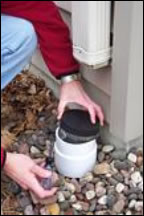
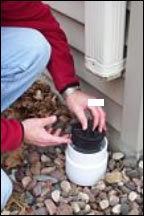
Be sure to cap the sewer standpipe — the open pipe remaining when the downspout is disconnected. This prevents water from going in. It also stops animals from falling into the opening, getting trapped, and having to be rescued. You can use a simple rubber cap secured by a hose clamp, PVC cap or a wingnut test plug and concrete if available cap sizes don’t fit.
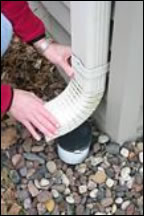
Insert the downspout into the elbow (if you put the elbow into the downspout, it will leak). You may need to crimp the end of the downspout with a pair of pliers to get a good fit.
Attach a downspout pipe extension to carry water away from the house and foundation. You can use a hacksaw to cut the extension to the desired length. Be sure to insert the elbow into the extension to prevent leaks. Drill a hole on either side and secure the elbow and extension with sheet metal screws. To prevent erosion where the water drains, you can place a splash pad at the end of the downspout extension.
Disclaimer
The City cannot guarantee the accuracy or completeness of the information or its application to any particular property. Readers should where possible verify the information before acting on it. Where appropriate, professional advice and service should be sought from a knowledgeable and licensed contractor or civil engineer.
While we endeavour to provide accurate information, it is provided strictly “as is” and the City makes no representations or warranties as to the accuracy, reliability, completeness, currency, or suitability of the information provided. Readers relying on this information and this web site do so entirely at their own risk. In no event will the City of Toronto be liable to you or anyone else for any decision made or action taken by you or anyone else in reliance on this information. The City does not accept and specifically disclaims any and all liability for any injury, loss or damage whatsoever incurred as a result of the use of, reliance on, the information provided by the City and in no event will the City, its Councillors, officers, directors, employees or contractors be liable to you or to any third party for any direct, indirect, incidental, consequential, special or exemplary damages or lost profit, including any property damage or loss or personal injury, associated with, resulting from or arising out of any use or misuse of this information.
Hiring a Contractor For Downspout Disconnection
Rather than doing it yourself, you may prefer to seek the professional advice and services of a City-licensed contractor to perform the disconnection. If you choose to hire a contractor, be consumer-wise. To ensure the job is completed properly:
Get at least three quotes.
Get references from other customers.
Enter into a written contract.
Ensure that all work to be done (including site cleanup) is clearly stated in the contract.
Ensure that the full price of the job is in the contract.
Agree with your contractor on a payment schedule and include the schedule in the contract.
Be aware of any contractors who:
Quote prices before seeing the job.
Give you a “special price.”
Offer discounts if they can “use your home to advertise their services.”
Several factors will be considered in the review of an exemption application. They include, but are not limited to:
Options for the relocation of one or more downspouts.
Ability to mitigate hazards and/or correct grading.
Compliance with other municipal by-laws and/or statutory regulations.
Applicants will be notified in writing of the decision to grant or deny an exemption for each connected downspout.
The General Manager reserves the right to revoke an exemption previously issued where any information provided is misleading or inaccurate, or when property and/or building conditions change. For example, the property’s landscaping is significantly modified or the roof is rebuilt.
For more information on the Mandatory Downspout Disconnection Program, contact 311.
Submit Application
Submit your completed application to:
City of Toronto
Mandatory Downspout Disconnection Program
PO Box 15266
STN BRM B
Toronto, ON M7Y 2W1
The Mandatory Downspout Disconnection Financial Assistance program offers a reimbursement of the costs of labour and materials for performing downspout disconnection work, up to a maximum of $500, if you are an eligible low-income senior or a low-income person with a disability.
To qualify for the Mandatory Downspout Disconnection Financial Assistance program, you must:
Own a residential property within the City of Toronto; and
Have a combined household income of $50,000 or less; and
Be 65 years of age or older or be 60-64 years of age and be receiving a Guaranteed Income Supplement under the Old Age Security Act; if widowed, be receiving the Spouse’s Allowance under the Old Age Security Act; or be 50 years of age or older and be receiving either a pension or a pension annuity resulting from a pension plan under the Income Tax Act (Canada) or
Be a person with a disability and receiving disability benefits.
Required Documentation
A completed and signed application with the following documents attached must be submitted within one year after the completion of the disconnection work. Applications must include:
Dated and unaltered original invoice(s) or receipt(s) fully itemizing the materials and work supplied and performed in respect to the disconnection and the cost.
Before and after photographs of the disconnected downspout(s).
Copies of the most recent Income Tax Notice of Assessment(s) from Canada Revenue agency for all persons occupying the property for which the application for financial assistance is made.
Seniors
In addition to the required documentation:
A copy of your Old Age Security T4A (if applicable), Guaranteed Income Supplement (GIS) (if applicable) and/or Spousal Allowance T4A (if applicable).
Proof of receipt of a registered pension or registered annuity under the Income Tax Act (Canada) (if applicable), if you are 50 years of age or older.
Persons with a disability
In addition to the required documentation:
A copy of disability benefit income from one or more of the following:
Ontario Disability Support Program (ODSP)
Canada Pension Plan
Workplace Safety and Insurance Board (WSIB)
Employment Insurance Sickness Benefit
Motor Vehicle Accident Insurance
Private Disability Insurance
Employer Disability Insurance
Disability programs provided by professional associations
Applicants are advised to block out the Social Insurance Number of all documents submitted.
For more information on the Mandatory Downspout Disconnection Program, contact 311.
Submit Application
Submit your completed application to:
City of Toronto
Mandatory Downspout Disconnection Program
PO Box 15266
STN BRM B
Toronto ON M7Y 2W1


 .
.