

Information is available in 简体中文, 繁體中文, فارسی, தமிழ், Español, Português, Français, Italiano, 한국어 and over 180 languages by calling 311.
The Vacant Home Tax (VHT) program requires homeowners in Toronto to let the City know if their property is occupied or vacant by making a declaration every year. The goal of the program is to increase the supply of housing by encouraging owners of vacant residential properties to sell them or rent them out. Owners who choose to keep their properties vacant are subject to a tax, with the revenue allocated to affordable housing initiatives.
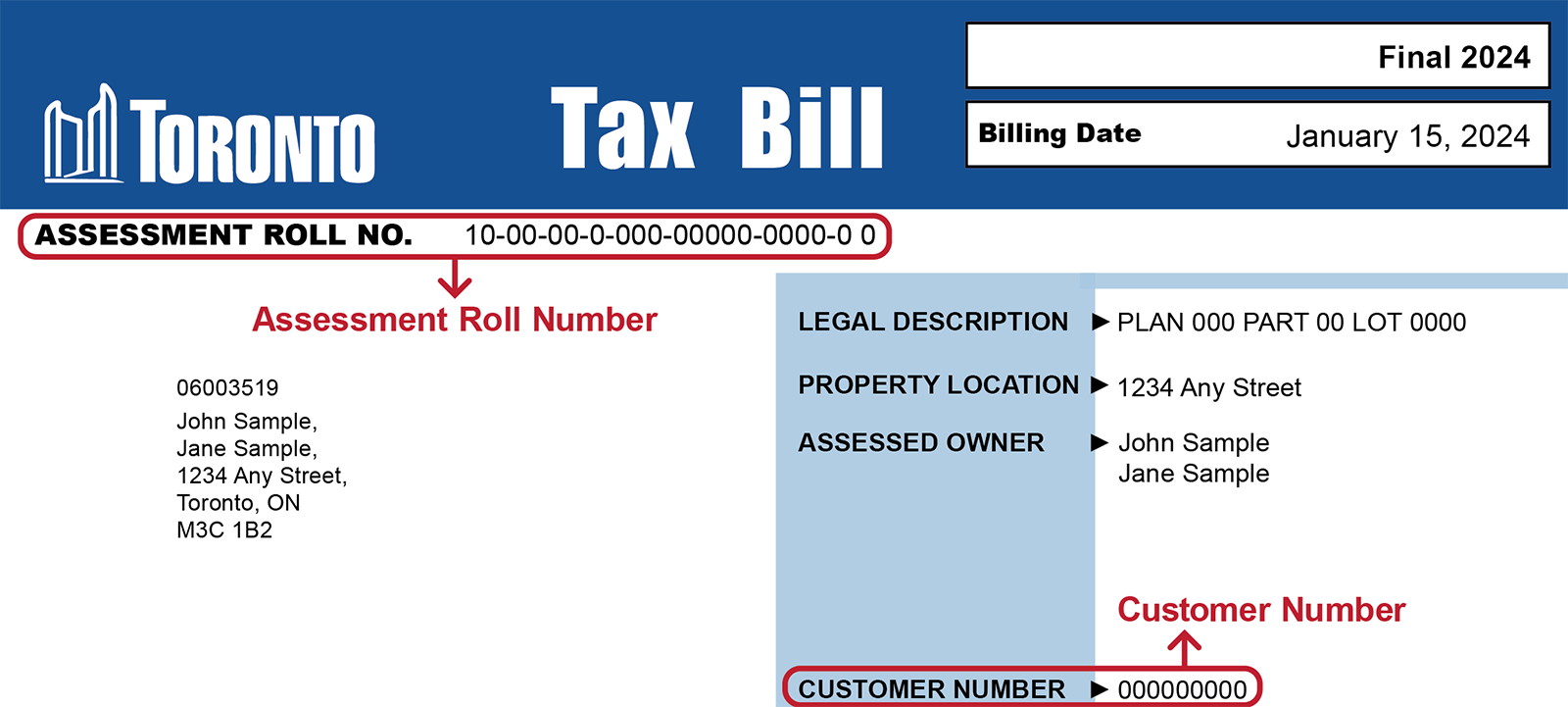
To make your annual declaration, you need your customer number and the address or 21-digit assessment roll number. You can find this information on your property tax bill, property tax account statement or Vacant Home Tax notice.
The property owner or someone authorized to act for them can submit the declaration.
You can check the occupancy status of your property by using the Property Tax Lookup and scrolling down to the Vacant Home Tax section.
If you own a residential property in Toronto, you must tell the City whether the property was occupied or vacant each year.
| Occupancy Status | Description | Subject to Tax? |
|---|---|---|
| Principal residence of homeowner | Choose this option if the property is where you live, receive mail, pay bills etc. You can only have one principal residence. The property must be your principal residence for at least six months of the tax year.
You can still claim this status if you are away for an extended period due to work or travel (e.g. snow birds). |
No |
| Occupied by someone other than owner | Choose this option if another person lived in the property. This may include:
Tenants must have a written agreement for at least 30 days, with a total occupancy period of at least six months during the year. Family members or friends must use the property as their principal residence for at least six months during the year. |
No |
| Vacant with an eligible exemption | Choose this option if the property was vacant but qualifies for an eligible exemption. You must provide supporting documentation when claiming and exemption. | No |
| Vacant | Choose this option if the property was vacant for six months or more during the tax year. A property will also be considered vacant if the owner does not submit a declaration by the deadline. | Yes |
| Situation | Description |
|---|---|
| Snowbirds and extended travel | You can be away from your principal residence for extended periods of time due to travel and still declare the property as occupied. As long as the property remains your principal residence, the tax will not apply. |
| Working outside Toronto or Canada | You can by away from your home for work and still declare the property as occupied. As long as the property remains your principal residence, the tax will not apply. |
| Medical Reason | You can declare the property as occupied if:
As long as a property remains your principal residence, the tax will not apply. |
| Business | If a business operates from a residential property, the property may be declared as occupied. This includes situations where:
|
| Owner of multiple properties | You must submit a declaration for each property you own. |
| Newly built homes | You only need to submit a declaration if the property has been assessed by the Municipal Property Assessment Corporation (MPAC) for that year.
A declaration is not needed for:
|
If your property was vacant, you must still submit a declaration. A property may be left vacant for six months or more and be exempt from the tax if any of the below criteria are met.
Please do not submit original documents, USB’s, medical records or photographs.
| Exemption | Description | Supporting Documentation |
|---|---|---|
| *Please do not provide personal medical documents or photographs as supporting documentation. | ||
| Death of a registered owner |
|
Death certificate. |
| Principal resident is in care |
|
|
| Repairs or renovations |
|
|
| Transfer of legal ownership |
|
Land transfer deed. |
| Occupancy for full-time employment |
|
Note: the letter or contract must indicate the year of employment |
| Court order |
|
Copy of court order. |
| Vacant new inventory (beginning in 2023) |
|
|
| Secondary residence for medical reasons (beginning in 2024) |
|
|
Making a false declaration or failing to provide requested information may result in a fine of up to $10,000 and payment of any Vacant Home Tax owing
You can check the status of your Declaration, Notice of Complaint, Appeal or Audit by signing into to the Property Tax Lookup.
If you do not submit a declaration by the April 30 deadline, the City will assume your property was vacant and issue a Vacant Home Tax bill. You can dispute the bill by submitting a Notice of Complaint.
If you receive a supplementary Vacant Home Tax bill following an audit, you can submit a Notice of Complaint within 90 days of the date shown on your bill.
You can dispute a Notice of Complaint decision by submitting an appeal within 90 days of the decision.
Your appeal will be heard in writing by the Appellate Authority (the City’s Deputy Treasurer). There will not be an in-person hearing of your appeal. It is important that you submit all documents that support your appeal.
Once your appeal is received, the written hearing will be scheduled within 90 days. A decision letter will be issued within 30 days of the decision being made.
The decision of the Appellate Authority is final.
Your property may be selected for audit. You may need to provide more documents to support your claim that the property was occupied or exempt. You will be contacted by mail if more documents are needed.
When an audit is complete, you will be sent a letter by mail. If your property is determined vacant, a Vacant Home Tax supplementary bill will be issued. You can dispute an audit decision by submitting a Notice of Complaint within 90 days of the decision.
You may be sent a letter asking you to provide more documentation or information to support your occupancy or exemption claim. If this happens, you will have 60 days from the date of the letter to respond.
You can upload your documents through the City’s secure online portal.
Before submitting documents that contain someone else’s personal information, make sure you have their permission.
Documents must relate to the year being reviewed.
Please do not submit original documents, USB’s, medical records or photographs. Documents submitted will not be returned.
Examples of supporting documentation include, but are not limited to:
Please note, photographs will not be considered as evidence to support an occupancy or exemption claim.
Keep all records and documents related to your occupancy or exemption claim for no less than three years.
If you believe a residential property is vacant, you can leave a message on the vacant property reporting hotline at 416-395-1098. Messages are not returned. Do not use this phone line to declare the occupancy status of your own property.
The Vacant Home Tax can affect both buyers and sellers. Both parties are responsible for ensuring that a declaration has been submitted.
If you are selling a property
If you are buying a property
Who should submit the declaration?
Scenario A: The property sold within the tax year being declared
For example, the declaration is for 2026 and the property sold in 2026. In this situation:
Scenario B: The property sold after the tax year being declared
For example, the declaration is for 2026 and the property sold in 2027. In this situation:
What happens if no declaration is submitted?
If no declaration is received:
If the previous owner did not submit a declaration, you should:
Power of sale is not an exemption from the Vacant Home Tax. When you purchase a property through power of sale, you purchase it as is. This means that you are responsible for any outstanding taxes.
Starting in 2024, the Vacant Home Tax rate is three per cent of a property’s Current Value Assessment (CVA).
For the 2025 Vacant Home Tax, payments are due in three equal instalments:
You can pay your Vacant Home Tax bill through your bank or financial institution using online banking, telephone banking, an automatic teller machine (ATM) or in person.
To avoid late penalties and interest, make your payment well before the due date. Make sure you select you select the correct payee and account number. Processing times vary by financial institution.
To set up and pay through online banking:
Make sure you select the correct bill payee and that your account number matches your current bill. A Payment Re-Distribution Fee applies if you request that an electronic payment made to the wrong account be transferred to the correct account. Remove outdated account information from your online or telephone banking profile to help avoid payment errors.
If you have recently bought or sold a property, or moved, review our tips on managing your accounts.
If you are enrolled in the City’s Pre-Authorized Payment Program, only your regular property taxes will be automatically withdrawn. You must pay the Vacant Home Tax separately.
You can send post-dated cheques for the payment due dates. Make cheques payable to the Treasurer, City of Toronto, and mail them to:
Treasurer, City of Toronto
PO Box 5000 Willowdale STN A
Toronto, ON M2N 5V1
If you pay by mail through Canada Post, send your payment several days before the due date to allow time for delivery. Your payment must reach the City by the due date to avoid penalty and interest charges.
Please note:
Property Tax, Utility and Parking Violation Inquiry & Payment Counters are open. You can pay by cash, cheque, money order or debit card at a counter. If you use a drop box, payment must be made by cheque or money order.
If you do not pay by the due date, penalty and interest charges will apply.
If the Vacant Home Tax remains unpaid, the amount will be added to the property’s tax account and collected in the same way as property taxes.
A fee applies if your payment is returned or not processed by your financial institution, including payments returned because of insufficient funds (NSF).
For more information about the VHT legislation please visit the following links.
Subscribe to receive updates about the Vacant Home Tax and reminders to submit an annual declaration of your residential property’s occupancy status and notices of important due dates.
Type (don’t copy and paste) your email into the box below and then click “Subscribe”. You will receive an email with instructions to confirm your request.
You can unsubscribe at any time.
Revenue Services collects your personal email address under the legal authority of the City of Toronto Act, 2006, Section 8 and Part XII.1, and the City of Toronto Municipal Code, Chapter 778, Taxation, Vacant Home Tax. The information will be used to inform subscribers through email about the Vacant Home Tax including reminders for important submissions dates and due dates. Questions about this collection can be directed to Manager, Customer Service, Revenue Services, 5100 Yonge Street, Toronto, Ontario, M2N 5V7 or by telephone at 416-395-1048.