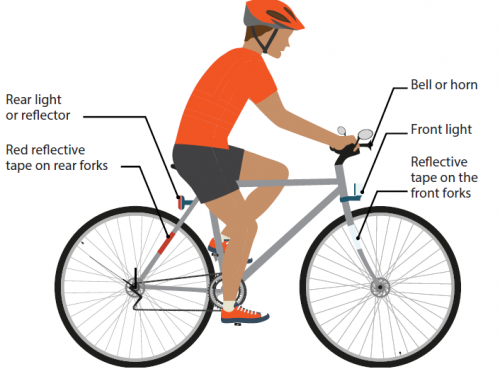
A bicycle must be equipped with the following items, as required by law from the Ministry of Transportation:
- White front light and red rear light or reflector (must be in use half an hour before sunset, or half an hour after sunrise)
- Bell or horn
- White reflective tape on front forks and red reflective tape on rear forks
While they are not required, the following items are recommended for adults:
- Approved cycling helmet (children aged 17 and under must wear a helmet)
- High quality lock
- Front and rear brakes in working order
- Backpack or pannier
- Bottle cage and water bottle. Drink before getting thirsty to prevent dehydration (recommended one bottle every 20 minutes on hot days.)
Choose a helmet that fits correctly and features a CSA, Snell, ANSI, ASTM British Standard or Australian Standard sticker, which shows that the helmet meets legislated standards.
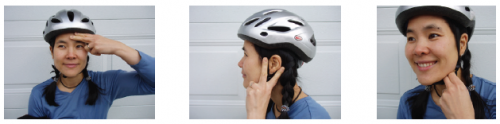
To ensure your helmet fits correctly, perform a 2-V-1 “helmet salute:”
- Place two fingers between your eyebrow and the bottom of your helmet to ensure it is sitting properly on your head.
- Place four fingers to make a V shape around the bottom of each ear to ensure the strap is sitting correctly.
- Place one finger under the chin strap to ensure the helmet is comfortable but secure.
Ontario’s mandatory bicycle helmet law requires all children under 18 who are riding or operating a bicycle to wear an approved bicycle helmet. Parents or guardians are liable to be fined $75 for not ensuring their children under 16 are wearing a helmet, while children aged 16 and 17 years old can be fined directly.
Bicycles are not equipped with turn signals or brake lights, so people cycling must use their hands to communicate with other road users when approaching an intersection, turning or changing lanes.
With your arm outstretched and palm flat, perform the following actions depending on your direction of travel:
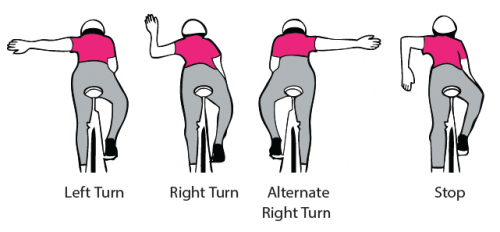
When changing lanes while cycling, perform the following steps:
- Turn your head 90 degrees to look over your shoulder in the direction you would like to turn, while cycling in a straight line.
- Using your hand, signal your intention to either move left or right into the next lane.
- Check over your shoulder again before completing the action.
People cycling year-round should wear:
- Clothing that will not catch in the wheels, chain or other moving parts of the bicycle.
- Comfortable, layered clothing that breathes, yet is wind resistant.
- Riding gloves made of leather or fabric to protect hands and to provide a good grip for brakes.
- Closed-toed, flat shoes that fit securely and do not slip off the pedals. Shoelace loops or ends should be tucked inside to avoid getting caught on the pedals.
- If cycling in the evening, wear light-coloured clothing or reflective fabric that glows in the dark.
Summer cycling
To protect against sun burn and melanoma, wear sunscreen when riding in the summer months, even on cloudy days. Sunscreen should have a SPF of 15 or higher and be waterproof.
Cycling in the rain
When cycling in the rain, wear fluorescent clothing to account for the decreased visibility.
Winter cycling
Avoid layering too much to avoid overheating. Instead, wear a close-fitting, breathable base layer under a jersey or shirt to keep your core warm.
A waterproof jacket and pants are ideal in cold and wet conditions.
Accessories such as headbands or balaclavas that can fit under a helmet and weather-resistant gloves will make your ride more comfortable.
Before beginning each ride, perform an ABCD check on your bicycle to ensure it is in good working order and is safe to ride.
A – Air and everything to do with the tires
- Press your palm firmly on your tires to ensure they are inflated.
- Spin each tire to check for cracks or punctures.
B – Brakes, bars and bell (or horn)
- Press hard on the right brake and walk your bicycle forward (the rear wheel should lock and skid on the ground). Remember Right = Rear!
- Press hard on the left brake and push your bicycle forward (the front wheel should lock and the back wheel should lift off the ground).
- Inspect the brake pads and cables to look for signs of damage or wear.
- Hold the front wheel between your legs while facing your bicycle and twist the handlebars left and right to ensure they are secure.
- Ring your bell to ensure it is loud enough for pedestrians and other people cycling to hear.
C – Chain and crank
- Ensure that your bicycle chain is grey or silver. If it is black, it should be cleaned and lubricated, and if it is rusted, it should be replaced.
- Pull the crank arms away from your bicycle at the same time to ensure they are secure.
D – Drop
- Lift your bicycle a few inches off the ground and drop it. Take note of any loose or broken items that may need to be fixed.
If you notice any items that need attention during the ABCD check, contact your local bike shop to schedule a complete tune-up.

