Election Services
Glossary of terms
Advance vote
A voting opportunity which happens before election day, also referred to as the Weekday and Weekend Advance Vote.
Ballot
A piece of paper containing the names of the candidates and the office they are running for. Electors vote by connecting the head and tail of the arrow pointing to the candidate of their choice.
BrowseAloud
BrowseAloud, is a free text to speech software which has been added to the Toronto.ca website. This screen reader will assist people with English as a second language, dyslexia, literary issues and partially sighted individuals. Download BrowseAloud.
By-election
An election other than a regular election.
City Clerk
The City Clerk is responsible for the conduct of municipal elections, by-elections, and referendums to obtain the assent of the electors to a by-law or to obtain the opinion of the electors on a question.
City Clerk's Office
Election information is available from the Elections and Registry Services counters of the City Clerk's Office from Monday to Friday, 8:30 a.m. to 4:30 p.m., at the following locations:
- Toronto City Hall, 100 Queen St. W., 1st floor North
- Etobicoke Civic Centre, 399 The West Mall, Main floor
- North York Civic Centre, 5100 Yonge St., Ground floor
- Scarborough Civic Centre, 150 Borough Dr., 3rd floor
- Election Services, 89 Northline Rd. (East York)
City Councillor
City Council is the main governing and legislative body of the City of Toronto. There is one Councillor for each of Toronto's 44 municipal wards. Councillors sit on committees and on community councils in the area where they have been elected and make decisions on behalf of their constituents. Issues are identified by the public, through research, follow-up to existing programs, services or policies. City Councillors are part of the everyday work of running a city and achieving council's priorities. Term of Office is four years.
Contribution
Money, goods or services given to a candidate for their campaign are contributions.
Contributions include:
- The ticket price for a fund-raising event.
- The difference of the amount paid and the market value of a good or service sold at a fund-raising event.
- The difference between the amount paid and the market value of a good or service purchased for the campaign.
- Any unpaid but guaranteed balance of a campaign loan.
Contribution limit
The limit on contributions from a single contributor in money, goods or services is:
- $2,500 for mayoralty candidates
- $750 for councillor candidates
Contributor
Someone who makes a contribution to a candidate's election campaign.
Election Day
Municipal Elections happen every four years on the fourth Monday of October. The next municipal election will happen on:
Election Day / Voting Day
Monday, October 27, 2014
10 a.m. to 8 p.m.
On this day eligible electors will vote for Mayor, City Councillor (one for each of the 44 Wards) and also School Board Trustee (one for each of the School Board Districts)
Elector (Eligible Elector)
A person who is eligible to vote in the municipal election. You can vote in the City of Toronto municipal election if you are:
- a Canadian citizen, and
- at least 18 years old, and
- a resident of the City of Toronto, or
- a non-resident owner or tenant of land in the City of Toronto or their spouse, and
- not prohibited from voting under any law.
Electoral system
The City of Toronto uses a first-past-the-post system. In this system, the candidate elected is the one who receives more votes than any other candidate.
Electronic Financial Filing System (EFFS)
EFFS is an online program that is available to all candidates and allows them to: Track all contributions, Print receipts, Import scanned signature for receipt purposes, Create an electronic file of receipts (ability to email directly to contributors), Link one contributor to multiple contributions, Be notified of any contributions that exceed the allowable limit, Input expenses, Input fund-raising events, Correctly calculate all contributions, income and expenses as needed on the financial statement, Display contribution information (amount of contributions, list of contributors who contributed over $100) on the financial statement, Produce the financial statement on the prescribed form, Submit contributions electronically, Set up accounts for campaign staff and monitor activity of those accounts.
Expense
Any expense incurred in whole or in part for goods or services for a candidate's campaign is a campaign expense. It includes the market value of any goods held in opening inventory (such as signs and brochures) and any contributions of goods or services to a candidate during the campaign period.
Mayor
The Mayor acts as chief executive officer of City Council, leads and represents the City in dealings with residents, elected officials, dignitaries and staff. The Mayor has a duty to conduct the business of the City in ways that are transparent, honest, efficient and inclusive. Responsible to ensure that City Council remains accountable and accessible to the public, the Mayor must uphold and carry out duties outlined in the City of Toronto Act, 2006 or any other Act. Term of Office is four years.
Non-resident
An individual who owns or rents property in the City of Toronto and lives outside the City.
Oath
A statement sworn in front of an official, attesting that whatever is stated is true.
Residence
The permanent lodging place to which, whenever absent, a person intends to return.
Resident
An individual who lives within the City of Toronto.
Scrutineer
A person representing a candidate at the voting location to observe the voting process.
Secrecy folder
A folder in which a ballot can be placed to conceal the names of the candidates and the marks made on the ballot by a voter.
Tabloid
A communications piece that is delivered to every household in the City. It provides electors with information on how to cast their vote, key election dates and ways to obtain information in languages other than English.
Tabulator
See Vote counting equipment
Touch screen
See Vote counting equipment
Trustee
A school board operates the province's publicly funded schools. The four school boards covering the area of Toronto are: Toronto District School Board, Toronto Catholic District School Board, Conseil scolaire de district du Centre-Sud-Ouest, Conseil scolaire de district catholique Centre-Sud. The number of elected trustees is based on the population in the board's area of jurisdiction. School Board Trustees approve annual board budget, deliberate and establish policies as authorized by the Education Act, monitor implementation of Ministry of Education and Board policy and programs and consult, represent and advocate for the constituents in their ward. Term of Office is four years
Voter
An "elector" becomes a "voter" when he or she accepts a ballot at a voting location.
Vote counting equipment
The City of Toronto uses two types of vote counting equipment, touch screens and tabulators, to ensure the accuracy of the vote and the efficiency of the counting process. A touch screen voting unit permits individuals to vote by touching the candidate's name on the screen. It also has an audio component for voters who are visually impaired. A tabulator digitally scans a specified area on a ballot to read the vote(s) and count the results. During the weekend Advance Vote, ballot marking equipment will be available to allow electors with disabilities to vote independently.
Voting place
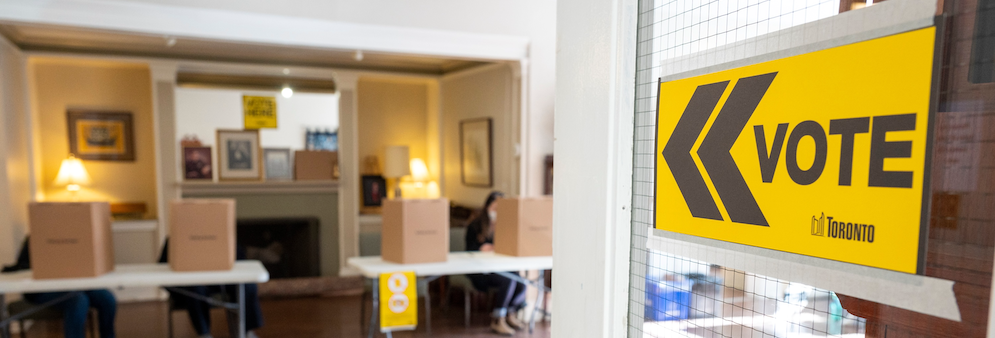
A building or part of a building or other facility at which voting is conducted.
Voter information card
A card sent to every elector whose name appears on the voters' list. It tells electors when and where they can cast their ballots on Election Day and at the weekend advance vote. Cards will be delivered in early October.
Voters' list
The list of names and addresses of eligible electors used at the voting location.
Voting screen
The place at the voting location where voters go to mark their ballot in private.
Ward
A geographical area represented by a member of Council. There are 44 wards in the City of Toronto.