

Queen's Park North was officially dedicated in 1860 as Canada’s first municipal park. It is a historic and cultural landmark and one of Toronto’s great civic spaces, known for its extraordinary tree canopy and as a site of community gathering and democratic expression.
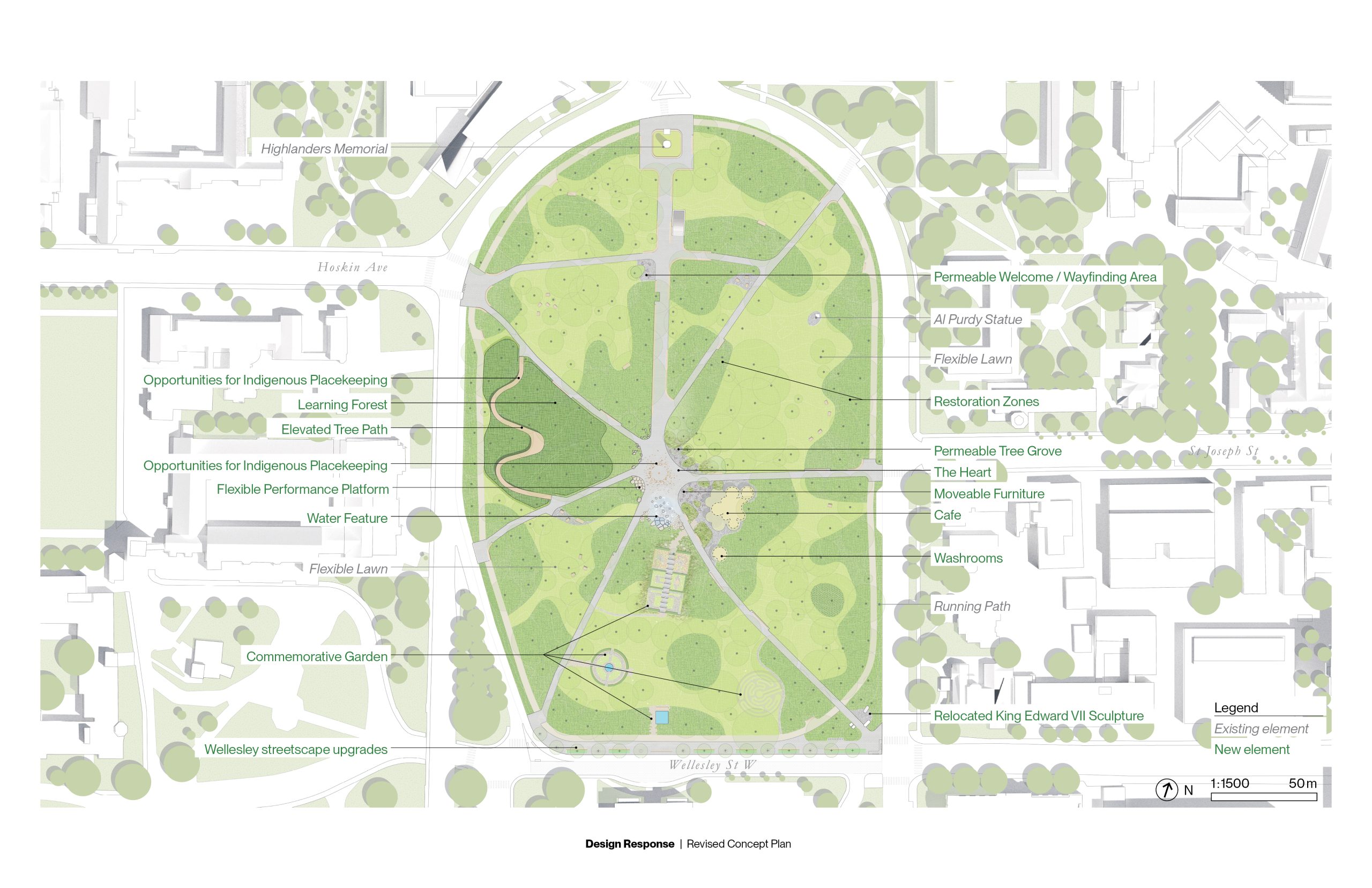
At its meeting on June 25, 2026, City Council adopted recommendations from the Queen's Park North Donation - Concept Plan Update Report, with amendments for the revitalization of Queen’s Park North.
City Council authorized staff to negotiate and execute agreements with the Weston Foundation to support community engagement, design and delivery of improvements to Queen’s Park North. View the decision.
The City worked with Indigenous communities, residents, community groups, institutions and other interested parties to confirm the project vision, identify priorities and challenges and refine the draft guiding principles for Queen’s Park North. View the summary.
The final vision and guiding principles for the revitalization were shared. The City presented the draft big moves and early ideas for park programming, and asked for feedback to support further refinement. View the summary.
The City held public meetings, focus group sessions and meetings with First Nations and Indigenous communities to present the draft Concept Plan and review further opportunities and changes in advance of detailed design. View the summary.
City Council authorized staff to negotiate a donation agreement of up to $50 million with the Weston Foundation and a tri-party agreement with the University of Toronto, subject to approval of an updated Concept Plan. City Council also directed staff to report to Infrastructure and Environment Committee in June 2026 with an updated Concept Plan, draft terms of reference for the Queen’s Park North Advisory Body, and additional information on the business plan for the proposed food and beverage component. Further direction included advancing an Urban Forest Management Plan and a Public Art Plan. View the decision.
City Council adopted recommendations from the Queen’s Park North Donation – Concept Plan Update Report, with amendments. As part of that decision, City Council directed staff to establish a Queen’s Park North Detailed Design Working Group. View the decision.
Staff will report back with a project update to the Infrastructure and Environment Committee in Q1 2027.
An extraordinary place for people and nature throughout the seasons, that respects the existing trees and heritage of Queen’s Park North, fosters a welcoming environment, and showcases excellence in design, ecological stewardship, education, animation and collaborative governance.
| Guiding Principle | Description |
|---|---|
| 1. Protect and enhance the trees | Care will be taken before, during and after construction to ensure the significant urban tree canopy continues to define the character of the park for generations to come. Enhanced tree maintenance practices, more ecologically appropriate understory planting and education and interpretative materials will ensure the trees will continue to thrive and be celebrated. |
| 2. Respect the cultural and natural heritage of Queen’s Park North | All current and future undertakings related to the planning, design and management of Queen's Park North will be guided by the development of a Statement of Significance, and the conservation and enhancement of the site’s character-defining elements. Through thoughtful planning, design and interpretation, there is an opportunity to honour the past while recognizing that the park will continue to evolve to serve the communities of today and in the future. This includes strengthening the living heritage of the park, celebrating and enhancing the landscapes, people, stories and changes that have shaped the park over time. |
| 3. Enhance the visitor experience and animate the park year-round through improved amenities and modest programming | New and improved park amenities, such as washrooms and seating, will provide a more welcoming and engaging park experience. Appropriately scaled animation and activity will be focused on a revitalized heart at the centre of the park to avoid impacting existing root zones of mature, healthy trees. A well-supported governance model with appropriate funding and expertise will provide a high standard of operations and maintenance. |
| 4. Incorporate Indigenous ways of knowing and being | Indigenous cultural values will be reflected and celebrated within a revitalized Queen’s Park North. These values, history and storytelling will be embedded in the physical landscape of the park as well as the stewardship strategy, guided by the concepts of Spirit: fostering a sense of hope by renewing and rebalancing a reciprocal relationship with land and ecosystem, Heart: A sense of belonging though spaces where people feel represented and connected, Mind: interweaving the stories of the park with Indigenous histories, and Body: connecting these concepts in to a cohesive park design; a space for all, for generations to come. |
| 5. Implement ecological and sustainable practices that restore the land, support plants and animal life, and enhance and expand ecological health and biodiversity | A planting approach informed by restoration ecology will focus on natural systems and symbiotic relationships, focused on supporting the existing tree canopy and highlighting local species and ecosystems. Queen’s Park North’s position as a signature urban green space will provide a stage to showcase urban ecology practices, including through public education and engagement activities. |
| 6. Maintain Queen’s Park as a public space and a place for both respite and civic life, welcoming to all | Queen’s Park North will continue to be a principle public space in the city, a place for gathering and democratic expression, and for respite and reflection. The design and animation of the park will ensure a safe and welcoming experience for all ages, abilities and interests. |
| 7. Strengthen relationships between public space and institutional and community partners | The City will collaborate with the nearby cultural, educational and governmental institutions such as the Royal Ontario Museum, Royal Conservatory of Music, Gardiner Museum and the University of Toronto (UofT) to provide programming opportunities for small-scale activities, classes and performances. |
The revitalization of Queen’s Park North is guided by a trees- and nature-first approach, celebrating the park’s defining feature: more than 350 trees, some over 100 years old, which make up one of Toronto’s most diverse urban forests.
Throughout the project, the City will ensure:
Long-term stewardship, programming and Indigenous placekeeping will help ensure the park continues to thrive as both a cultural landmark and an important urban ecosystem.
A key priority is maintaining Queen's Park North as a peaceful, restorative green space where people can connect with nature, relax and enjoy a sense of respite in the heart of the city.
Queen’s Park North is home to at least 62 tree species, including many significant native trees.
The park is home to two butternut trees, an endangered species in Ontario due to Butternut Canker. The butternut tree holds deep cultural significance for Anishinaabe and other Indigenous peoples, providing edible nuts, medicinal uses, and natural materials such as dyes made from its husks and bark.
Norway maples account for approximately 13 per cent of the park’s trees, making them the second most common species.
Introduced to North America in the late 1700s, Norway maples were widely planted because they grow quickly and tolerate urban conditions. However, their dense root systems and rapid spread allow them to outcompete native trees for light, water and nutrients, reducing biodiversity. The revitalization will help restore a healthier balance by supporting native species over time.
The Queen’s Park North community engagement process followed the typical Park and Recreation Facility Design and Development Process, which ensures a transparent, iterative and collaborative approach to designing public spaces.
Through the community engagement process, community members are helping to shape key elements that guide the final design.
This phase of the community engagement process took place from March to June 2025 and included stakeholder conversations and interviews to better understand the issues and opportunities associated with the park.
During Phase 1, the City worked with First Nations and Urban Indigenous communities, residents, community groups, institutions and other interested parties to confirm the project vision, identify priorities and challenges and refine the draft guiding principles for Queen’s Park North.
Download the Community Engagement Phase 1 Summary.
In this phase, the final vision and guiding principles for the revitalization were shared. The City also presented the draft big moves and early ideas for park programming and asked for feedback to support further refinement.
Download the Community Engagement Phase 2 Summary.
In this phase, the City shared project updates and a draft Concept Plan and sought feedback through public meetings, focus group sessions, meetings with First Nations and Indigenous communities, an online survey and other activities.
Download the Community Engagement Phase 3 summary.
Queen’s Park North is a five-hectare park located just north of the Ontario Legislature. It is Canada’s first municipal park and one of the largest parks in Toronto’s downtown.
The park acts as a green oasis within the city centre. It has a longstanding function as a civic gathering space, has a rich cultural heritage, and has continued to change throughout the years to respond to an evolving and growing city with shifting public needs and expectations.
The land is owned by the University of Toronto and leased to the City of Toronto under a 999-year agreement. Depending on the nature of any changes to the park proposed as part of the revitalization, the landowner’s approval may be required under the terms of the lease.
In 2019, the City completed improvements to the park’s landscaping, lawns and pathways. Community feedback identified priorities for future revitalization, including tree protection, winter use, cultural programming, gardens, water features and washrooms.
The current revitalization builds on that work by protecting the park’s mature tree canopy, enhancing the natural landscape and introducing new amenities and programming that reflect the park’s educational, cultural and civic setting.
To inform the project, the City completed site studies, technical assessments and a Historic Context Statement to help ensure future improvements respect the park’s cultural and historical significance.
The revitalization of the park aligns with the City’s commitment to ensuring the park system continues to expand and adapt to meet the needs of a growing city. The demand for high-quality public greenspace is especially strong in growing downtown neighbourhoods.
The Weston family strongly believes in the important role that parks and gardens play in shaping stronger, more vibrant communities. They have a longstanding history of supporting city-building initiatives and innovative, sustainable park projects, such as the Evergreen Brick Works, Grange Park, UHN Tunnels Revitalization, The Meadoway and Breakwater Park.
The family has a special connection to Queen’s Park North, as the late Hon. Hilary M. Weston, CM, CVO, OOnt served as Lieutenant Governor of Ontario from 1997 to 2002. The family has also supported cultural and educational institutions near Queen’s Park North, including the University of Toronto, the Royal Ontario Museum, the Gardiner Museum, the Royal Conservatory of Music, as well as neighbouring healthcare centres like Mount Sinai and UHN.
The Weston family and City share a common ambition – for Queen’s Park North to serve as an exceptional, welcoming and sustainable place for all people, in all seasons.
A donation is a voluntary gift, either cash or in-kind, made without expectation of commercial benefit.
To ensure fairness and transparency:
The Donations to the City for Community Benefit Policy provides City staff with a guiding framework for considering donations:
Parks and Recreation regularly works to refine and deliver projects funded through donations.
In response to this donation, City Council directed staff to undertake public consultation on potential park improvements and to negotiate a donation agreement
Read about the Donations to the City of Toronto for Community Benefits Policy.