

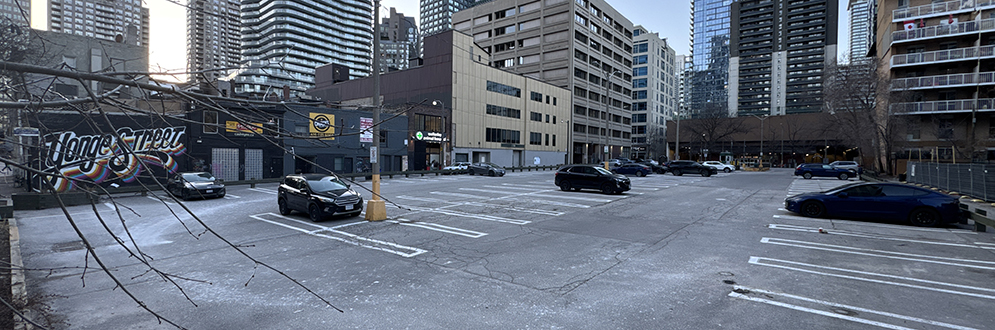
A new 3,900 m2 park, slightly smaller than a junior soccer field, is coming to 15 Wellesley St. E., at the intersection of Yonge Street and Wellesley Street East, directly across from the Wellesley subway station. The site is currently a parking lot, which will be closed when construction begins. The park’s design will be determined through community engagement.
The timeline is subject to change.
Sign up for or unsubscribe from updates related to the New Park at 15 Wellesley St. E.
This project has been classified as a Collaborate project based on the International Association of Public Participation Spectrum. This means we aim to partner with the public, stakeholders and rightsholders in each aspect of the design process, including the development of design options and the identification of a preferred design.
This project will have a Community Advisory Committee composed of community members and local stakeholder representatives. The Committee will provide feedback, guidance and advice to the project team at key points during the community engagement process, meeting at least once in each phase. Their role is strictly advisory, and they will not make decisions or represent the entire community.
The Committee will be formed through a modified civic lottery, which is a democratic best practice increasingly used in Canada and internationally to create representative advisory groups for government projects.
In this phase, the project team collected feedback to develop a draft vision statement, guiding principles and big moves which will guide the development of design options in Community Engagement Phase 2.
The vision is co-created with the community to describe the ideal future park. It is a big-picture statement that should inspire everyone toward a common understanding of the project’s overall goals and objectives.
The vision for the New Park at 15 Wellesley is:
The new park at 15 Wellesley Street East will prioritize adding trees and shade wherever possible, using approaches that work within the realities of a dense, built up site, while providing a vibrant gathering place for all, where Black, African, Caribbean, Indigenous, Two-Spirit, Trans and 2SLGBTQ+ communities are centred, celebrated, and feel ownership, safety, and belonging.
Transforming an underused downtown site into a flexible, year-round, community-led space, the park will honour the activist history and ongoing cultural presence of Black queer and trans communities, including Indigenous placekeeping and public art recognizing Michelle Ross, a pioneering Jamaican-Canadian drag performer and cultural icon who played a foundational role in Toronto’s 2SLGBTQ+ community, particularly in the Church-Wellesley Village.
Designed to be permissive rather than prescriptive, the new park will support everything from quiet rest to major events like BLOCKORAMA, offering shaded seating, accessible places to sit, lean, lie down, use mobility devices, and enjoy art, music, play and ceremony. With queer and trans art permanently visible, harm-reduction principles embedded throughout, and inclusive programming guided by equity-deserving communities, the park will be a joyful, resilient and welcoming oasis where residents, newcomers and visitors can gather, connect, celebrate and thrive 365 days a year.
The guiding principles are high-level directions that reflect the community’s most important values and ideas for how the park should look and feel. They help to clarify the vision statement and guide how the park should be designed by describing the desired outcomes.
The guiding principles for the New Park at 15 Wellesley are:
The big moves communicate the main priorities of both the community and the City for the design of the park. They are specific directions for how the physical design can achieve the vision and guiding principles.
In no particular order, the big moves for the New Park at 15 Wellesley are:
On October 25, the Community Advisory Committee met for the second time at the Central YMCA. The meeting included a panel discussion and a workshop focused on developing a vision, guiding principles and big moves for the new park. Participants engaged in hands-on visioning exercises and discussions. A meeting summary will be posted on this page.
On July 14, seventeen members of the Community Advisory Committee (CAC) took part in an optional sensory site tour at the future park site. The tour was offered in response to interest expressed during the first CAC meeting. The tour was intended to support early-stage visioning by focusing on participants’ sensory, emotional and physical responses to the space, rather than detailed site analysis or design solutions. The experience encouraged exploration of how these personal and collective impressions could help shape the park’s vision statement, guiding principles, and high-level big moves (design direction).
Download the July 14, 2025 Sensory Site Tour summary.
On July 5, the Community Advisory Committee (CAC) held its first meeting. The session included an orientation to review the Terms of Reference, introduce the site and project timeline, clarify roles and begin building trust and dialogue. Members were also invited to share early reflections on the park’s significance to the Church-Wellesley neighbourhood and Toronto’s 2SLGBTQ+ communities.
Download the July 5, 2025 Community Advisory Committee meeting summary.
From May 28 to June 11, community members could apply to be a member of the Community Advisory Committee (CAC). The CAC will work closely with the project team throughout the design process by sharing ideas and feedback that will inform the development of the park.
From May 6 to May 20, an online thought exchange activity gathered ideas for the new park. The activity received a total of 249 thoughts and 6,000 thought ratings from 291 participants.
Download the May 2025 Thought Exchange Activity summary.
In this phase, the project team will collect feedback on the design options from the community.
The community engagement activities anticipated in this phase include:
The anticipated outcome of this phase is the selection of a preferred design.
In this phase, the project team will share the preferred design with the community and collect feedback to help finalize the design.
Once the preferred design is confirmed, the project will move into the detailed design phase, where the design team will finalize the preferred design by working through the technical details and plans for the construction contractor.
The anticipated outcome of this phase is a refined preferred design.