A new 1250 m2 park is coming to 2788 Bathurst St. as a result of a mixed-use development project at the corner of Bathurst Street and Glencairn Avenue. The park design will be determined through community engagement and is proposed to include accessible pathways, lighting, a seating area and other features.

While we aim to provide fully accessible content, there is no text alternative available for some of the content on this site. If you require alternate formats or need assistance understanding our maps, drawings, or any other content, please contact Erika Bullock at 647-923-4674.

  • Spring 2023: Hire a design team
  • Fall 2023/Spring 2025: Community engagement and design development
  • Summer 2025 to Spring 2026: Detailed design
  • Summer 2026: Construction starts
  • 2027: Construction complete, park opens

The timeline is subject to change.

Sign Up for Updates

Sign Up Now

Sign up for updates related to the New Park at 2788 Bathurst St. or unsubscribe from the mailing list.

Level of Engagement

This project has been classified as a Consult project based on the International Association of Public Participation Public Participation Spectrum. This means we obtain public feedback on existing analysis, alternatives and/or proposals.

The final design was informed by feedback collected in Community Engagement Phases 1 and 2.
Site Plan

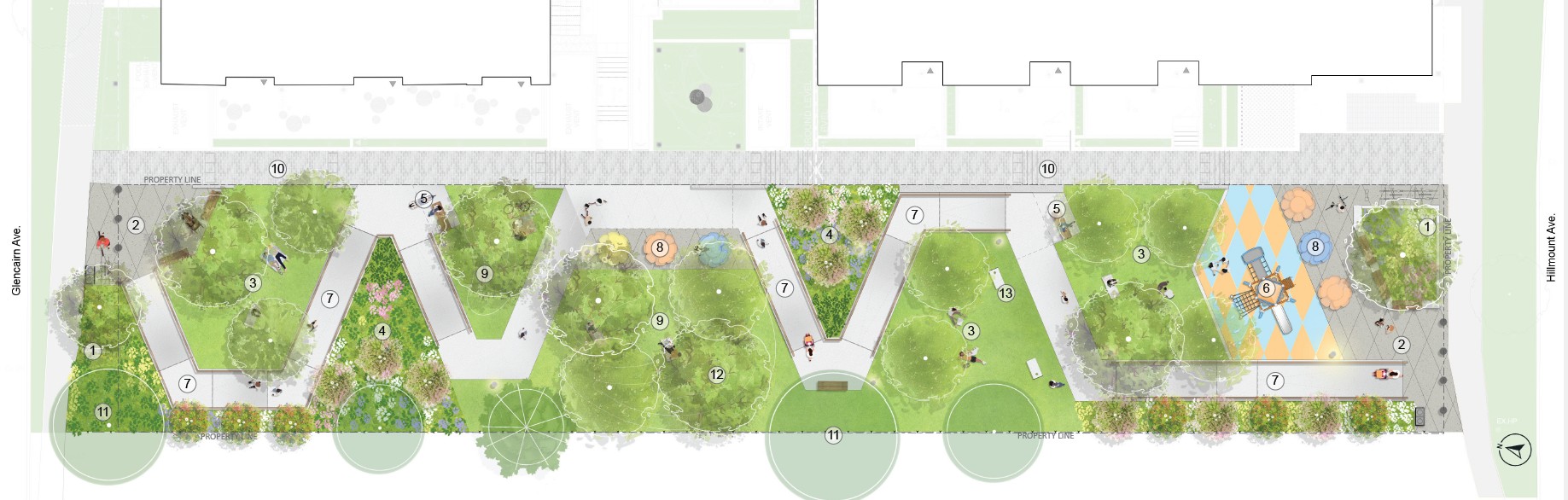
Site plan of the final design for the new park at 2788 Bathurst Street. The image is in landscape orientation, with Glencairn Avenue on the left indicating the north side and Hillmount Avenue on the right indicating the south side of the park.

  1. Park signage
  2. Entry plaza
  3. Open lawn with trees
  4. Pollinator garden
  5. Rest area
  6. Playground
  7. Ramps
  8. Seating area
  9. Sodded low hills
  10. Publicly accessible spaces
  11. Existing trees to remain
  12. Proposed trees
  13. Fixed lawn games

The final design reflects the following community preferences and design considerations:
  • Inviting and accessible community park with a balance of open green space, gathering areas, play opportunities and diverse planting.
  • Accessible pathways and ramps connecting plazas, open lawns and play areas while accommodating the site’s 5-metre grade change through contoured landscapes.
  • Canopy trees, shrubs and pollinator gardens provide shade, seasonal interest, and ecological benefits throughout the park.
  • South entry plaza includes seating and shade umbrellas and connects directly to the playground, creating a welcoming destination for families and residents.
  • North entry plaza includes accessible seating and rest areas.
  • Large central lawn offers flexible space for recreation, relaxation and informal gathering beneath shade trees.
  • Central plaza provides additional seating and gathering opportunities, framed by gently sloped lawns that create inviting spaces for picnics and relaxation.
  • The overall design creates a comfortable, connected and vibrant park that supports recreation, social interaction and biodiversity.
Cross Section A

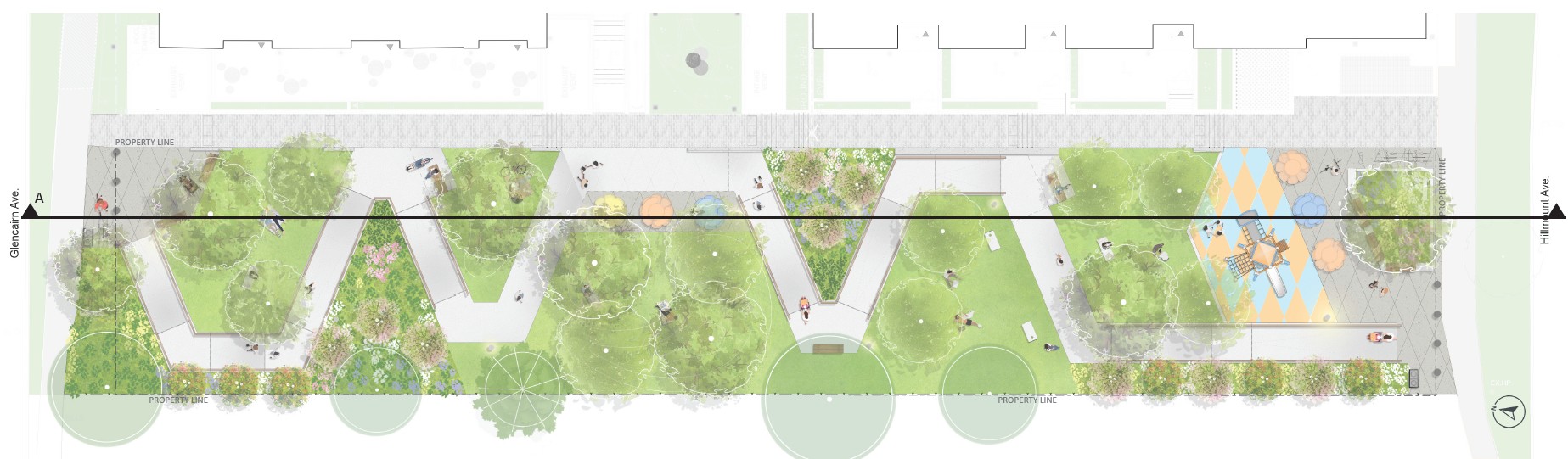
Site plan of the final design for the new park at 2788 Bathurst Street. A line extends across the image from left to right indicating the location of cross section A, running along the east side from the top of the north entry plaza on the right to the top of the south entry plaza on the right.

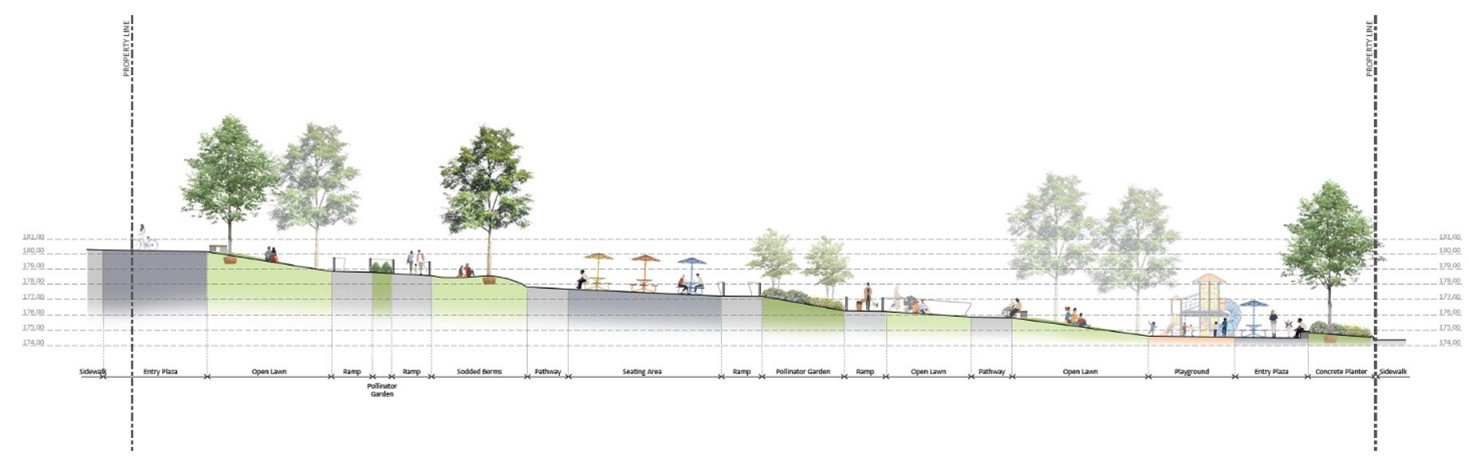
Image of cross section A, indicating the different functional areas of the park design and showing the site’s 5-metre grade change from the North side to the South side.

Section A illustrates the park’s north–south alignment and the 5-metre grade change along the east side, highlighting the relationship between key park elements.

  • Three plazas located at the north end, south end and centre of the park.
  • Entry plazas, playgrounds, open lawns and pathways connected through accessible circulation.
  • Open green spaces linking key destinations across the site.
  • A clear rhythm of active and passive areas throughout the park.

This arrangement supports a variety of uses and experiences across the site.
Cross Section B

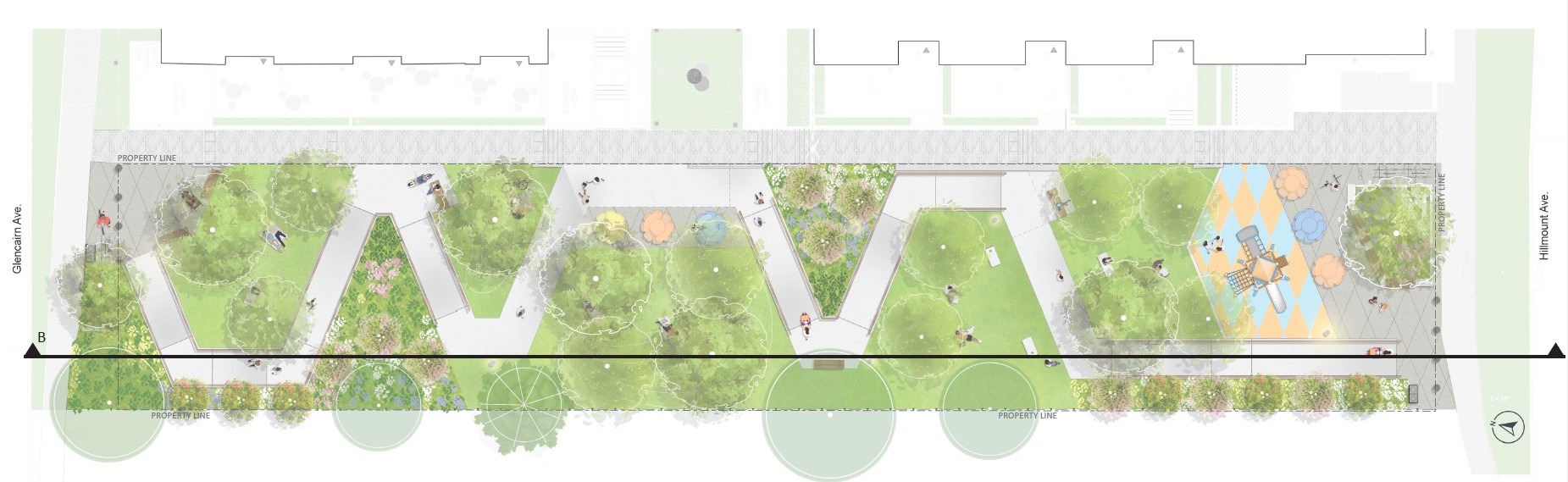
Site plan of the final design for the new park at 2788 Bathurst Street. A line extends across the image from left to right indicating the location of cross section B, running along the west side from the tree plantings near the north entry plaza on the right to the bottom of the south entry plaza on the right.

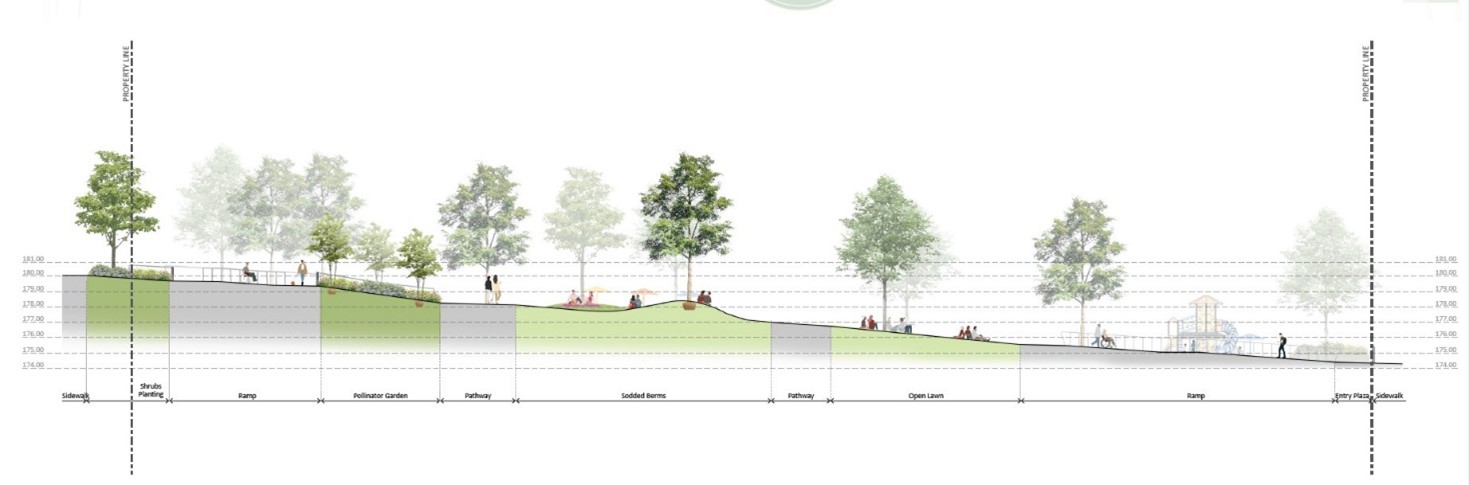
Image of cross section B, indicating the different functional areas of the park design and showing the site’s 5-metre grade change from the North side to the South side.

Section B illustrates the park’s north–south alignment on the west side and how open lawns, ramps and gently sloped landscape areas respond to the site’s elevation changes.

  • Accessible ramps at the southern and northern ends provide barrier-free connections to the surrounding streets.
  • Open lawns in the central area support informal, passive use such as lounging, picnicking and enjoying park views.
  • Gently sloped landscape areas help transition changes in elevation across the site.
  • A continuous north–south alignment organizes circulation and open space along the west side of the park.

This configuration supports accessible movement and a range of relaxed, informal uses throughout the park.

In this phase, the City worked with the community to develop a vision and guiding principles for the new park. The input helped shape the two design options presented in Community Engagement Phase 2.

Vision

The vision is co-created with the community to describe the ideal future park. It is a big-picture statement that should inspire everyone toward a common understanding of the project’s overall goals and objectives.

The vision for the new park is:

A vibrant, welcoming green space where families and individuals of all ages can gather, relax and connect – offering a safe, serene and well-maintained park that nurtures community and belonging

Guiding Principles

The guiding principles are high-level directions that reflect the community’s most important values and ideas for how the park should look and feel. They help to clarify the vision statement and guide how the park should be designed by describing the desired outcomes.

The guiding principles are:

Social

The park design should feature spaces to sit and/or eat, and gather with friends and family. The park should welcome visitors of all ages and be a meeting place for the community.

Playful

The park design should include spaces for children and adults to play, featuring playground elements, open space for free play and game opportunities for the community.

Relaxing

The park should have open green spaces with areas to enjoy and observe plantings. Adding trees to provide shade within the park. The park should be a calm, safe and well-maintained space.

Accessible

The park design must prioritize accessibility with accessible paths and/or ramps and rest areas to get safely and comfortably from one end of the park to the other.

September 2023

Online Thought Exchange Activity

From July 14 to August 3, over 290 people participated in an online interactive thought exchange activity where they provided 189 ideas and over 3,700 idea ratings.

The following section summarizes the most popular ideas collected in the survey as part of the activity.

Review a full summary of the results in an interactive report.

The most popular park uses included:

  • Relaxing in open green spaces (60 per cent)
  • Using a children’s play area (58 per cent)
  • Sitting and/or eating (55 per cent)
  • Gathering with friends and family (50 per cent)
  • Enjoying and observing planting areas (39 per cent)
  • Playing with game tables (34 per cent)

The most popular park amenities and programming included:

  • A playground area (63 per cent)
  • Adult/senior oriented space (49 per cent)
  • Youth-oriented space (42 per cent)

Preferred seating in the park included:

  • Benches (78 per cent)
  • Café-style tables with umbrellas (52 per cent)
  • Seatwalls (31 per cent)

Preferred Park features to ensure safety included:

  • Lighting (84 per cent)
  • Wide pathways (54 per cent)
  • Buffers from adjacent roadways (55 per cent)
  • Visibility and sight lines (52 per cent)
  • Active edge (45 per cent)

Other thoughts on park safety included:

  • Emergency phone or post with an alert button.
  • Fence for children’s safety and universal design to ensure easy navigation for better accessibility.

All 189 thoughts and ideas shared by over 290 respondents have been summarized into the following points:

  • Build a park that is child and family-friendly and allows children to explore and socialize.
  • Include a variety of play structures for children of all ages, as well as a shaded seating area nearby for parents to gather.
  • Encourage community building by introducing areas that can be used for social activities like live music, community events and picnics.
  • Include fitness equipment for all ages, as well as an open multi-use space for exercising to promote healthy and active living.
  • Incorporate lots of open greenspace, flowers, pollinators and natural shade to create a lush and relaxing space.
  • Ensure the park is accessible to people of all abilities (including those with mobility devices, sensory and other needs).
  • Provide a variety of seating options, with a preference for café-style tables and benches.
  • Ensure Park maintenance and cleanliness.
  • Ensure the park is equipped with proper drainage and water fountains.
  • Consider including amenities like:
    • Community garden
    • Ping pong table and other game tables
    • Provide ample natural shade along with seating to cool down.

In this phase, the City and its design consultant will present two design options for community feedback. The feedback will be used to develop a preferred design for the new park.

June 2025

Online Survey

From June 2 to June 16, an online survey collected 191 responses with community feedback and preferences on the proposed design options for the new park.

Overall, participants preferred design option B (80 per cent) over design option A (12 per cent). Eight per cent of participants had no preference between the two options.

Feedback Summary

Participants were asked to rank the most important features in creating a social character for the new park. The top three features identified by participants were:

  • open lawn gathering space (32 per cent)
  • built-in seating such as benches, wood deck platforms and seatwalls (26 per cent)
  • café-style chairs and tables (16 per cent)

Participants were asked to rank the most important features in creating a playful character for the new park. The top three features identified by participants were:

  • a traditional play feature (27 per cent)
  • open lawn space for free play (25 per cent)
  • integrated hill slide (21 per cent)

Participants were asked to rank the most important features in creating a relaxing character for the new park. The top three features identified by participants were:

  • retain existing trees and add new trees to enhance urban canopy and provide shade (29 per cent)
  • create a calm, safe and well-maintained space (23 per cent)
  • have open green spaces (20 per cent)

Both design options include switchback paths to navigate the park’s significant grade change and meet Toronto Accessibility Design Guideline requirements. Participants were asked which option provides better pathways for ease of movement through the park.

  • 72 per cent prefer design option B
  • 13 per cent prefer design option A
  • 14 per cent have no preference between the two options

When asked about their favourite seating type, the most preferred options were:

  • Option B – seating areas built along the path and in open lawn space (51 per cent)
  • A combination of both design options (28 per cent)
  • No preference among the two options (11 per cent)
  • Option A – seating areas built into the pathway system and larger paved plazas (10 per cent)

Participants were asked to select and rank the five features most important to them and their household when considering the new park design. The top five preferred features were:

  • trees and canopy (20 per cent)
  • play equipment (17 per cent)
  • shade structure (15 per cent)
  • native plants and flowers (11 per cent)
  • seating options for small groups (11 per cent)

Participants were asked to indicate which design option they think most effectively achieves the community’s vision and guiding principles for the new park. The design option that best achieved each guiding principle was:
  • There is a good balance between paved surfaces and green space – Design option B (69 per cent)
  • The play features are engaging and age-appropriate – Design option B (44 per cent)
  • The park is family-friendly – Design option B (50 per cent)
  • There are enough new trees and plantings to provide a green and calm oasis to relax in – Design option B (60 per cent)
  • There are quiet, reflective spaces – Design option B (53 per cent)
  • The park is accessible – Both options (54 per cent)
  • The design achieves a safe, welcoming atmosphere – Both options (46 per cent)
  • There are enough flexible spaces for small community events – Design option B (35 per cent)
  • There are seating options for people of all ages and abilities – Both options (51 per cent)
  • There is enough seating throughout the park – Both options (55 per cent)

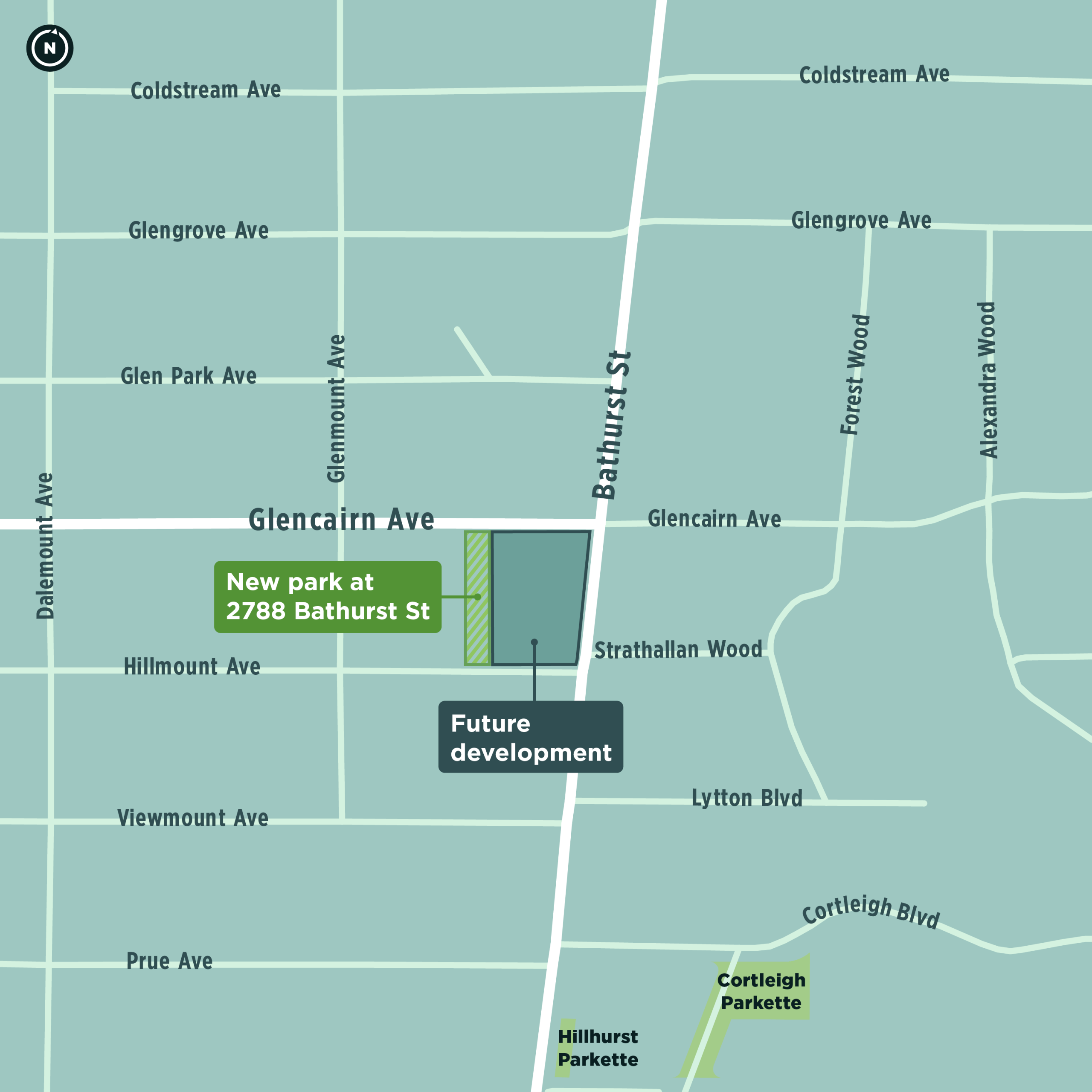
Context map of the new park at 2788 Bathurst Street. It highlights the future development to the east of the new park, and the area of the new park. The park is bounded by Glencairn Ave to the north and Hillmount Ave to the south.

Date modified: June 5, 2026