

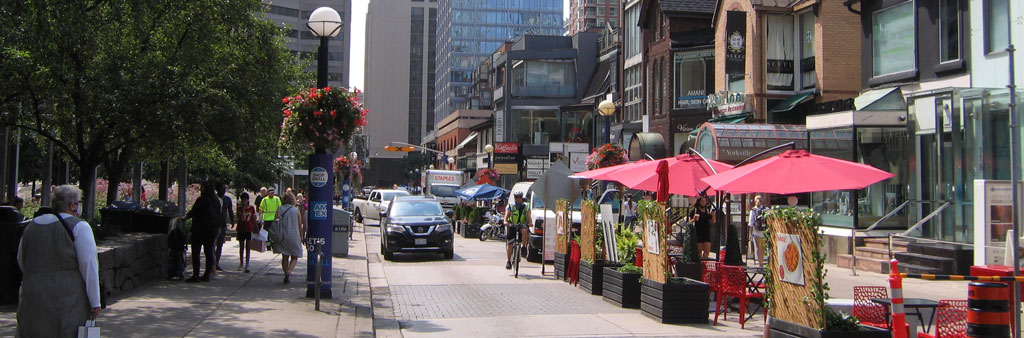
The Bloor-Yorkville Secondary Plan builds on a series of established policy work and ongoing planning initiatives.
In 2014, planning staff worked with community stakeholders to form the Yorkville – East of Bay Planning Framework. This framework establishes built form criteria and locations for tall building sites in part of the Bloor-Yorkville area and supports a network of pedestrian mid-block connections and open spaces.
In 2015, local Business Improvement Areas and Residents’ Associations undertook a community-led process to form a comprehensive plan for part of the Bloor-Yorkville area. This was in response to concerns and pressures from increasing local development activity and resulted in the creation of the Bloor-Yorkville/North Midtown Planning Framework and Implementation Strategy. This document highlights the special character of the Bloor-Yorkville area and identifies key objectives to accommodate recent growth.
In 2016, City Council adopted the Planning Framework and directed staff to consider this document during the evaluation of current and future development applications prior to the completion of the Bloor-Yorkville Secondary Plan.
In 2017, planning staff and local stakeholders identified concerns from upcoming development applications that would negatively impact local character. In response, City staff introduced a zoning by-law amendment to increase the minimum front lot line setback for properties in the Village of Yorkville. These changes were implemented to protect the character of the area and to ensure adequate space for the public realm, as existing properties feature front setbacks that form part of the local pedestrian space.
The Downtown Plan (OPA 406) was adopted by City Council in May 2018, and provides an updated planning framework across downtown Toronto, including Bloor-Yorkville. The Downtown Plan integrated many of the objectives and recommendations from the Planning Framework into the Official Plan, with a focus on transitions in mixed-use areas and on public realm improvements. The Secondary Plan will elaborate on the Downtown Plan to provide more local direction for the Bloor-Yorkville area.
In 2021, heritage planning staff began the Bloor-Yorkville Cultural Heritage Resource Assessment (CHRA) to document the area’s development history and to ensure that properties of cultural heritage value or interest are appropriately identified, understood and conserved. A Cultural Heritage Resource Assessment applies provincial criteria to evaluate properties for their cultural heritage value or interest. That evaluation is informed by community engagement and historical research. A CHRA results in an understanding of the history of an area, and identifies built heritage resources.
The CHRA team conducted two Heritage Focus Group meetings, in April and September of 2021, and participated in Indigenous engagement and community meetings through the planning Study. Engagement summaries for the Heritage Focus Group meetings are available under Meetings and Events on this webpage.
In 2023, the Bloor Yorkville Planning Study and the Cultural Heritage Resource Assessment were paused as staff responded to major changes to Provincial planning policy and to the Ontario Heritage Act. The CHRA was resumed in the spring of 2025, and a final Heritage Focus Group meeting was held in November, 2025.
A final report for the Bloor-Yorkville Cultural Heritage Resource Assessment has been completed by Common Bond Collective, heritage consultants for the project. A staff report to the Toronto Preservation Board and City Council is projected for the first quarter of 2026.
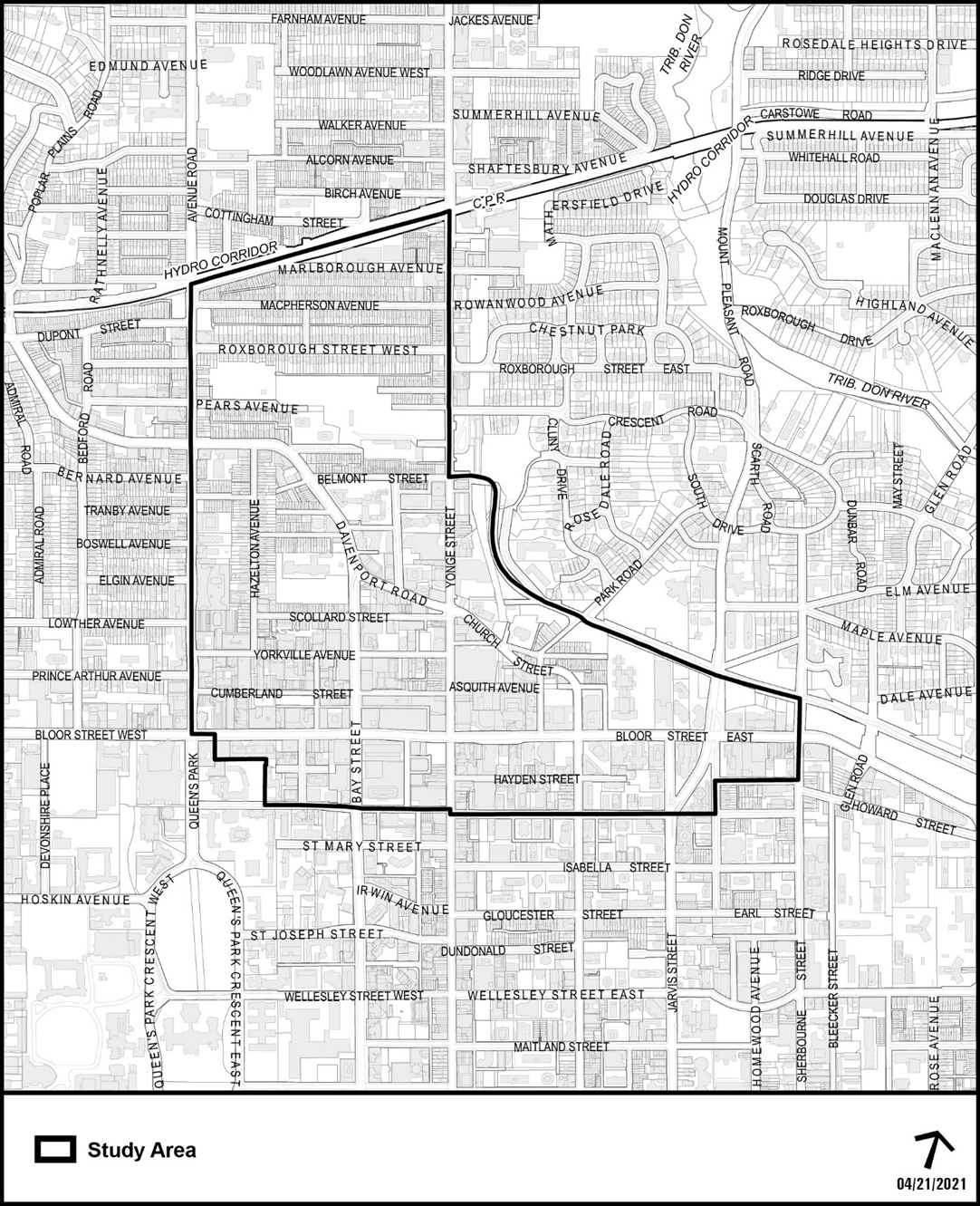
The Bloor-Yorkville Secondary Plan study area is generally bounded as follows:
North: The Canadian Pacific Railway corridor
East: Yonge Street, Rosedale Valley Road and Sherbourne Street
South: Charles Street
West: Avenue Road
While we aim to provide fully accessible content, there is no text alternative available for some of the content on this site. If you require alternate formats or need assistance understanding our maps, drawings, or any other content, please contact cityplanning@toronto.ca.