|
The Lower Don
river follows a narrow, steeply sloped valley south from the Forks
of the Don (at the confluence of three tributaries: the East and
West Don rivers and Taylor Creek) to Lake Ontario. While only 8.0
kilometres long and a small fraction of the watershed's total 360
sq. km. area, the river passes through some of Toronto's most developed
and densely populated neighbourhoods. The Lower Don has held an
important role in the region's history as a place of settlement,
agriculture and, later, industry. Present-day efforts to renaturalize
the watershed and restore its health will revive the Lower Don's
role as a natural greenspace corridor.
The river valley
was an inland transportation route well-known to Native peoples
for its abundant hunting and fishing. European settlement in the
Lower Don valley began about 200 years ago. Fertile floodplain lands
were soon cleared by farmers to grow fruits and vegetables. The
wood was used for building and heating. As mills were established
along the river, the watercourse was rerouted and dammed to provide
power. Growing demands for food and manufactured goods such as textiles
and leather followed an expanding population in Toronto. By the
1900's, this once thickly-wooded valley had been reshaped into an
industrial and transportation corridor at the expense of greenspace
and natural habitats.
Changes to
the valley were obvious. Most of the mixed deciduous and coniferous
forests had disappeared. South of Gerrard Street the slow, meandering
river was straightened and its banks reinforced with wood and steel
to control floods (made worse by the disappearance of vegetation).
Marshes and river oxbows were cut-off and filled. Portions of Lower
Don tributaries such as Castle Frank Brook, Rosedale Brook and Mud
Creek were buried underground. This resulted in improved passage
for the C.N.R. railway and added industrial lands, while apparently
combatting the cholera epidemic (a virus believed to propagate in
wetlands). Railways and roads moved a growing flow of traffic along
the floodplain. In 1892, the Beltline Railway was opened -- a passenger
service which linked the city to the new suburban communities of
Rosedale, Moore Park and Forest Hill via the Don valley. New steel
bridges at Queen and Bloor Streets spanned the valley. The Ashbridge's
Bay delta, at the mouth of the Don River, was filled in and the
river rerouted through the concrete banks of the Keating Channel.
The Lower Don
became a productive industrial area, valuable for its employment
and the goods and services created there. By the late-1800's, improved
transportation and abundant resources like water and clay had attracted
manufacturers of paper, bricks, chemicals and beer. Mill sites located
along the Lower Don included Todmorden Mills, Taylor Paper Mills,
Don Valley Paper Company, and the Weyborn Degreasing Plant (later
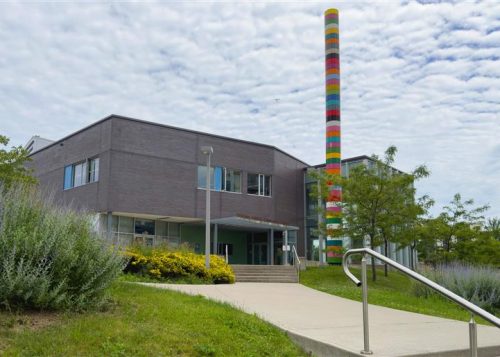
owned by Domtar Polyresins). The Don Valley Brickworks, founded
by the Taylor family about 1890, used rock extracted from the nearby
valley walls and water from the river to produce much of Toronto's
building stone for the next fifty years. Historic Toronto architecture
such as Casa Loma, Massey Hall, the Ontario Legislature, and University
of Toronto buildings such as Hart House and Convocation Hall were
constructed with Don Valley Brickworks material. While significant
for its role in regional industrial heritage, the north face of
the old Brickworks quarry is also recognized internationally for
its Pleistocene geology --excavation has revealed a series of glacial
and fossil deposits at least 300,000 years old. In 1984, the Brickworks
was acquired for public open space purposes.
Rapid population
growth and automobile-dependent suburbanization following World
War II further disconnected the valley's natural communities. In
the 1960's, development of the Don Valley Parkway and the Bayview
Avenue Extension ensured the Lower Don would remain an important
transportation corridor for Toronto as urban expansion proceeded
further and further north. By the late 1980's, virtually the entire
watershed had been urbanized. The health of the river's headwaters
and related wetland habitats were threatened. River water flowing
downstream into the Keating Channel, at the mouth of Lake Ontario,
was heavily polluted.
These conditions
caused public attention focus on the need to improve the health
of deteriorated greenspace resources. In this effort, the Don watershed
became a case study. The Royal Commission on the Future of the Waterfront's
reports "Watershed" (1990) and "Regeneration" (1992) suggested a
planning strategy that reconnected valley corridor ecosystems to
foster the renewal of healthy, self-sustaining natural habitats.
In 1992, a 25-member Don Watershed Task Force was established with
a mandate to help the former Metropolitan Toronto and Region Conservation
Authority develop a regeneration plan for the entire watershed.
The resulting "Forty Steps To A New Don" recommended that regeneration
plans for sub-watersheds be guided by a Don Watershed Council, with
public and elected officials as members.
In a spirit
of cooperation, communities and the municipal government are working
together to develop regeneration plans for their local areas. The Task Force to Bring Back the Don's 1991 report, "Bringing Back the Don" is
one example of
a sub-watershed plan to reconnect the river and its surrounding
natural environment. The Parks & Recreation department work with
with groups such as the Evergreen Foundation and Boy Scouts of Canada
on landscape restoration, naturalization and wetland re-establishment
projects. In 1994, the Boy Scouts planted 4800 spruce and pine seedlings
in the Lower Don valley. Many other groups have planted wildflowers
and shrubs. Over time, these efforts will return the watershed to
a healthy, self-sustaining condition and provide a model for ecosystem
planning in urban communities.
|