Tomatillos and Eggplant in tub.
The Children’s
Garden Program provides children, youth and families with an
opportunity to participate in hands-on organic gardening activities
like planting, maintenance, composting and more!
We have
two garden locations: High Park and the Waterfront. School programs
are currently offered at the High Park Children’s Garden,
which is wheelchair accessible.
School
Programs
The City
of Toronto invites school groups to visit the garden and participate
in hands-on gardening activities.
Programs
are suitable for K-8 and last approximately 2 hours. We also
offer customized programming for children with special needs.
The Children's
Garden Program is available from mid-May to the end of June
and from mid-September to early October. Registration is done
on a first come first served basis so don't forget to register
early! The program cost is $5/child.
Possible
Activities Include:
- Planting
and Harvesting
- Soil
Investigation
- Plant
Identification
- Scavenger
Hunts
- Composting
- Bug Hunts
- Garden
Crafts
- Drama
and Music
All programs
are hands-on, interactive, and reflect Ontario Ministry of Education
Curriculum.
For more
information, or to register a class, please contact Keely Forth
at 416-392-1329 or kidsgrow@toronto.ca.
Summer
Events, Eco Camp and Family Drop-in Programs
The Children's Garden and Exploring Toronto Programs
will be hosting a number of drop-in programs and community events,
as well as our Eco Camp this summer. Join us for hands-on gardening
and nature exploration activities, nature crafts, garden harvest
cooking, nature tours, eco-games and live performances.
For
complete details see the Calendar
For more
information, please contact 416-392-1329 or kidsgrow@toronto.ca.
Volunteering
Interested in volunteering for any of our spring, summer or
fall programs? Contact 416-392-1329 or kidsgrow@toronto.ca.
| About
the Children's Gardens |
Our gardens
are grown organically, which means that we do not use any chemical
pesticides or fertilizers. Instead, we try to work with nature
by using companion plants and natural sprays to control pests
and by using compost for fertilizer.
Some of
the vegetables grown at the gardens are harvested and eaten
by children during our summer programs. The rest is cooked and
prepared for our summer Sunday events to provide a yummy organic,
vegetarian lunch for the community. Any extra vegetables that
cannot be used are given to local soup kitchens and food banks.
The
High Park Children's Garden
- The High
Park Children's Garden was created in 1998 on what used to
be a parking lot. It features colourful raised beds in the
shape of the letters A,B,C.
-
The
garden features a large compost demonstration site with
a variety of composters. All of the organic waste produced
at the garden goes into the composters and then back into
the soil to feed the plants. We also have a worm composter
which is featured in our programming. The worms are a big
hit with the kids and help make the compost even better!!
High
Park Compost Site.
- We grow
a wide variety of annual vegetables and flowers including
tomatillos, corn, okra, cucumbers, marigolds, sunflowers and
much more. Perennial features include a hillside of native
wildflowers and grasses, a culinary and medicinal herb bed
and a new permaculture bed with an herb spiral and a fedge
(or food-bearing hedge) with various berry and fruit plants.
-
The
High Park site also features a sandbox, birdhouse trellis,
picnic shelter, tool shed and two rain barrels.
High
Park Children’s Garden
The Waterfront
Children's Garden
- The Waterfront
Garden was created in 1999, at the same time as the adjacent
Toronto Music Garden.
- The site
features a butterfly garden with a six-foot caterpillar topiary,
a three-bin composter and a vegetable and herb garden.
Emily at the Emily's Garden
- As it
is very hot and dry at this location, we try to place heat-loving
vegetables including hot peppers, tomatillos, okra, eggplants
and herbs like basil and oregano.
- The children
and youth from the Harbourfront Community Centre help to plant
and care for this garden throughout the spring and summer.

- Have
you heard the myth that if you cut a worm in half it becomes
two worms? Well it’s not true! A worm can re-grow some
of its tail if the end was cut off but they can’t survive
being cut in half.
- Did you
know that the longest earthworm ever found was almost 22 feet
long?
- Toronto
has some of the richest agricultural lands in Canada but very
little space. Come to the High Park Children’s Garden
to learn how to grow lots of food in very small areas!
- Did you
know that water levels in the Great Lakes are getting lower?
This is just one of the reasons to conserve water. At the
High Park garden, our rain barrels help us to recycle rainwater
that runs off the picnic shelter. This means we always have
a supply of water for when the plants get dry.
- Did you
know that the First Nations people called corn, beans and
squash the "Three Sisters"? Come see how they grow
together.
- High
Park is home to a lot of wildlife. Some of the creatures that
have been spotted in the park include coyotes, fox, possums,
beavers and even deer! Of course, there are also lots of chipmunks,
squirrels, racoons and rabbits. We have also seen lots of
birds near the garden including Robins, Downy Woodpeckers,
Sparrows, Scarlet Tanagers, Northern Flickers and a Northern
Saw-whet Owl.

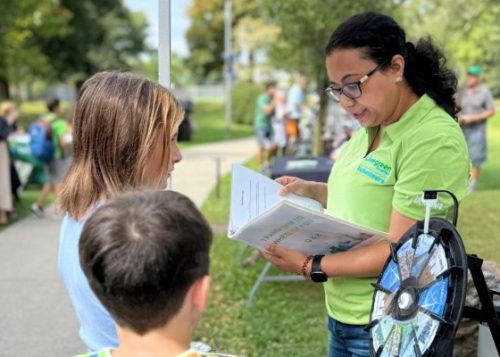
Keely and Kids Planting Access Week.
|