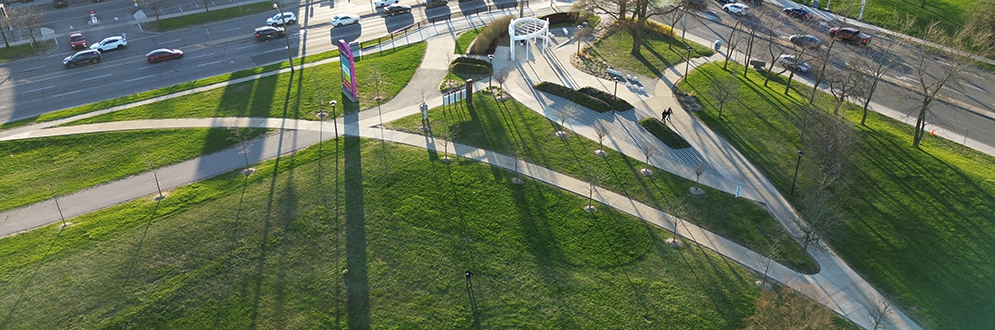
A new Community Recreation Centre is coming to 1377 Sheppard Ave. W., near Sheppard Avenue West and Keele Street in the Downsview neighbourhood. The design will be developed through community engagement and will provide cultural and recreational opportunities that support the growth and well-being of the Downsview community.

  • Spring 2026: Hire a design team
  • Summer 2025 to Spring 2026: Community Engagement Phase 1
  • Spring to Fall 2026: Community Engagement Phase 2
  • Fall to Winter 2026: Community Engagement Phase 3
  • Winter 2026 to 2027: Detailed design
  • Fall 2027: Hire a construction team and construction starts
  • 2028: Construction starts
  • 2031: Construction complete, Community Recreation Centre opens

The timeline is subject to change.

Sign Up for Updates

Sign Up Now

Sign up for or unsubscribe from updates related to the Downsview Community Recreation Centre.

Level of Engagement

This project has been classified as an Involve project based on the International Association for Public Participation Spectrum. This means we work directly with the public, stakeholders and rightsholders throughout the design process to ensure that ideas and aspirations are understood and considered.

Community Advisory Committee

This project has a Community Advisory Committee (CAC) made up of representatives of the Downsview community. The CAC’s mandate is to provide a forum for feedback, guidance and advice to the project team at key decision points during the community engagement process. The CAC will meet approximately one to two times per phase of the project. The CAC is not a decision-making body and does not speak on behalf of the entire community.

Indigenous Community Knowledge Circle

This project has an Indigenous Community Knowledge Circle (ICKC) organized by the City, Northcrest Developments and Canada Lands Company. The ICKC will provide Indigenous-led dialogue, community input and culturally grounded guidance for the redevelopment of Downsview specifically as it relates to Downsview’s District Plans, Community Development Plan, and parks and recreational spaces.

In this phase, the City worked with the community and project advisory groups to define an overall vision, guiding principles and big moves for the new Community Recreation Centre (CRC). These will guide the development of design options in Community Engagement Phase 2.

Draft Vision Statement

The vision is co-created with the community to describe the ideal future community recreation centre. It is a big-picture statement that should inspire everyone toward a common understanding of the project’s overall goals and objectives.

The new Downsview Community Recreation Centre will be a safe, affordable, welcoming, accessible and technologically vibrant hub where diversity is celebrated, connections are fostered and everyone feels a true sense of belonging.

Accessibility will go beyond the standard. Children and seniors will be supported to participate. It will be uniquely designed as a desired destination, creating spaces where people of all ages, abilities, religions and cultures can gather and be motivated to do something they love. The CRC should be the heart of the community, inclusive and reflective of our multiculturalism. It will have a balance of program specific and non-program specific spaces to be active, relax, play and enjoy nature, culture and social experiences.

It will be a family-friendly environment that promotes health and wellness, inspires long-term enjoyment and community connections, and offers something for everyone.

Draft Guiding Principles

The guiding principles are high-level directions that reflect the community’s most important values and ideas for how the community recreation centre should look and feel. They help to clarify the vision statement and guide how the community recreation centre should be designed by describing the desired outcomes.

  • Foster belonging and community representation: The community recreation centre should reflect community needs and create a welcoming place where diverse groups feel safe, represented and connected.
  • Ensure affordability and access: Programs and spaces should be free or low-cost so that families and community members of all income levels can participate fully.
  • Connect with nature: The design should integrate greenery, gardens and seamless connections to the surrounding park to promote health and sustainability.
  • Champion accessibility and safety: The community recreation centre must be barrier-free, safe and inclusive for people of all ages, abilities and schedules.
  • Celebrate diversity: The community recreation centre should reflect the area’s identity, celebrate cultural diversity and offer programs that draw people from across Toronto.
  • Promote health and wellness: The community recreation centre should inspire active, healthy living and holistic wellbeing through fitness, recreation and lifelong learning.

Draft Big Moves

Big moves are the main priorities for the design of the community recreation centre. They are specific directions for how the physical design can achieve the vision and guiding principles.

  • Add aquatic centre with pool and water play features.
  • Add weight room and fitness studio.
  • Add multi-purpose rooms and spaces.
  • Indoor play space for children and families.
  • Add multi-use courts and sport lines.
  • Add a community kitchen.
  • Add inclusive areas such as sensory rooms.

Community Engagement Meetings and Events

April 2026

Indigenous Community Knowledge Circle Meeting 2

On April 21, the Indigenous Community Knowledge Circle met to discuss opportunities for Indigenous Placekeeping at the new community recreation centre.

Feedback Summary
  • Participants considered how the community recreation centre could help support an Indigenous-led food sovereignty model through access to food and medicine. Suggestions included growing berries and other food on-site, planting pollinator and herb gardens, providing habitat for bees and hosting cooking classes in a community kitchen.
  • Participants shared ideas for land-based learning and environmental education initiatives, such as seminars on climate action grants, community stewardship programs and Indigenous gardening mentorship programs.
  • Participants emphasized the importance of programs for Indigenous youth that provide skills development, certifications, training and pathways to employment.
  • Participants spoke about the role of artwork in storytelling and creating a safe, inclusive space for Indigenous community members. Suggested topics for artwork included Indigenous athletes and traditional sports such as lacrosse and snow snake.
  • Participants saw the community recreation centre as a space for knowledge exchange through teachings about our connection and responsibilities to Mother Earth. They highlighted the need to collaborate with Knowledge Keepers and Elders and to offer programs immersed in Indigenous cultural values and languages.
  • Other comments referenced wildlife connectivity in the surrounding Downsview area and posting protocol for ceremonial and cultural space.

September 2025

Community Advisory Committee Meeting 2

On September 25, the Community Advisory Committee met to learn about the project, draft a vision statement for the new recreation centre and develop initial draft guiding principles and big moves to inform the design process.

Download the combined Community Advisory Committee Meeting 1 and 2 summary.

Indigenous Community Knowledge Circle Meeting 1

On September 10, the Indigenous Community Knowledge Circle met to review the draft Terms of Reference and participate in a project overview presentation

August 2025

Camp Workshop

On August 13, the project team held a workshop with children attending CampTO summer programs at Grandravine Community Recreation Centre. The purpose of the workshop was to gather ideas for the design of the new community recreation centre.

Approximately 48 campers between the ages of six and 12 participated in two sessions. Each session began with a short presentation and group discussion, followed by a hands-on activity where campers decorated blank pennants to illustrate their vision for the new community recreation centre.

At the new community recreation centre, participants want to:

  • Splash, swim and slide down water slides
  • Run, climb and use playgrounds
  • Explore natural spaces and gardens
  • Play sports like basketball, soccer and tennis
  • Create, dance and make music

July 2025

Online Thought Exchange Activity

From June 12 to July 24, an online thought exchange activity gathered ideas for the new community recreation centre. The activity received a total of 235 thoughts and 4,025 thought ratings from 325 participants.

Feedback Summary

Respondents were asked what functions they would most like to see, which features and spaces should be prioritized, and what building aspects they feel are most important in creating a comfortable and welcoming community centre. Responses are shown in parentheses below.

Respondents ranked what functions they would most like to see in the recreation centre, with one being the highest and six being the lowest:

  1. Aquatics
  2. Fitness and wellness
  3. Sports facilities
  4. Arts and culture
  5. Community building and social spaces (4.53 average ranking)
  6. Age-friendly spaces and programs

Respondents ranked what aquatic features should be prioritized, with one being the highest and three being the lowest:

  1. Leisure pool
  2. Lane pool
  3. Interactive play features

Respondents ranked what fitness and exercise spaces should be prioritized, with one being the highest and five being the lowest:

  1. Gymnasium
  2. Fitness studio
  3. Weight room (2.79 average ranking)
  4. Running track (3.27 average ranking)
  5. Dance studio (4.06 average ranking)

Respondents ranked what indoor sports or physical activities should be prioritized, with one being the highest and five being the lowest:

  1. Fitness and wellness (2.21 average ranking)
  2. Racquet and paddle sports (2.48 average ranking)
  3. Ball sports (2.52 average ranking)
  4. Movement-based programs (3.02 average ranking)
  5. Other sports (4.77 average ranking)

Respondents ranked what arts and culture spaces should be prioritized, with one being the highest and four being the lowest:

  1. Dance studio (2.16 average ranking)
  2. Art studio (2.33 average ranking)
  3. Event space e.g. exhibitions, performances (2.52 average ranking)
  4. Music space (3.00 average ranking)

Respondents ranked what community and social spaces should be prioritized, with one being the highest and four being the lowest:

  1. Multi-purpose rooms (73 average ranking)
  2. Main lobby, common spaces and administration areas (2.71 average ranking)
  3. Community kitchen (2.72 average ranking)
  4. Lounge areas (84 average ranking)

Additional comments that were highly rated by participants included:

  • An inclusive, welcoming centre where people of all ages, cultures, incomes, and abilities feel safe and respected
  • Barrier‑free access and transit‑friendly design, with amenities that work for people with disabilities.
  • Affordable or free programs and low fees that prioritize community use over business needs.
  • A reliable mix of nearby programs for children, youth, adults, and seniors, which will help address current shortages and registration challenges.
  • Year‑round, weather‑proof spaces to be active, socialize, decompress, and support physical and mental health.
  • A vibrant “third place” that strengthens community ties and reflects local history and cultures through art and storytelling.

Review the July 2025 Thought Exchange activity results summary, including top thoughts and themes.

Community Advisory Committee Meeting 1

On July 15, the Community Advisory Committee met to learn about the project, draft a vision statement for the new recreation centre and develop initial draft guiding principles and big moves to inform the design process.

June 2025

Community Advisory Committee Application

From May 8 to June 17, community members could apply to join the Community Advisory Committee. The Committee will provide feedback, guidance and advice to the project team at key decision points during the community engagement process.

This phase is divided into two parts. In Phase 2A, feedback will be collected from the project advisory groups on early draft design options. In Phase 2B, feedback will be collected from the community on a refined draft design based on input from Phase 2A. The feedback will be used to develop a preferred design for the Community Recreation Centre (CRC).

The community engagement activities anticipated in this phase include:

  • a Community Advisory Committee meeting
  • an Indigenous Community Knowledge Circle meeting
  • a youth workshop

Community Engagement Meetings and Events

June 2026

Indigenous Community Knowledge Circle Meeting 3

On June 29, the Indigenous Community Knowledge Circle met to review and provide feedback on two early draft design options for the new community recreation centre.

Feedback Summary
  • Participants discussed the community recreation centre’s potential to be a meaningful gathering place for Indigenous communities, while considering the diversity of Indigenous perspectives and experiences.
  • Participants expressed interest in dedicated ceremonial and cultural spaces in the community recreation centre, as well as intergenerational programming and opportunities for cultural practice, learning and connection. Participants supported land-based learning through activities such as foraging, harvesting, plant identification and food preservation.
  • A participant appreciated the attention to lost rivers and historic water systems in the draft design options, highlighting the importance of water in Indigenous teachings and connections to the land.
  • A participant recommended incorporating environmentally sensitive design features, such as downcast lighting to reduce impacts on wildlife, bird-friendly windows, rainwater collection and water recirculation systems.
Community Advisory Committee Meeting 3

On June 16, the Community Advisory Committee (CAC) reviewed two draft design options for the new community recreation centre. The meeting took place at Northwood Community Centre from 6 to 9 p.m. 26 CAC members attended the meeting including representatives from the following organizations:

  • ARBO Seniors Association
  • Downsview Lands Community Voice Association
  • North York Harvest Food Bank
  • Stanley Greene Neighbourhood Facebook Group
  • Wilson Village BIA
  • York Centre Karate

Asynchronous feedback about the meeting material was received from ARBO Seniors Health Village.

The meeting opened with a presentation, followed by three group activities assessing how the draft designs align with the vision statement, guiding principles and big moves.
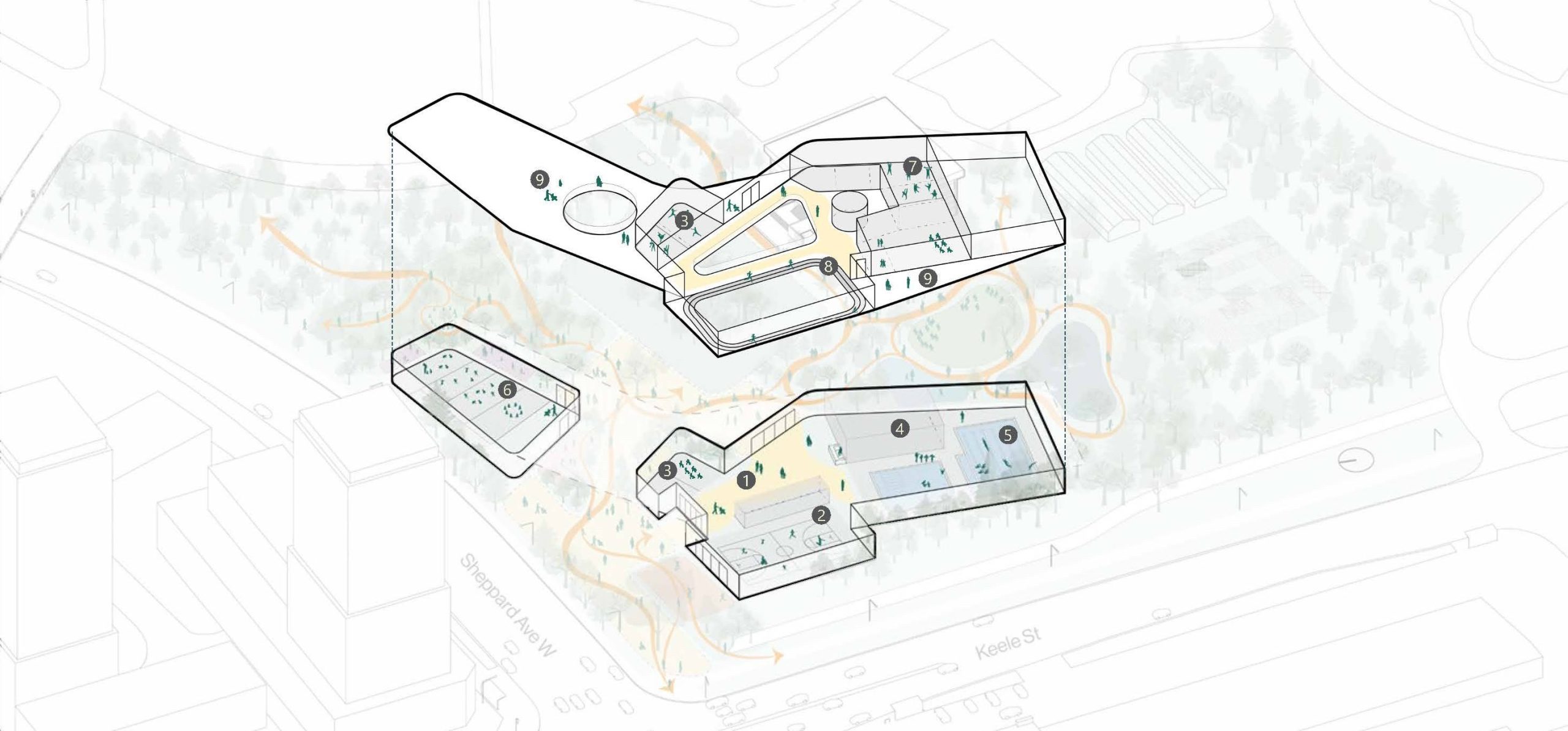
Draft Design Option: The Clearing

3D diagram of The Clearing option, which includes two buildings and a central plaza that links the street corner to the park and surrounding area. Both levels of the buildings are outlined and numbered according to the list of features after the image.

  1. Community living room
  2. Gymnasium
  3. Activity rooms
  4. Change rooms/pool support
  5. Natatorium
  6. Future program
  7. Fitness and dance studio, weight room, admin and youth space
  8. Running track
  9. Exterior rooftop

The Clearing organizes the community recreation centre in two buildings separated by a central covered outdoor gathering space. The concept creates multiple routes through the site and provides a direct connection between Sheppard Avenue West and Keele Street corner and Downsview Park.
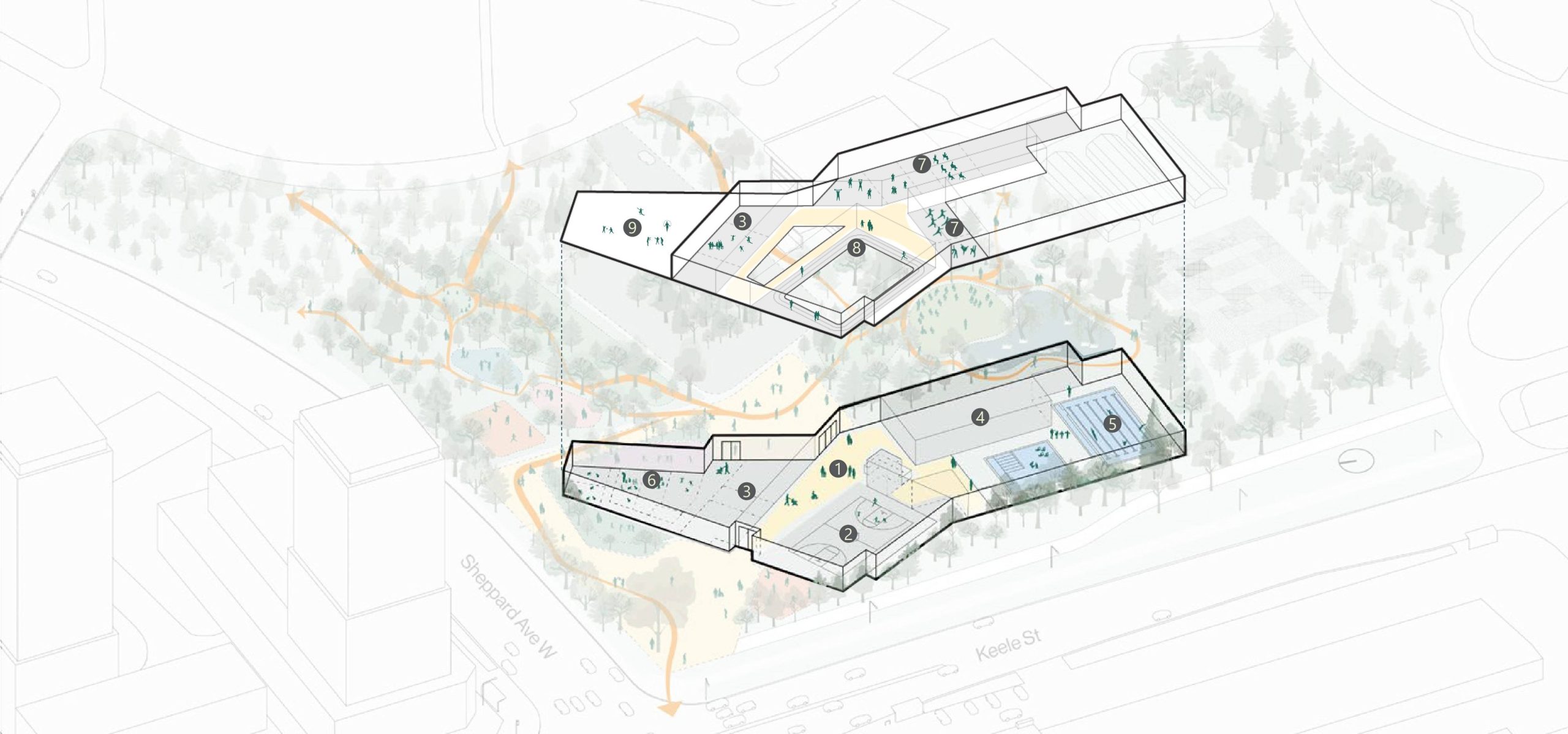
Draft Design Option: The Lodge

3D diagram of The Lodge option, which includes one building along Keele street that shelters the green space and park to its east. Both levels of the building are outlined and numbered according to the list of features after the image.

  1. Community living room
  2. Gymnasium
  3. Activity rooms
  4. Change rooms/pool support
  5. Natatorium
  6. Future program
  7. Fitness and dance studio, weight room, admin and youth space
  8. Running track
  9. Exterior rooftop

The Lodge organizes the community recreation centre within a single building, creating a clear separation between the centre’s indoor and outdoor activity areas and the surrounding context.

Discussion Summary

During the presentation, participants shared initial impressions of the draft designs and asked questions about the evolving design process. Key discussion themes included:

  • Desire for a connection to nature and the surrounding park
  • Considerations for enhancing safety, such as clear sightlines, staff presence, multiple entrances, outdoor courts and the relationship between recreational spaces and traffic on Keele Street and Sheppard Avenue West
  • Recommendations to consider accessibility beyond physical access including accessible fitness equipment, recreation spaces and programs for a wide range of bodies, abilities and needs
  • Value of increased opportunities for seniors and flexible spaces for changing communities
  • Interest in markets, food vendors, cafés, cultural celebrations, public art and informal gathering spaces
  • Incorporation of Indigenous culture, art and Placekeeping
  • Commemoration of historic events and people in the Downsview community
  • Requests for features offering weather protection and winter comfort, such as sheltered courts, covered outdoor spaces and comfortable connections between programs year-round
  • Some concern about parking supply and congestion during major events, as well as support for balancing vehicle access with outdoor amenities and a pedestrian-oriented site
Activity 1: Rose, Bud and Thorn Summary

CAC members worked in six table groups to evaluate the two early draft design options using a Rose, Bud and Thorn exercise. Participants identified elements they felt worked well (Rose), had potential for further development (Bud), or presented a concern or challenge (Thorn).

For The Clearing, participants appreciated:

  • Strong connections and pathways into Downsview Park
  • Indoor, outdoor and in-between spaces
  • The central covered gathering space
  • Multiple entrances and choices for movement
  • The distinctive character and identity of the concept
  • The “heart” of the community centre for community connection and activation opportunities

Opportunities and concerns included strengthening the connection between the two buildings, supporting year-round use, maintaining visibility and safety, providing adequate weather protection, and considering the relationship between pedestrian movement and vehicle drop-off areas.

For The Lodge, participants appreciated:

  • The simplicity of a single-building arrangement
  • The ability to move between programs indoors during winter
  • Preservation of green space
  • The larger outdoor plaza and opportunities for outdoor programming
  • Clear and intuitive internal circulation
  • The “heart” of the community centre for community connection and activation opportunities

Participants identified opportunities to increase visual and physical connections between the building and park, create brighter spaces with views of nature, activate exterior building edges and provide additional outdoor programming. Concerns included the perceived scale of the building, its relationship to the park, and parking and loading arrangements.

Activity 2: Space, Materials and Artwork Selection Summary

CAC members reviewed a collection of precedent images showing different architectural spaces, landscape treatments, recreational amenities and approaches to public art. Each group selected images that most resonated with them and shared their rationale. Images selected by two or more groups were identified as recurring preferences. Common interests included:

  • Indoor-outdoor and transitional spaces
  • Naturalized play areas
  • Sheltered outdoor courts and gathering areas
  • Informal gathering spaces, alcoves and overlooks
  • Views into active spaces such as the pool while maintaining patron privacy
  • Markets and opportunities for food and cafés
  • Places for cultural celebration
  • Integrated public art and opportunities for rotating artwork
  • Strategic use of colour within the building
  • Flexible spaces supporting a range of activities
  • Inclusive spaces and wayfinding that provide opportunities for people of different ages and abilities
  • Programming spaces that consider safety, privacy and functionality as well as indoor-outdoor connection

Participants also expressed interest in natural materials, weather-protected outdoor spaces, amphitheater-style gathering areas, climbing walls, water play and spaces that celebrate Indigenous and other cultural identities.

Activity 3: Guiding Principles Evaluation Summary

CAC members scored the designs on a scale of one to five based on how well each option supported the six guiding principles, with five representing an excellent design response. The scores were then mapped onto a radial chart for comparison.

The Clearing received its highest average scores for:

  • Promote health and wellness (4.7)
  • Connect with nature (4.4)
  • Foster belonging and representation (4.0)

The Lodge received its highest average scores for:

  • Foster belonging and representation (4.1)
  • Promote health and wellness (4.0)

Overall, The Clearing was preferred in the Guiding Principles Evaluation activity and received more positive comments during the Rose, Bud and Thorn exercise. At the same time, participants identified valued qualities and opportunities in both designs, suggesting that elements of each should inform the evolving design of the centre.

In this phase, the City will share the preferred design with the community and project advisory groups. Once the preferred design is confirmed, the project will move into the detailed design phase, where the design team will finalize the preferred design by working through the technical details and plans for the construction contractor.

The anticipated outcomes of this phase include a refined preferred design.

The community engagement activities anticipated in this phase include:

  • a joint Community Advisory Committee and Indigenous Community Knowledge Circle meeting
  • an open house

Downsview Community Recreation Centre (CRC) will offer a variety of year-round programs and services for Downsview’s growing communities and surrounding areas.

The CRC is proposed to include:

  • a six lane, 25-metre lane pool
  • a leisure/tot pool
  • a double gymnasium with a running track
  • fitness studios
  • multi-purpose spaces
  • a community kitchen
  • a weight room
  • seniors and youth spaces
  • Indigenous program space
  • WIFI access throughout the facility

The CRC will meet Accessibility for Ontarians with Disability Act accessibility standards and target Net Zero emissions building design.

Date modified: September 2, 2026