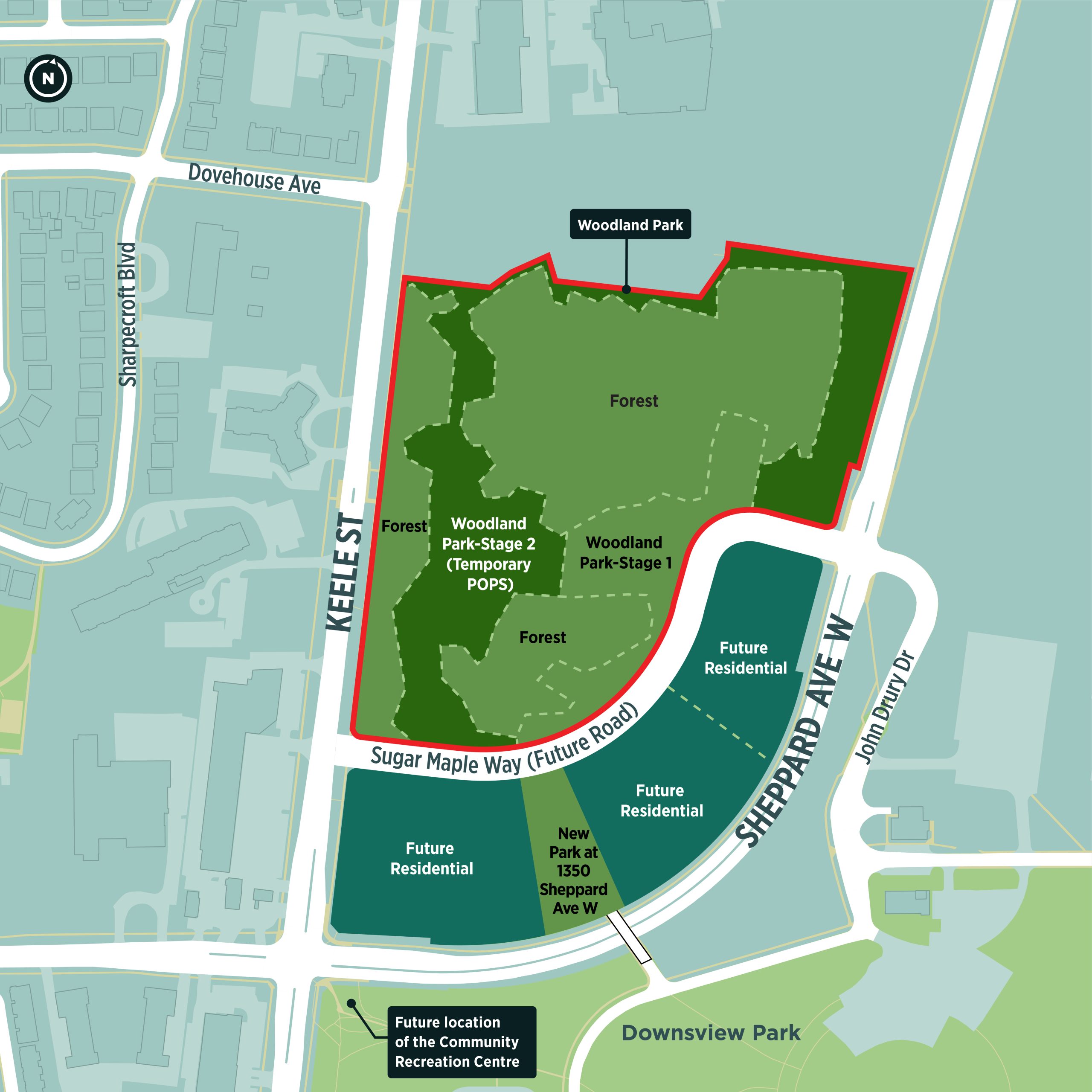
Two new parks are being developed in the William Baker/Arbo District near Sheppard Avenue West and Keele Street as part of the Downsview Secondary Plan. The design of the New Park at 1350 Sheppard Ave. W. and Woodland Park, will be informed by a community engagement process and shaped by the Downsview Community Development Plan.
The New Park at 1350 Sheppard Ave. W. will be 4,452 m2, approximately the size of one baseball diamond and four basketball courts. Woodland Park will be built in two phases: Stage 1 will be 11,024 m2, roughly the size of three baseball diamonds and three basketball courts, while Stage 2 will follow in a later phase and add an additional 27,216 m2 of park space. Until Stage 2 is constructed, this portion of the site will be a temporary Privately-Owned Publicly Accessible Space (POPS).
These names are placeholders and are not the official park names.
While we aim to provide fully accessible content, there is no text alternative available for some of the content on this site. If you require alternate formats or need assistance understanding our maps, drawings, or any other content, please contact Leigh Lichtenberg at 437-235-7022.
The timeline is subject to change.
Sign up for or unsubscribe from updates related to the New Parks in William Baker/Arbo District.
This project has been classified as an Involve project based on the International Association of Public Participation Spectrum. This means we aim to work directly with the public throughout the process to ensure that public concerns and aspirations are consistently understood and considered in developing design options and identifying a preferred design.
In this phase, the City worked with the community to develop design priorities for the new park at 1350 Sheppard Avenue West and Woodland Park. The feedback will help inform the development of design options in Community Engagement Phase 2.
From February 6 to 20, an online survey collected feedback to shape designs for the new parks.
The preferred character for the new park was:
The most popular park uses were:
The preferred types of seating were:
The preferred playground features were:
The preferred styles of playground were natural (39 per cent) and modern (30 per cent).
64 community members provided comments on how to ensure the New Park at 1350 Sheppard Avenue West is welcoming and accessible for all community members. The most common themes included requests that the new park be accessible to those with disabilities, and requests for pool, splashpad or water feature.
The most popular current park uses were:
The most popular park uses for the future park were:
The preferred types of seating were:
35 community members provided comments on how to ensure the Woodland Park is welcoming and accessible for all community members. The most common themes included requests to retain the paths through the woodland, and comments related to safety.
From February 19 to 27, an online survey collected feedback from Indigenous community members and Nations connected to the project, including the Indigenous Community Knowledge Circle (ICKC), the Mississaugas of the Credit First Nation, and the Six Nations of the Grand River. One community member provided feedback through the survey and reflected a similar vision for the New Park at 1350 Sheppard Avenue W. to what was shared by other survey respondents, with an increased emphasis on gathering and celebration. For the Woodland Park, they suggested that it presented a good opportunity to integrate Indigenous education, culture, and traditions – including space for ceremony, storytelling, and cultural recognition. They also advocated for natural materials to be used in designs, and finding balance between human, plant, and animal needs.
On January 27, members of the project team presented the project to the Downsview ICKC. 10 members of the group were in attendance and provided feedback and insight for consideration in the development of the Arbo District Plan, including the Woodland Park. Discussion themes included land stewardship & tree management, ecological integrity & four-season use, Indigenous-informed park design & storytelling, and naming & cultural recognition.
Members expressed an interest in site ecology and supporting our plant and animal relatives, and minimizing the impact on the environment – while increasing connection to the space for gathering, reflection, and ceremony. An interest in holding ceremony for the trees to be felled and creative reuse of the tree material was also shared and discussed. Art and education, through interactive storytelling and Indigenous-designed spaces was seen as a good opportunity in the Woodland, with suggestions for medicine wheel and medicine gardens, creative and interactive sculptures, soundscapes, and QR-code-enabled storytelling.
On January 15, members of the project team met with members of the Mississaugas of the Credit First Nation’s (MCFN) Department of Consultation and Accommodation office to introduce the project and discuss respectful ways forward. They suggested that the Woodland Park should remain a naturalized space, with preference not to formalize the informal trails that exist in the woodland, keeping the dense forested area, and wildlife, protected.
The MCFN also recommended exploring teaching opportunities in space, and to consider the development of ceremonial/gathering spaces at a later time, when there are more community connections to the area. If a narrative is included along the trail, it was suggested that it tells a common story, so the space feels inclusive. Some cultural elements or storytelling that could be embraced in the Woodland Park design include grandfather stone etchings, affiliation sister stones, marker trees, the Moccasin Identifier and moments that embrace the five senses.
The MCFN proposed that the project team consider the history of the lands when naming streets and public space, with opportunities to acknowledge the Indigenous, Black, aerospace, and local histories.
In this phase, the City and its design consultant will work off the outcomes of Community Engagement Phase 1 to develop two design options for the new park at 1350 Sheppard Ave. W. and one proposed design for Woodland Park. These designs will be presented to the community for feedback and will be used to develop a preferred design for each park.
The community engagement events anticipated in this phase include:
In this phase, the City will share the preferred designs for the new park at 1350 Sheppard Ave. W. and Woodland Park on this page and with the subscribers on the project mailing list. The project will then move into the detailed design phase, where the design team will finalize the designs by working through the technical details and plans for the construction contractor.
The anticipated outcome of this phase is a refined preferred design for each park.
The William Baker District Plan aims to create a mixed-use, transit-oriented community that emphasizes the preservation of its existing natural heritage.
The new park at 1350 Sheppard Ave. W. will sit between two residential blocks. The area currently includes existing trees.
Early ideas for the park include:
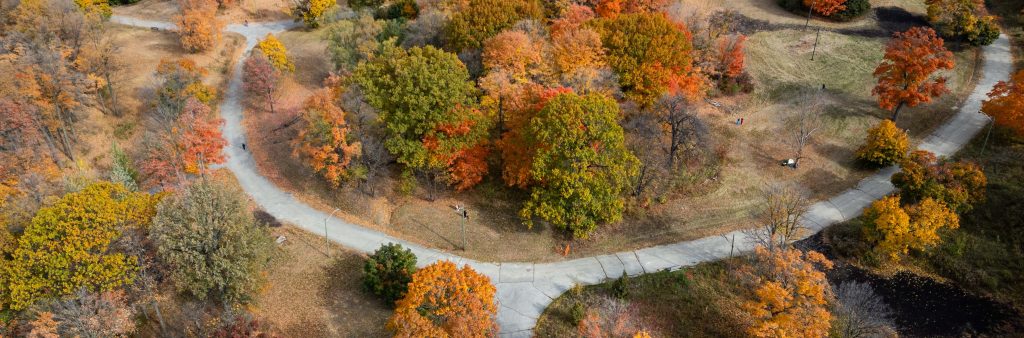
Woodland Park is characterized by a mature forest. The site used to contain military housing that has since been removed. A small road network still exists and currently provides a walking and cycling route; these roads will be removed. A narrower path will be added approximately where the former road was to limit impact to the site’s ecology.
The forested areas in Woodland Park include dense tree coverage and provide important ecological value. Some parts of the forest are broken up by old roads and past development, creating small, isolated patches.
Following advice from ecological specialists, the project will:
The project will include few well-placed entrances and paths to help visitors access the park without harming the forested areas.
Forest-related improvements will be planned during Stage 1 and constructed during Stage 2.
Until stage 2 construction begins, the temporary Privately-Owned Publicly Accessible Space (POPS) will stay in its current condition, including the existing roadway for walking and cycling route.