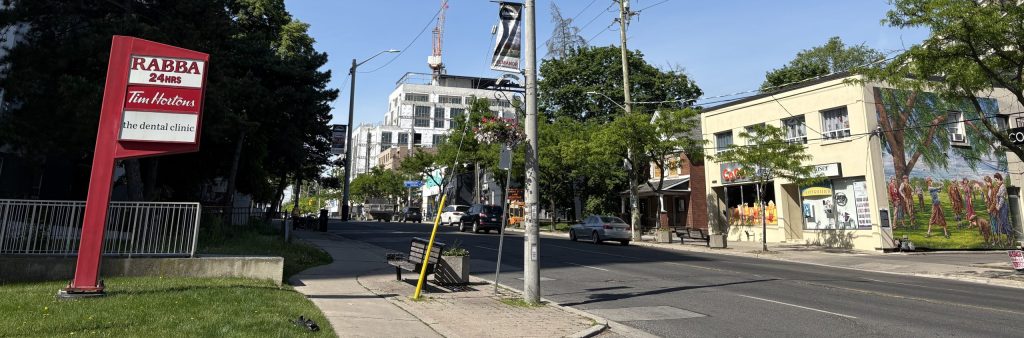
The City is reviewing existing policies, strategies, and guidelines applicable to Islington Village (the Village) to identify opportunities to reinforce the area’s main street character. The Planning Framework will focus on the pedestrian-oriented character of the Village, streetscape and public realm improvements, and opportunities for placemaking that enhance this character, while addressing new Provincial changes related to density around transit stations.
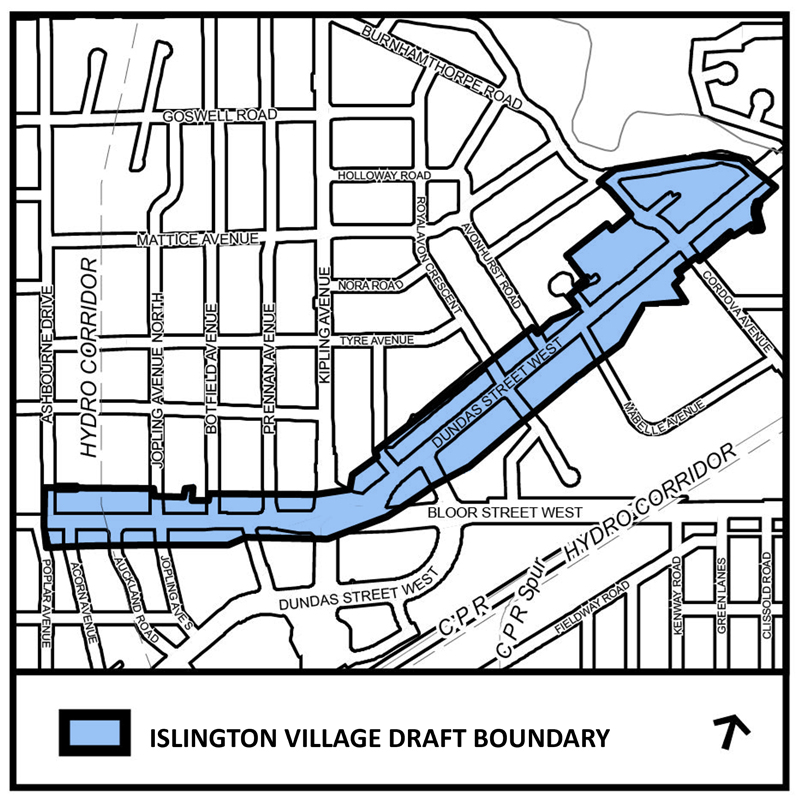
Map showing the boundary of Islington Village, which consists of lands facing either side of Bloor Street West and Dundas Street West between Poplar Avenue/Ashbourne Drive and Islington Avenue.

The draft Planning Framework boundary is generally defined by the properties fronting the north and south sides of Bloor Street West and Dundas Street West, between Poplar Avenue/Ashbourne Drive to the west and Burnhamthorpe Crescent to the east.

Please note that the boundary is still in draft form and is subject to change following consultation with the community and Ward Councillors.

Status Report to Community Council

The Etobicoke York Community Council adopted a Status Report for the Islington Village Planning Framework on July 7, 2026, which provided information on the draft area of focus, scope, phasing, and timing. The Status Report is available on the City’s website: Item – 2026.EY33.11.

Council Direction

On May 13, 2024, Etobicoke York Community Council adopted Item 2024.EY13.17, which directed City Planning staff to conduct scoped review of existing Islington Village policies and guidelines, identify opportunities for placemaking, and recommend policy or guideline updates to better maintain the village character.

Current and Approved Development Applications

You can search for development applications within the surrounding area and across the City using the Application Information Centre (AIC).

Key Terminology

  • Streetscape: means the combination of elements that shape a street’s environment beyond the street itself, including, but not limited to, sidewalks, street trees, lighting, street furniture (such as benches), and public spaces.
  • Public Realm Improvements: means physical and design interventions that are intended to enhance the usability, safety, accessibility, and visual quality of public spaces, such as streets, sidewalks, and parks.
  • New Provincial changes related to density around transit stations: in the context of the Islington Village Planning Framework, refers to the modifications made by the Ministry of Municipal Affairs and Housing (MMAH) to Chapter 8 of the Official Plan, containing the City’s Major Transit Station Areas (MTSAs) and Protected Major Transit Station Areas (PMTSAs), approved on August 15, 2025. The draft boundary of the Islington Village Planning Framework is situated within the Kipling and Islington Station PMTSA boundaries. For more information, please visit the City’s Official Plan Review website.
  • Cultural Heritage Resource Assessment (“CHRA”): A CHRA is a type of heritage study, completed as part of a Planning Study/ Framework, and Heritage Study that includes research, public engagement and a property survey. CHRA can be prepared internally by City of Toronto Heritage Planning staff, or by a consultant. The research component documents and analyzes how an area has developed over time, and what forces have contributed to its evolution and present-day sense of place. Staff engage the community, through consultations and open houses to gain an understanding of what people value in their communities, as it relates to heritage. Finally, the property survey is an any analysis of all properties within the study area against provincial criteria for determining cultural heritage value. Properties that are identified as having potential cultural heritage value or interest can then be considered for inclusion on the City’s Heritage Register.
  • Heritage Context Statement (“HCS”): Historic Context Statements are specialized documents that support the identification of properties and places that may have cultural heritage value. Historic Context Statements analyze and explain the important themes, patterns of development, and forces that have shaped the history of an area or community. A draft Historic Context Statement is produced to explain the area’s contemporary form and character by identifying significant periods of historical evolution and analyzing key themes.
  • Listed Properties: Listed properties are those who have been identified as having heritage value, but do have protection under the Ontario Heritage Act. Property owners are only obligated to give the City 60 days notice of their intention to demolish listed buildings.
  • Designated Properties: Properties may be designated under Part IV and/ or Part V of the Ontario Heritage Act (“OHA”). Part IV properties are individually protected, and require permission to alter or demolish heritage attributes. Heritage attributes are features that have been identified as being of specific importance, i.e. windows, roof, landscaping, etc. Part V properties are part of a Heritage Conservation District (“HCD”), which is a group of properties that have been identified as having heritage value, and relating to one another, i.e. they were built around the same time period. Permission is required to alter or demolish properties in HCDs.

In-person Community Engagement Events

Thank you for joining us at our first Community Consultation Meeting on May 13, 2026, and our Open House on June 8, 2026!

Engagement materials provided at both of these events are available for download, including the presentation slide deck and interactive poster boards.

Online Engagement Tool

Visit the online engagement tool to share your feedback on the Islington Village Planning Framework. Share your feedback by September 30, 2026.

Date modified: August 24, 2026