

The City has prepared a new Little Jamaica and Oakwood Vaughan Planning Framework: Where We Are and What’s Next – A Project Guide and Resource to help community members and stakeholders understand how the project has evolved and what comes next. The document summarizes work completed to date, key themes and perspectives heard through engagement, related City initiatives, how feedback is considered, and current and upcoming engagement opportunities. It is intended to provide helpful background and context as the draft Planning Framework is refined and future public and stakeholder engagement continues.
The Stakeholder Advisory Committee (SAC) has been launched to support the refinement of the Little Jamaica & Oakwood Vaughan Planning Framework. The SAC brings together stakeholders with diverse interests, experiences, and perspectives to provide advice and feedback to City staff as the Planning Framework is refined.
The feedback period for the Interactive Consultation Mapping tool has been extended until November 30, 2026, providing additional opportunity for community members to share feedback and identify priorities across the study area.
Due to the municipal election period, engagement activities will be limited between July 1 and October 26, 2026. The next phase of engagement is anticipated following this period.
The Little Jamaica and Oakwood Vaughan Planning Framework intends to guide future development in the area. Staff will continue to refine the Framework based on feedback received and the applicable planning considerations as work progresses towards completion.
The Little Jamaica and Oakwood Vaughan Planning Framework draft and proposals report was adopted by Planning and Housing Committee on April 14, 2026. The Planning Framework Final Report will be shared with the Planning and Housing Committee in Q1 of 2027.
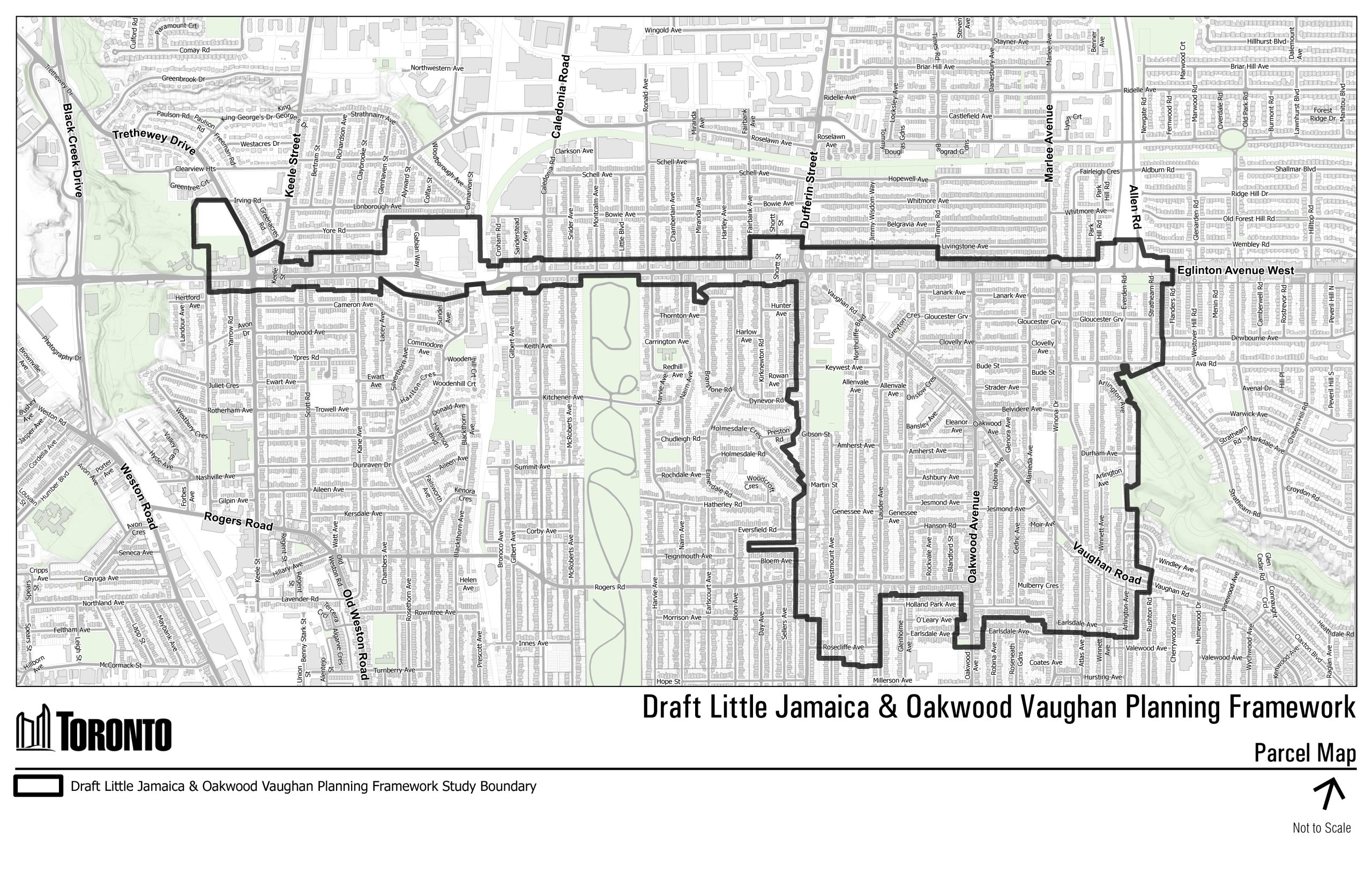
While the influence and impact of Little Jamaica spans well beyond the geographic boundary, the area of focus for the Little Jamaica and Oakwood Vaughan Planning Framework is proposed to be bounded by the properties on the north side of Eglinton Avenue West to the north, Keele Street to the west, Rogers Road to the south and Cedarvale Park to the east. The area includes the diverse neighbourhoods of Oakwood Village, Little Jamaica, Eglinton West, Cedarvale, Caledonia-Fairbank, Briar Hill-Belgravia, Beechborough-Greenbrook, and Keelesdale. These neighbourhoods have played an important role in bringing together different cultures to create a vibrant and inclusive community.
 While we aim to provide fully accessible content, there is no text alternative available for some of the content on this site. If you require alternate formats or need assistance understanding our maps, drawings, or any other content, please contact LJOV.Planning.Framework@toronto.ca
The Eglinton West corridor is a commercial main street that has been of great cultural heritage significance to the City of Toronto as a distinct ethnic and cultural hub for Caribbean and African immigrants for many decades. Commonly known as both “Little Jamaica” and “Eglinton”, the area is recognized for the clusters of Black-owned businesses of cultural relevance, including barber shops, restaurants specializing in Caribbean-cuisine, Black aesthetics and hair shops, recording studios, and music stores. The corridor plays an important role as a commercial and cultural destination for both local residents and visitors from other parts of the city and the surrounding Greater Toronto Area.
Oakwood Village is defined by its strong community identity and long-standing residential character. Situated just south of Eglinton West, this diverse neighbourhood is anchored by a vibrant commercial corridor that hosts a unique mix of independent businesses, community services, and cultural organizations. As a central hub for neighbourhood-scale activity, Oakwood Village plays a vital role in supporting the daily needs and social lives of its residents. It serves as an essential transition area between residential streets and busier commercial zones, woven deeply into the social and economic fabric of the broader community.
The Planning Framework is a non-statutory planning tool that responds to significant transit investment, development interest, and reflects community priorities. Although it is not a policy document, it will serve as a useful guide for the review of development applications and City-initiatives once finalized. The draft guiding principles for the Planning Framework include the following:
The draft Planning Framework has a number of directions:
Community priorities in the draft Planning Framework are based on what has been heard to date from diverse residents and businesses in the planning framework area. The priorities focus on fostering sustainable growth, enhancing resiliency, and addressing the diverse needs of the local population like the need for affordable retail, intergenerational and accessible spaces, affordable housing and space to grow culturally relevant food.
Retail within the planning framework area is defined by its small-scale community-oriented nature, serving as a cultural hub for the Caribbean and Black community, while gradually evolving to embrace and welcome a diverse range of cultures. Small-scale retail and the surrounding spaces not only facilitate businesses but also provide third spaces for community gathering and support to act as extensions of community services.
Business owners – from record and beauty supply stores to restaurants – often use their spaces for multiple purposes, including recording studios, rehearsal spaces and small live-music venues. The multipurpose nature of spaces along Eglinton Avenue West has created a network of third spaces for gathering and community building. The continued use of commercial spaces for multiple purposes maintains and strengthens the area’s role as a cultural hub.
As the area grows, it is essential to expand and improve public spaces through development – wider sidewalks, improved lighting, seating, landscaping, street trees, public open spaces and cultural squares – ensuring they are accessible, high-quality, and support both formal and informal interactions.
There are three key corridors within the planning framework area (Eglinton Avenue West, Oakwood Avenue, and Vaughan Road) that contribute to its vibrancy. Specific direction is needed for development along these streets to help ensure the spirit of the spaces are retained and sustained.
The draft Planning Framework identifies key areas with deep rooted ties to community, where the function and spirit of these spaces should be maintained and strengthened as the community grows and evolves. Four Focus Areas are identified in the draft Planning Framework: Vaughan Hub, Oakwood Vaughan Centre, Reggae Lane, and Dufferin and Eglinton Apartment Neighbourhoods.
Community and stakeholder engagement is paramount to the development process of the Little Jamaica and Oakwood Vaughan Planning Framework. Community consultation activities will take place from the second quarter to the end of the third quarter of 2026 and includes an interactive virtual mapping tool, in-person and virtual community consultation meetings, and targeted engagement activities with stakeholder groups. Community and stakeholder engagement will be coordinated with Heritage staff to inform both the Planning Framework and the Cultural Heritage Resource Assessment.
Stakeholder engagement is underway and includes residents, businesses, community organizations, agencies, and other interested stakeholders. Feedback received through questionnaires, written submissions, stakeholder discussions, and future Stakeholder Advisory Committee working sessions will help inform revisions to the draft Planning Framework before it is finalized and presented to Planning and Housing Committee. The engagement process is intended to gather feedback on the draft Planning Framework and support the development of the final Planning Framework.
Additional opportunities to participate in the engagement process, including public consultation activities and online engagement, will be posted here as they become available.
The Spring and Summer 2026 in-person and virtual community consultation activities for the Little Jamaica and Oakwood Vaughan Planning Framework have concluded. Thank you to everyone who participated and shared feedback. Staff received input through the Interactive Consultation Map, virtual community consultation meeting, in-person drop-in events, and emails. Your feedback has provided valuable insights on key topics such as neighbourhood boundaries, cultural identity, retail, housing, transportation, public realm, and parks and green spaces. Feedback received throughout the engagement process will be considered in refining the draft Planning Framework and summarized in the Final Report.