


The City of Toronto is committed to creating a barrier free city in compliance with the Accessibility for Ontarians with Disabilities Act (AODA). By meeting or exceeding the AODA design standards, the City is improving the accessibility and consistency of our streets and sidewalks. In addition, the City has an Accessibility Design Guidelines which are applied to all City infrastructure to ensure our City is safe and accessible for all users.
The Toronto Accessibility Design Guidelines (TADG) include best practices which can be used by all sectors to conduct accessibility audits and to plan for barrier-free development in the physical environment.
Based on the human rights principles of respect, dignity and inclusion, the Guidelines are a key component of the City’s Accessibility Plan.
The Accessibility Guidelines are the result of the collaborative effort among community and professional experts working with City staff and Members of Council.
By January 1, 2016 the City must comply with the Accessibility for Ontarians with Disabilities Act (AODA), under Part IV.1 of O.Reg 191/11 on the built environment for all newly constructed or redeveloped infrastructure.
As part of these requirements a number of accessibility improvements are being implemented across the City, including raised profile tactile walking surface indicators are being installed at the bottom edge of curb ramps and depressed curbs.
For further details please consult the AODA Design of Public Spaces Standards (Accessibility Standards for the Built Environment), Part IV.1 of Ontario Regulation 191/11.
Many storefronts in Toronto have one or more steps at the entrance, creating barriers for people using wheelchairs, walkers, strollers, or carts. To address this, City Council has adopted amendments to Toronto Municipal Code Chapter 743, to permit temporary ramps as encroachments within the public right-of-way. These amendments provide clarity on requirements for maintaining pedestrian clearways, cane detectability for persons with visual impairments, and responsibilities for safe ramp placement and maintenance.
Temporary ramp rules support businesses and property owners by explaining how ramps must be placed to improve accessibility while ensuring sidewalks remain safe and accessible for all users.
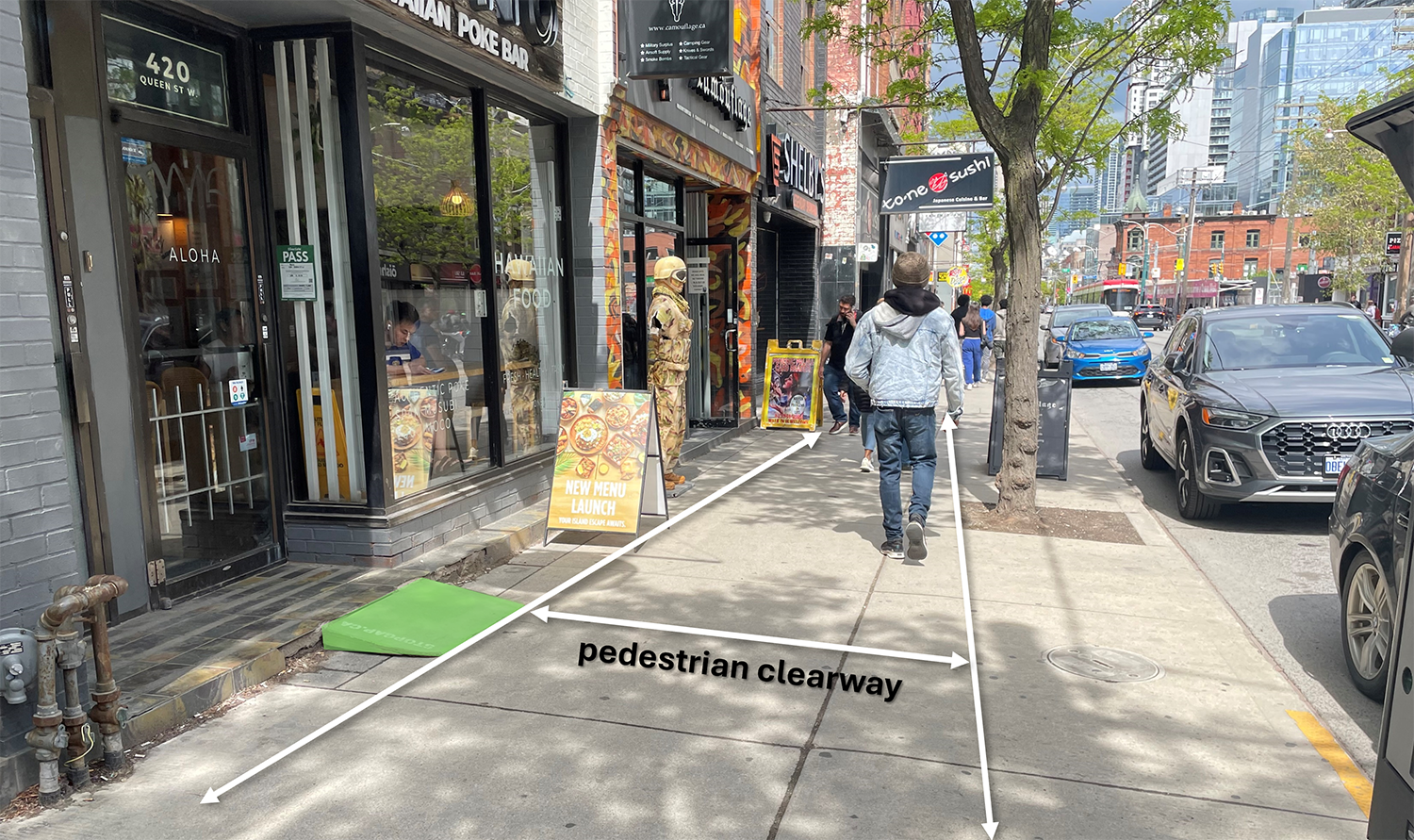
Recommended: Businesses should post a sign or other visible communication to let customers know how to request assistance. In many cases, users of wheeled mobility devices may need assistance to open the building door before ascending the ramp. An option is that the ramp is stored indoors and made available upon request.
Refer to Toronto Municipal Code Chapter 743 for full requirements. Non-compliance may result in fees and/or removal of the temporary ramp by city authorities at the owner’s cost.
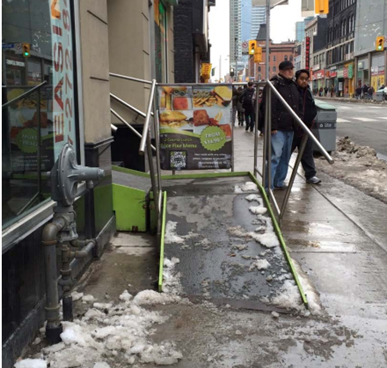
Example of a poorly maintained ramp, covered in snow and ice, with placement that blocks most of the sidewalk.
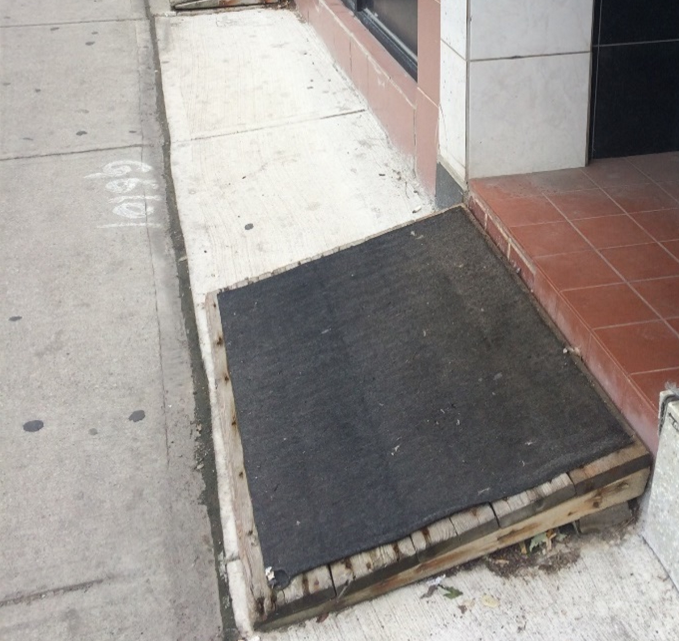
Example of an unstable ramp, misaligned with the step, with side gaps that create wayfinding challenges.
Learn more on tactile walking surface indicators, including their specifications and associated construction standards.
Learn more on Accessible Pedestrian Signals (APS), how they work and the current inventory of locations.