

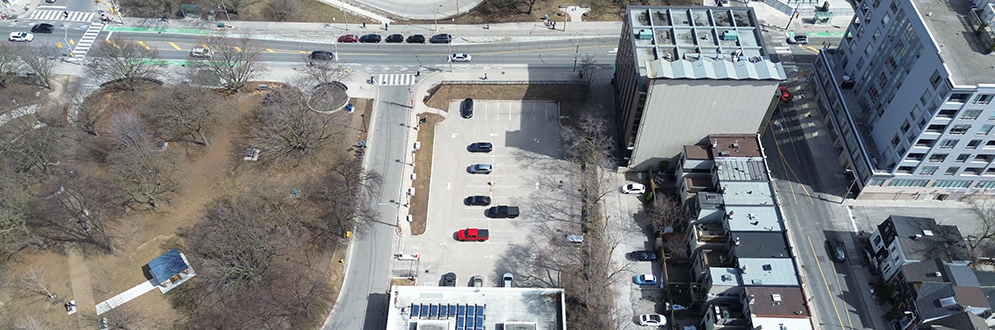
In September 2025, the City launched an international design competition inviting design teams from around the world to help shape the future of the new Ramsden Park Community Recreation Centre.
The new building will be accessible and net zero emissions, just steps away from Rosedale Subway Station. The facility will front Ramsden Park to the north and Budd Sugarman Park to the east and is proposed to include a 25-metre lane pool, a leisure pool, a gymnasium with a running track, and multi-use activity spaces.
The timeline is subject to change.
Sign up for or unsubscribe from updates related to Ramsden Park Community Recreation Centre.
This project has been classified as an Involve project based on the International Association for Public Participation Spectrum. This means we work directly with the public, stakeholders and rightsholders throughout the design process to ensure that ideas and aspirations are understood and considered.
This project has a Community Advisory Committee (CAC) made up of both representatives from key stakeholder groups and residents who represent the demographics of the overall community. The CAC’s mandate is to provide a forum for feedback, guidance and advice to the project team at key decision points during the community engagement process. The CAC will meet approximately one to two times per phase of the project. The CAC is not a decision-making body and does not speak on behalf of the entire community.
This project has an Indigenous Advisory Circle (IAC) made up of community members who identify as Indigenous to Canada (First Nations, Métis, Inuit). The IAC will provide insight, feedback, and guidance to the project team for the new Ramsden Park Community Recreation Centre, ensuring Indigenous perspectives are reflected in the design and engagement process. The IAC will meet approximately once per phase of the project, with members receiving an honorarium for their contributions.
In August 2025, the City launched a two-stage international design competition for a new Ramsden Park Community Recreation Centre.
The new Ramsden Park Community Recreation Centre will enrich Toronto’s civic life through innovative architecture and urban design, provide vital community amenities and reflect the city’s diversity and dynamism. The design competition is part of the City’s commitment to fostering design excellence and enhancing the public realm. Applicants are invited to imagine a vibrant, inclusive, and welcoming destination while advancing global best practices in design and sustainability.
In Stage One, applicants submitted their qualifications for consideration. In Stage Two, the five highest-rated applicants develop and present their designs. Feedback from experts and residents help a jury choose the winner.
Applicants could submit their qualifications for consideration until November 12, 2025.
In this stage, the City invited applications in response to the terms and conditions outlined in the RFSQ to determine their eligibility. Stage One RFSQ submissions are reviewed by an Evaluation Committee made up of City staff and an independent Professional Advisor.
The following five highest-rated design teams, each led by a Canadian architect, will advance to Stage Two:
In this stage, the five shortlisted design teams submit conceptual designs for the new community recreation centre in response to the RFP.
The shortlisted design teams are required to present their designs to a jury comprised of recognized design and architecture professionals, the City and the Community Advisory Committee. Designs are shared through the project website and a public exhibition for public feedback before the jury’s decision. Public feedback informs the jury’s decision to select the winner of the competition, and their decision is final.
The winning design team for the new Ramsden Park Community Recreation Centre is anticipated to be announced in fall 2026, following the public exhibition and jury deliberation.
In this phase, the City worked with the community, the Indigenous Advisory Circle and the Community Advisory Committee to define visions, and guiding principles for the new Community Recreation Centre (CRC). These will guide the development of design options in Community Engagement Phase 2.
The vision statements were co-created with the Indigenous Advisory Circle and the Community Advisory Committee to describe the ideal future community recreation centre. These visions are big-picture statements that should inspire everyone toward a common understanding of the project’s overall goals and objectives.
The new Ramsden Park Community Recreation Centre will be a safe, welcoming and inclusive gathering place rooted in Indigenous ways of knowing, being and relating. Informed by a Two-Eyed Seeing approach, it will honour the original peoples of this land while creating space for shared learning, understanding and connection across communities.
Guided by respect for land, water, fire and all our relations, the Centre will recognize the water flowing beneath the site and the surrounding park as sources of knowledge, ceremony and relationship. Indigenous languages, art, music and cultural expression will be meaningfully present throughout the space, supporting storytelling, reflection, creativity and connection to living traditions.
Through accessible and flexible spaces for gathering, recreation, learning and creativity, the Centre will nurture physical, emotional, mental and spiritual wellbeing grounded in intergenerational exchange, cultural continuity, Indigenous leadership and community responsibility.
The Ramsden Park Community Recreation Centre will serve as a living place where all can explore, learn, share, heal and thrive together – now and for future generations.
The new Ramsden Park Community Recreation Centre will be a vibrant, inclusive hub that brings people of all ages, abilities and backgrounds together to connect, create, play and thrive.
Through outstanding architecture and design, the centre will honour Ramsden Park’s unique identity, including its role as the source of Toronto’s distinctive yellow bricks, its ravine landscape, Indigenous heritage and the diverse communities that have shaped the neighbourhood. Art, storytelling and cultural expression woven throughout the building and park grounds will celebrate community memory, creativity and belonging.
Recreation, health and play will be at the heart of the centre. Children will enjoy both dedicated spaces and open play areas with novel equipment that sparks imagination, while people of all ages will have their needs met through mindful and inclusive design. Multipurpose spaces and informal “third spaces” will support affordable, year-round recreation, sports, fitness, cultural expression and lifelong learning, while quiet areas will offer calm and reflection.
The centre will be recognized for its leading-edge sustainable design, making extensive use of natural light and materials. Strong integration with Ramsden Park and surrounding green spaces, including gardens with Indigenous plants, will support environmental learning, seasonal use and community stewardship, while ensuring the building remains adaptable and resilient for generations. Together, these elements will create an iconic, park-integrated community home, a place where creativity, wellbeing and belonging can flourish for generations.
The guiding principles are high-level directions that reflect the community’s most important values and ideas for how the community recreation centre should look and feel. They help to clarify the vision statement and guide how the community recreation centre should be designed by describing the desired outcomes.
The City met with project advisory groups to provide an update on the design competition for the new community recreation centre and share how community input collected to date is helping shape the next phase of the project. These included virtual meetings with:
At each meeting, the project team reviewed the design competition process and highlighted how feedback gathered through engagement activities in Community Phase 1 has directly informed the vision statements, guiding principles and building program for the new community recreation centre. These will form a key part of the design brief provided to the five shortlisted design teams as they develop their proposals.
Participants were reminded that advisory groups will continue to play an important role throughout the design competition process. Later in 2026, both the Indigenous Advisory Circle and Community Advisory Committee will review the design submissions and provide feedback on how effectively each proposal reflects the project’s vision and guiding principles.
The project team reviewed the vision statements and guiding principles developed by both the Community Advisory Committee and Indigenous Advisory Circle. Members discussed the strong alignment between the two groups’ work, including shared themes of belonging, inclusion, wellness, cultural expression, connection to nature, community gathering and supporting future generations. The discussion also explored how a Two-Eyed Seeing approach can help bring together distinct yet complementary perspectives to inform the future design of the community recreation centre.
As part of the Two-Eyed Seeing approach, participants were introduced to research exploring the site’s geological and cultural history. Discussions highlighted the buried rivers beneath the site, the historic Davenport Trail, the ancient shoreline of Glacial Lake Iroquois and the site’s connections to Indigenous movement, settlement and storytelling. These insights will help inform how design teams think about the site’s identity and future.
The project team announced the five shortlisted design teams selected to participate in the Stage Two of the design competition. 21 submissions were received through the Request for Supplier Qualifications process, and five multidisciplinary teams were selected to advance.
The shortlisted teams will now develop conceptual design proposals that respond directly to the project’s vision statements, guiding principles, building program, technical requirements and design brief. A professional jury will review the submissions, informed by feedback from advisory groups, City staff, technical advisors and the public.
Participants asked questions and shared comments regarding:
Members expressed enthusiasm about the quality and diversity of the shortlisted teams and the opportunity to help evaluate design proposals later this year.
Stage Two of the design competition is now underway. The five shortlisted teams will prepare conceptual designs throughout summer and fall of 2026. Subsequently:
The project team thanked members of the Indigenous Advisory Circle and Community Advisory Committee for their ongoing contributions and commitment to helping shape the future community recreation centre.
On January 29, the Indigenous Advisory Circle met for the second time. This meeting focused on developing a vision for the new Community Recreation Centre and participants engaged in hands-on visioning exercises and discussions.
A meeting summary will be posted on this page.
On December 11, the Indigenous Advisory Circle met for the first time. Advisory members had a chance to introduce themselves, meet the project team, learn about the new community recreation centre and discuss how the group wants to work together and their visions for its future.
A meeting summary will be posted on this page.
On June 12, the Community Advisory Committee (CAC) held its first meeting in person at the Belmont House. The session included an orientation to review the Terms of Reference, to learn more about the project, their role and the community engagement process for the new CRC.
On June 23, the Community Advisory Committee met in person for the second time at the Belmont House. This meeting focused on developing a vision and guiding principles for the new Community Recreation Centre and participants engaged in hands-on visioning exercises and discussions.
Download the combined Community Advisory Committee meeting summary.
On June 16, 105 students in grades one and two, 53 students in grades three and four, 58 students in grades five and six and 99 students in grade at Jesse Ketchum Junior and Senior Public School participated in a workshop to share ideas for the new recreation centre.
Each session began with a short presentation and group discussion, followed by a hands-on activity where students decorated blank pennants to illustrate their vision for the new community recreation centre.
At the new community recreation centre, participants want to:
From May 30 to June 16, an online thought exchange activity gathered ideas for the new community recreation centre. The activity received a total of 135 thoughts and 2,600 thought ratings from 173 participants.
Review the June 2025 Thought Exchange activity results summary, including top thoughts and themes.
Feedback Summary
Respondents were asked what functions they would most like to see, which features and spaces should be prioritized, and what building aspects they feel are most important in creating a comfortable and welcoming community centre. Responses are shown in parentheses below.
Respondents ranked what functions they would most like to see in the recreation centre, with one being the highest and seven being the lowest:
Respondents ranked which aquatic features should be prioritized, with one being the highest and five being the lowest:
Respondents ranked which fitness and exercise spaces should be prioritized, with one being the highest and seven being the lowest:
Respondents ranked which indoor sports or physical activities should be prioritized, with one being the highest and six being the lowest:
Respondents ranked which arts and culture spaces should be prioritized, with one being the highest and five being the lowest:
Respondents ranked which community and social spaces should be prioritized, with one being the highest and five being the lowest:
Additional comments that were highly rated by participants included:
From March 25 to May 26, community members could apply to be part of the project’s Community Advisory Committee.
On March 24, a project kick-off event took place at Belmont House to share information about the design process and the engagement plan for the new Community Recreation Centre.
Download the March 2025 Kick-Off meeting presentation.
This phase will be separated into two parts, A and B. In Phase 2A, feedback will be collected from the community and the project advisory groups on the early draft design. In Phase 2B, feedback will be collected on refined draft designs based on input from Phase 2A. The feedback will be used to develop a preferred design for the Community Recreation Centre (CRC).
The community engagement activities anticipated in this phase include:
In this phase, the City will share the preferred design with the community and the project advisory groups. Once the preferred design is confirmed, the project will move into the detailed design phase, where the design team will finalize the preferred design by working through the technical details and plans for the construction contractor.
The anticipated outcomes of this phase include a refined preferred design.
The community engagement activities anticipated in this phase include:
The Ramsden Park Community Recreation Centre (CRC) was identified through the Parks and Recreation Facilities Plan Implementation Strategy and will offer a variety of year-round programs and services for Rosedale’s growing communities and surrounding area.
The CRC is proposed to include:
The CRC will meet Accessibility for Ontarians with Disability Act accessibility standards and target Net Zero emissions building design.