Skip to content City of Toronto
Registration for the spring cleanup on April 24 to 26 is now open.


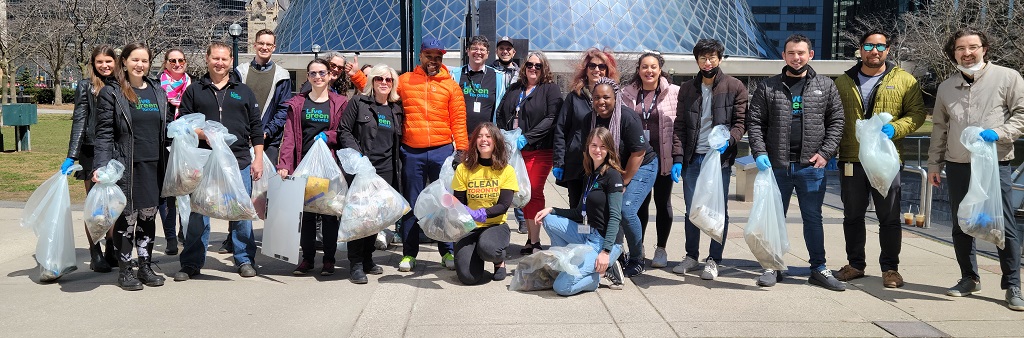
A big thank you to all the community groups, families, individuals, schools and businesses who participated in the spring cleanup from April 25 to 27, 2025. Over 700 self-directed cleanups were held across the city, including 400 in City parks. We look forward to seeing you again for the 2026 cleanup from April 24 to 26.

In April, community groups, families, individuals, businesses and schools in Toronto are invited to clean up litter in a local park or other public space.

Doing a self-directed cleanup is an easy yet impactful way to help keep our shared spaces beautiful, by picking up small plastics, cans, bottles and other harmful litter.

How to Organize a Cleanup

  1. Complete the online registration.
  2. Choose an approved cleanup location such as a park or beach.
  3. Pick a day that’s convenient for you: Friday, Saturday or Sunday.
  4. Determine a start time. Mornings are the best time to avoid crowds.
  5. Gather supplies for your cleanup, such as litter bags, gloves, trash grabbers (optional), hand sanitizer and water/snacks. The City will have bags and gloves available at select locations for pickup. More details will be provided by email prior to your cleanup event.
  6. City staff will contact you to confirm your cleanup location, provide you with relevant information and arrange for special litter collection, if required.

Important Information

  • Litter cleanups are a self-led activity.
  • City staff do not organize or attend cleanups.
  • City staff will not validate volunteer hours.
  • Supplies will be available for pickup at select locations.
  • Safety tips, litter sorting and other guidance will be provided to all registered participants.
  • There are no rain dates.
  • Registration is important so that the City can track areas cleaned, prevent double bookings and recognize the efforts of participants.

The registration form contains a list of approved park locations. For more guidance on selecting a park for your cleanup, refer to the Clean Toronto Together Pre-Approved City Parks Map.

Approved Locations

  • Beaches
  • Dog Off-Leash Areas
  • Parks
  • Playgrounds
  • Skateparks
  • Sports Fields
  • Trails

Locations Not Approved

  • Allotment Gardens
  • Areas of Natural and Scientific Interest (ANSI)
  • Community Gardens
  • Environmentally Significant Areas (ESA), including ravines and select parks
  • Golf Courses
  • Indoor Facilities
  • Naturalized and Restoration Spaces
  • Public Gardens
  • Private Properties
  • Parking Lots and Bike Lanes
  • Wading Pools and Splash Pads
  • Wetlands

Students can celebrate Earth Day by cleaning up their schoolyard or a neighbourhood park. All educational institutions in Toronto, including schools, colleges and universities are encouraged to join.

  • School groups are encouraged to register their cleanup so the City can provide resources, support and recognition.
  • School cleanups require the approval of your school principal or property manager.
  • City staff will provide you with relevant information for your cleanup, including where to collect supplies.
  • Wear appropriate clothing and protection (long pants, long sleeves, boots, gloves, rain jacket, hat, sunscreen and insect repellent). Learn how to avoid tick bites.
  • Bring a first aid kit; students should be accompanied by a person trained in first aid.
  • Be mindful of vehicles when near or adjacent to a road.
  • Do not work on unstable or slippery ground (ravines, river banks), in tunnels or near stormwater management ponds.
  • Only pick up litter. Leaves, twigs and plants should remain on the ground.
  • Avoid stepping on shrubs, bulbs and flowers.
  • Do not pick up or move heavy objects such as tree limbs.
  • Do not pick up animal waste.
  • Do not pick up needles or other dangerous items (e.g. syringes, metal, chemicals, medical waste). Report the location of these items to 311.
  • Hazardous waste such as batteries, aerosol containers, lights and light bulbs, fluorescent tubes, helium and propane tanks/cylinders should be set aside from recycling and litter and disposed of at a City Drop-Off Depot or Community Environment Day.
  • Report suspicious items to Toronto Police Service via their non-emergency telephone number at 416-808-2222.

Collecting Litter

    Household Hazardous Waste

    • Keep hazardous waste separate from garbage and recycling. Hazardous waste includes batteries, aerosol containers, lights and light bulbs, fluorescent tubes, helium and propane tanks/cylinders.
    • Do not pick up needles or other dangerous articles (e.g. syringes, metal, chemicals, medical waste). Report the location of these items to 311.
    • School cleanup leaders should report needles or other dangerous articles to their school caretaker.

    In 2004, Toronto launched an ambitious plan to enhance the city’s cleanliness and beauty. As part of the Clean and Beautiful City initiative, the 20-Minute Makeover was introduced, encouraging both public and private sector involvement in litter removal from our public spaces. In April 2004, the inaugural 20-Minute Toronto Makeover was held, attracting more than 44,000 participants.

    Since its inaugural event, the 20-Minute Makeover has been championed by successive Mayors and implemented under various names, including Clean Toronto Together. Toronto’s cleanup initiative has grown to become the largest annual litter cleanup in Canada and includes the support of a wide range of participants, from residents and students to businesses and City staff, all working together to keep Toronto’s public spaces litter-free.

    The City of Toronto is exploring the possibility of extending Clean Toronto Together from May to October to meet popular demand. More details will be provided soon.

    Clean Toronto Together – Photo Gallery