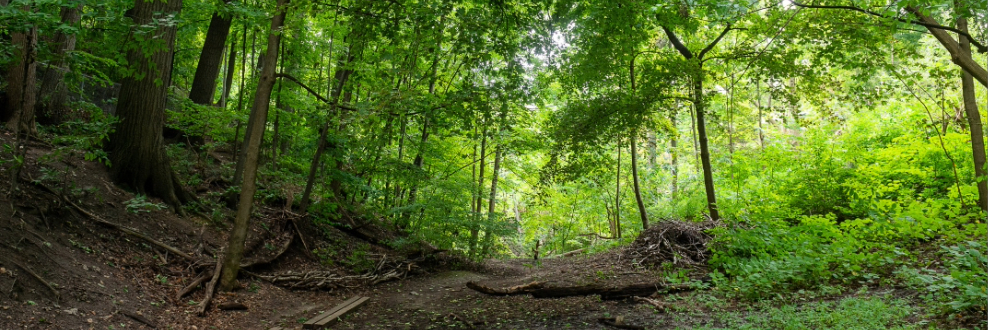
Toronto has many
natural areas including ravines, woodlands, and the shoreline of glacial Lake Iroquois, on both private and public land. Working in co-operation
with agencies such as the Toronto Region Conservation Authority,
we enforce protection by-laws and limit development proposals
in and adjacent to ravine and natural feature areas. We also initiate projects, and
work with community groups to restore native species and forest
cover to areas currently denuded. For more information on ravine
areas please call 311.
Did you know that
Toronto's landscape was created 10,000 years ago when the last glaciers
receded? Over the past 200 years, urban development has contributed
to many changes in our natural landscape. In some cases, natural
valleys were filled and streams were altered or buried. Fortunately,
a number of our natural areas have escaped these dramatic changes.
Some of the trees
in Toronto's natural areas are now more than 150 years old. They survived
the urbanization of Toronto, and are part of our living history.
Our urban forest adds beauty to the landscape. It's also a welcome
refuge from the hustle and bustle that's part of life in a city.
Trees also add new life to the forest ecosystem by anchoring soils
on fragile sites, shading young plants at their base, and providing
a wide range of habitat for birds and other wildlife.
Ravines
and woodlands are highly sensitive areas. They are storehouses of water and vegetation.
When the topography, water flow or the natural plant community is
altered in any way, the ecology and function of the natural feature are also
affected. This, in turn, impacts on forest health, water quality,
flood control, wildlife habitat and natural linkages.
Certain human
actions can result in problems to ravines and slopes. A change to the natural topography, the removal of vegetation, or the
disposal of run-off water from swimming pools or eavestroughs down the slope can cause erosion. This results in the loss of valuable
topsoil that is needed to sustain and anchor plant communities.
Severe erosion can also result from the damage done to vegetation
and soil when people ride mountain bikes off designated trails.
As well, introduced invasive tree and shrub species can alter plant
ecosystems.
If you have never
done so, we encourage you to explore one of the natural areas in your
neighbourhood. Discover the natural beauty of the deep, tree-lined
valleys, and the cool running streams. If you are drawn by the desire
to help protect these places from encroaching urban communities,
please get involved in a local stewardship group.
Invasive Species:
The natural plant communities
in Toronto's ravines and woodlands have developed over thousands
of years. A fragile interelationship exists between the various
plant communities. Invasive species can be introduced when compost
and leaves are dumped into the ravine, and when invasive plants
are planted close to ravines allowing the plants to spread or seed
into the ravines.
Invasive species
often look quite similar to their native counterparts, however they
differ in their ability to regenerate and their effect on other
plants and organisms within the forest. For example, native
oak trees allow more light to reach ground level than Norway maples.
This results in a brighter forest environment with a greater number
of plant species. Some invasive plants, such as Manitoba or
Norway maple, easily out-compete other vegetation and will dominate
a site if they are not controlled. Unfortunately, where this occurs, soil erosion and slope failure are almost certain to follow.
The City initiates
programs to control invasive species in our ravines and woodlands
in order to retain the more biodiverse native plant communities.
High Park is a
good example of a unique ecosystem that would be lost if introduced
invasive plants were left to colonize the natural areas of the park.
Invasive plants are being controlled in the park and
methods are being used to restore the parks natural plant communities.
A native plant
guide has been developed by the City for people who want to use
native woody and herbaceous plants in their yards. The use of native
plants is especially important where yards are directly adjacent
to natural areas.
The City of Toronto
Ravine and Natural Feature Protection By-law provides for better management of public and
private natural areas within the City.
In the areas protected by the by-law you may not, without a permit:
- injury or destroy
any tree;
- change the
natural land topography, by excavation or adding soil or other
materials on slopes;
- dump or place
any type of debris including garden waste, leaves and branches;
- construct new
or replacement structures or retaining walls.
Contact Information

Click for larger image
For more information about the specific regulations affecting your address in Toronto, you may contact a City of Toronto Forestry planner.
North York |
416-392-0585 |
North of Lawrence between Keele Street and Victoria Park |
Toronto and East York |
416-392-1900 |
South of Lawrence between Keele Street and Victoria Park |
Etobicoke / York |
416-392-7815 |
West of Keele Street and Parkside Drive |
Scarborough |
416-392-1377 |
East of Victoria Park Avenue |
Related
Information
Ravine
and Natural Feature Protection By-law Information
Pesticides
Link: Pesticide
By-law
Forestry
Facts & Native Plant Lists
Invasive
Species Management
Sustaining
Biodiversity - A Strategic Plan for Managing Invasive Plants
in Southern Ontario
Ravine and Park Information