From the week of April 6 to late June 2026, the playground will be closed for construction. Visit the Playground Improvements section for more information.


The City is improving the playground and adding a skate spot in Woburn Park – Scarborough. The playground improvements are part of an ongoing program to enhance playgrounds and play spaces across the city. The skate spot is part of the Skateboard Strategy, aimed at serving local youth skateboarders, particularly those at the beginner and intermediate levels. The skate spot will include select features such as ledges and railings, strategically placed to provide an introductory yet engaging skateboarding experience.

Timelines are subject to change.

Playground

  • February 2025: Community engagement (online survey)
  • March to July 2025: Detailed design
  • August to September 2025: Hire a construction team
  • Spring 2026: Construction starts, playground closes
  • Summer 2026: Construction complete, playground reopens

Skate Spot

  • Spring to Summer 2025: Hire a design team
  • Fall 2025 to Spring 2026: Design development and community engagement (online survey)
  • Spring to Summer 2026: Detailed design
  • Fall to Winter 2026: Hire a construction team
  • Spring 2027: Construction starts
  • Summer 2027: Construction complete, skate spot opens

Sign Up for Updates

Sign Up Now

Sign up for or unsubscribe from updates related to Woburn Park Playground Improvements and New Skate Spot.

This section provides updates on the playground improvements, including community engagement activities, what we heard and how it is shaping the design.

April 2026

Construction Update

Construction for the new playground starts and is anticipated to continue until late June 2026.

The nearest playgrounds are located at Heather Heights Woods, Meadowglen Place Park and Confederation Park.

October 2025

Final Layout Plan

The final layout plan for the new Woburn Park playground, which has been relocated to the east of the splash pad and will include the features in the first list following the image.

The new Woburn Park Playground is located to the east of the existing splash pad. The following features will be included in the new playground and surrounding area:

  1. accessible walkway
  2. bench on concrete surfacing
  3. concrete ramp into play area
  4. accessible playground with engineered wood fiber safety surfacing and concrete curb
  5. armourstone seat wall and retaining wall
  6. graded slope

Final Playground Design

The final design for the new Woburn Park playground, which has been refined based on community feedback. It will be bright colours, like yellow, orange and purple and will include the play features in the first list following the image.

The final playground design and layout were determined using feedback from the community. The new playground will be Accessibility for Ontarians with Disabilities Act (AODA) compliant and will include the following play features:

  • A swing set with:
    • three belt swings
    • two toddler swings
    • one accessible swing
  • A junior play structure for ages two to five with:
    • one double slide
    • two climbing options
    • one step pod
    • one climbing sculpture
    • two play panels
  • A senior play structure for ages five to 12 with:
    • one covered curved slide
    • one curved slide
    • three climbing options
    • three overhead climbing options
    • one sliding pole
    • one bridge
    • one tunnel
    • five seats
    • two step pods
    • five play panels
  • one seesaw
  • one spring toy
  • one group spinner

The new playground will also include an accessible walkway connecting the playground to the main walkway, a concrete ramp into the play area, an accessible bench, and an armourstone retaining and seat wall.

February 2025

Online Survey

From February 10 to February 23, feedback on multiple playground design options was collected in an online survey. The survey was promoted through paid social media ads, outreach to nearby schools, the local Councillor’s office, on-site signage and on this page. The survey received a total of 340 responses.

The design team will use this feedback to refine the final playground design.

Key Feedback Highlights
  • When asked to rank their playground design preference, respondents ranked Playground Design C highest (36 per cent) followed by Playground Design A (32 per cent) and Playground Design B (32 per cent).
  • Respondents shared that the three most important features to include in the new playground are:
    • Senior play structure for ages five to 12
    • Climbing structures
    • Belt swings
  • Respondents shared that the three least important features to include in the new playground are:
    • Play panels
    • Stand-alone toys (e.g. imaginative play vehicle, play house, sensory sculptures, etc.)
    • Straight slide
  • If budget permits, the three features respondents would like more of in the improved playground are:
    • Climbing structures
    • Senior play structure for ages five to 12
    • Motion toys (e.g. standing or sitting spinners, spring toys, teeter totters, etc.)
  • For seating around the playground:
    • 27 per cent of respondents like seatwalls
    • 71 per cent of respondents like benches
    • 71 per cent of respondents like picnic tables
  • The preferred colour scheme for the new playground was bright colours, like yellow, orange and purple (48 per cent) over earthy colours like green, brown and grey (36 per cent) and no preference (16 per cent).
Playground Options

All three designs are AODA compliant, have the same amount of play features and cost the same amount.
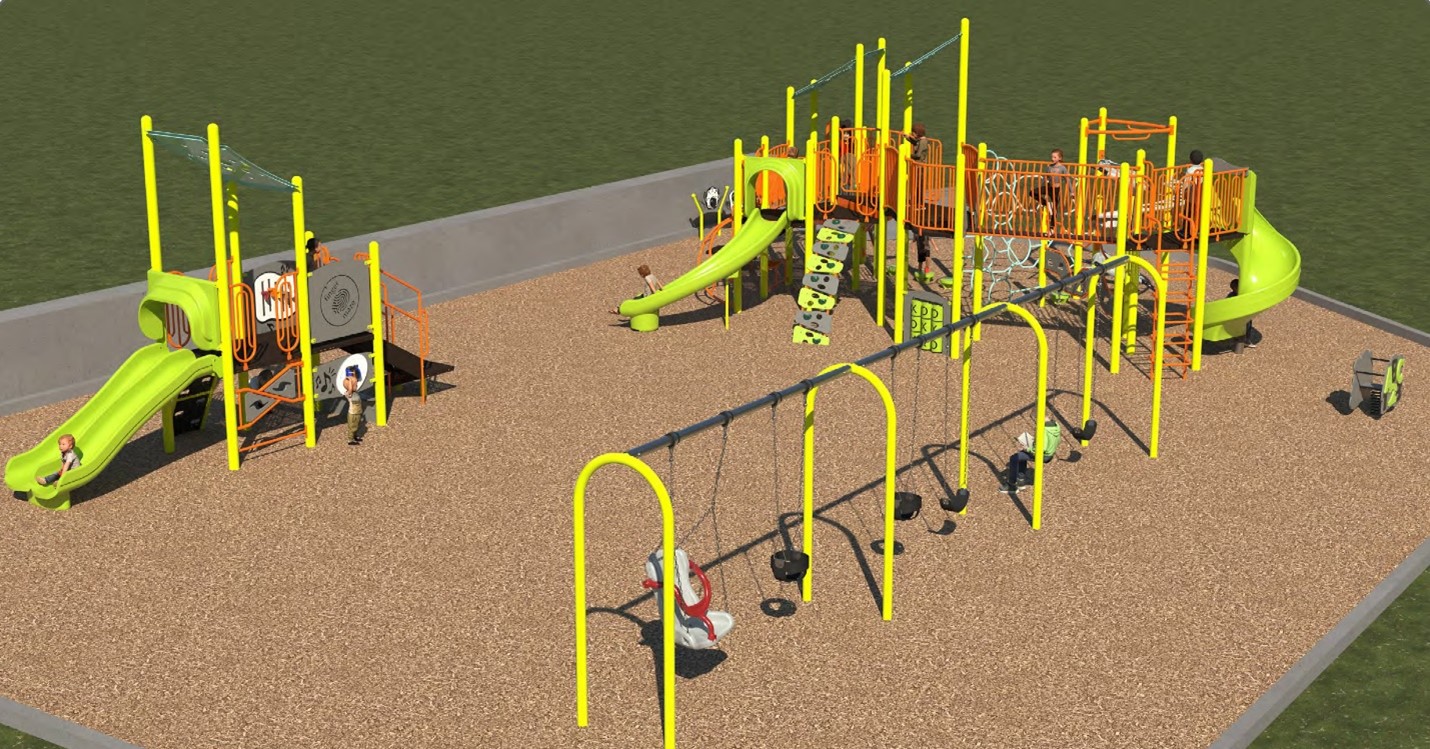
Playground Design A

Aerial view of Playground Option A looking south-west. From bottom left to upper right: swings, spring toy, junior play structure, music panels, and senior structure.

Design A includes:

  • A swing set with:
    • Three belt swings
    • Two toddler swings
    • One accessible swing
  • A junior play structure for ages two to five with:
    • One double slide
    • Three climbing options
    • Four play panels
  • A senior play structure for ages five to 12 with:
    • One curved slide
    • One spiral slide
    • Eight climbing options
    • One overhead climbing option
    • One bridge
    • Four step pods
    • Four play panels
  • One spring toy
  • Three musical panels
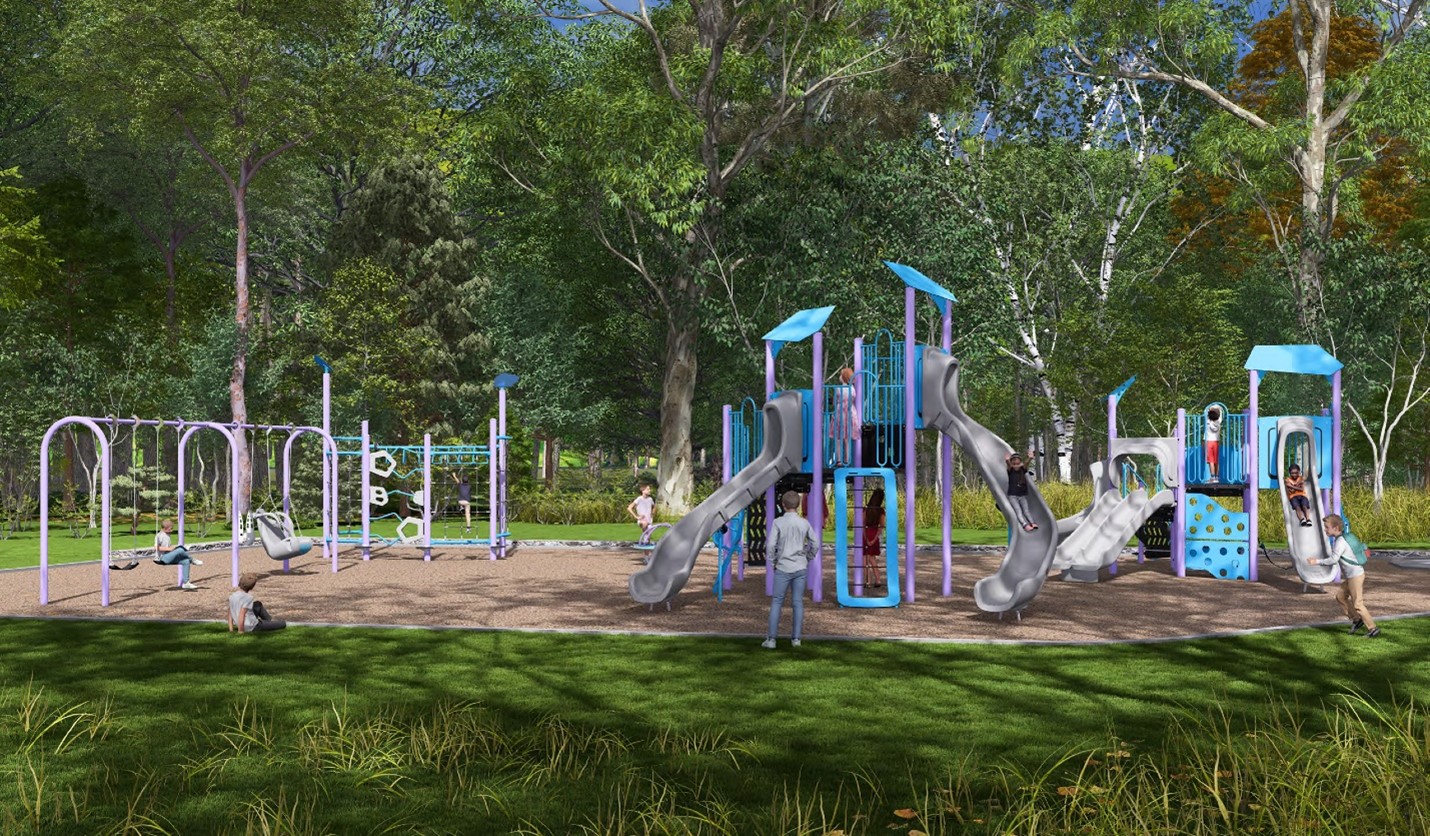
Playground Design B

Ground level view of Playground Option B looking south-east. From left to right: swings, climbing course, group spinner, spring toy, senior play structure, and junior play structure.

Design B includes:

  • A swing set with:
    • Two belt swings
    • One toddler swing
    • One accessible swing
  • A junior play structure for ages two to five with:
    • One straight slide
    • One curved slide
    • One double slide
    • Five climbing options
    • One hammock
    • Three play panels
  • A senior play structure for ages five to 12 with:
    • Two curved slides
    • Three climbing options
    • Three play panels
  • One group spinner
  • One spring toy
  • One climbing obstacle course with:
    • Four climbing options
    • One overhead climbing option
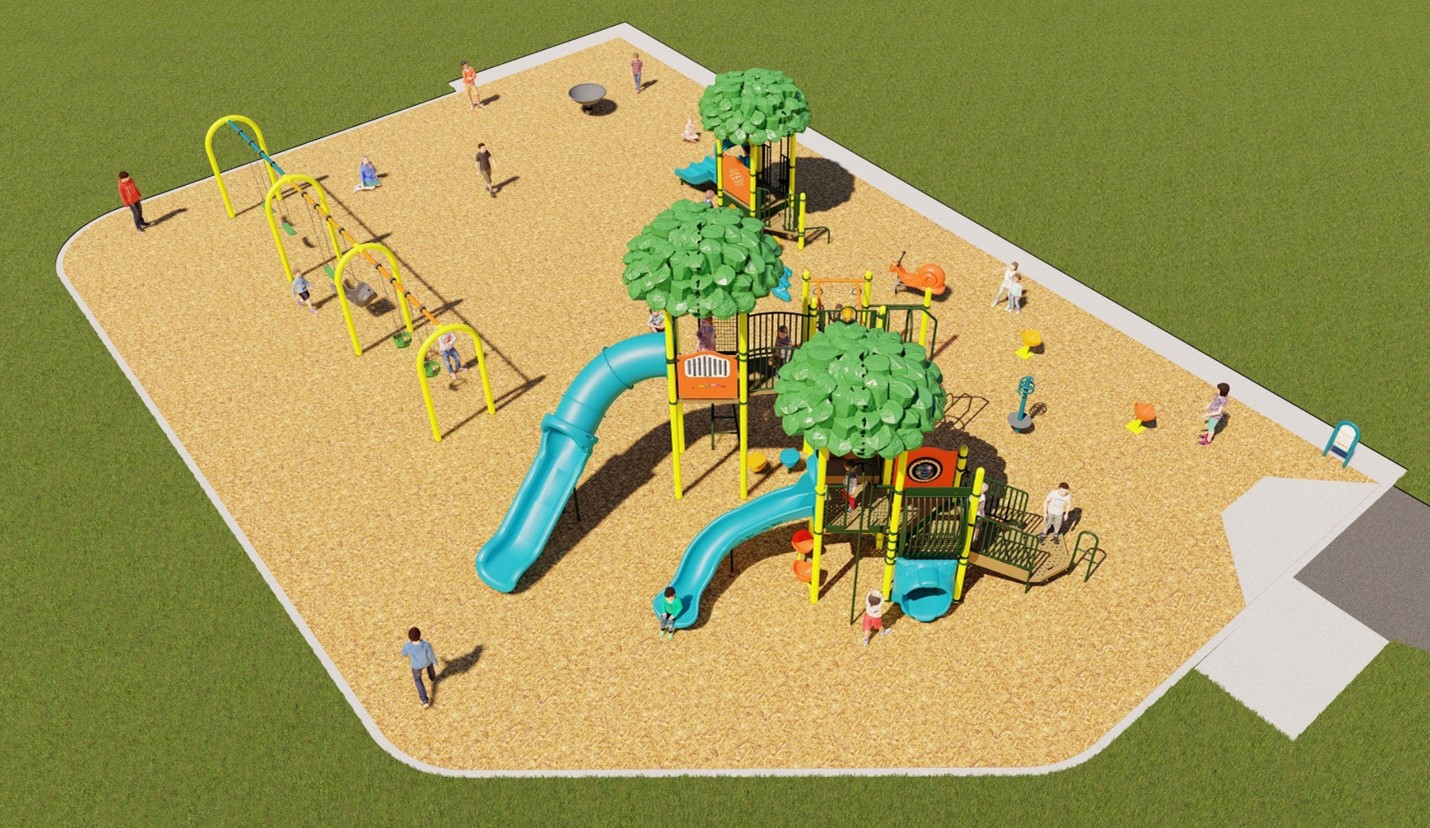
Playground Design C

Aerial view of Playground Option C looking south-east. From bottom left to upper right: senior play structure, three spinners, one spring toy, swings, junior play structure, and group spinner.

Design C includes:

  • A swing set with:
    • Three belt swings
    • Two toddler swings
    • One accessible swing
  • A junior play structure for ages two to five with:
    • One double slide
    • Two climbing options
    • One step pod
    • One climbing sculpture
    • Two play panels
  • A senior play structure for ages five to 12 with:
    • One covered curved slide
    • One curved slide
    • Three climbing options
    • Three overhead climbing options
    • One sliding pole
    • One bridge
    • One tunnel
    • Five seats
    • Two step pods
    • Five play panels
  • Two sitting spinners
  • One standing spinner
  • One spring toy
  • One group spinner

This section provides updates on the new skate spot, including community engagement activities, what we heard and how it is shaping the design.

April 2026

Online Survey

From April 1 to April 15, an online survey gathered feedback from 189 respondents on the design options and features for the new skate spot.

  • 47 per cent of respondents identified as skateboarders
  • 23 per cent identified as parents or caregivers of skateboarders
  • 15 per cent participate in other roller sports (e.g. roller skating/blading, biking, scootering)
  • 11 per cent want to learn to skateboard
  • 32 per cent of respondents do not skateboard

Respondents could select multiple categories, so total exceeds 100 per cent.

Overall, 58 per cent were satisfied with the two proposed design options, 17 per cent were neutral and 25 per cent were dissatisfied. A small minority (less than one per cent of all survey respondents) expressed opposition to the skate spot in comments.

46 per cent of respondents preferred Design Option 1, 39 per cent preferred Design Option 2 and 15 per cent liked neither of the design options.

Design Option 1: Linear Plaza

This design is inspired by the pedestrian path entering the park and the high visibility to Dormington Drive. This design offers user-friendly and approachable obstacles such as ledges, 2-tiered manual pads, and a gap ledge. The skate spot is primarily geared toward skateboards, but can also be used with bikes, scooters, and rollerskates. This simple yet fun set-up establishes two primary travel lanes, allowing beginners the space to learn, intermediate skaters the option of linking up tricks in a “line,” while more advanced skaters will be able to move through the space continuously. The pyramid hip is the only transitional feature in the space, creating a fun moment and a unique surprise in the space.
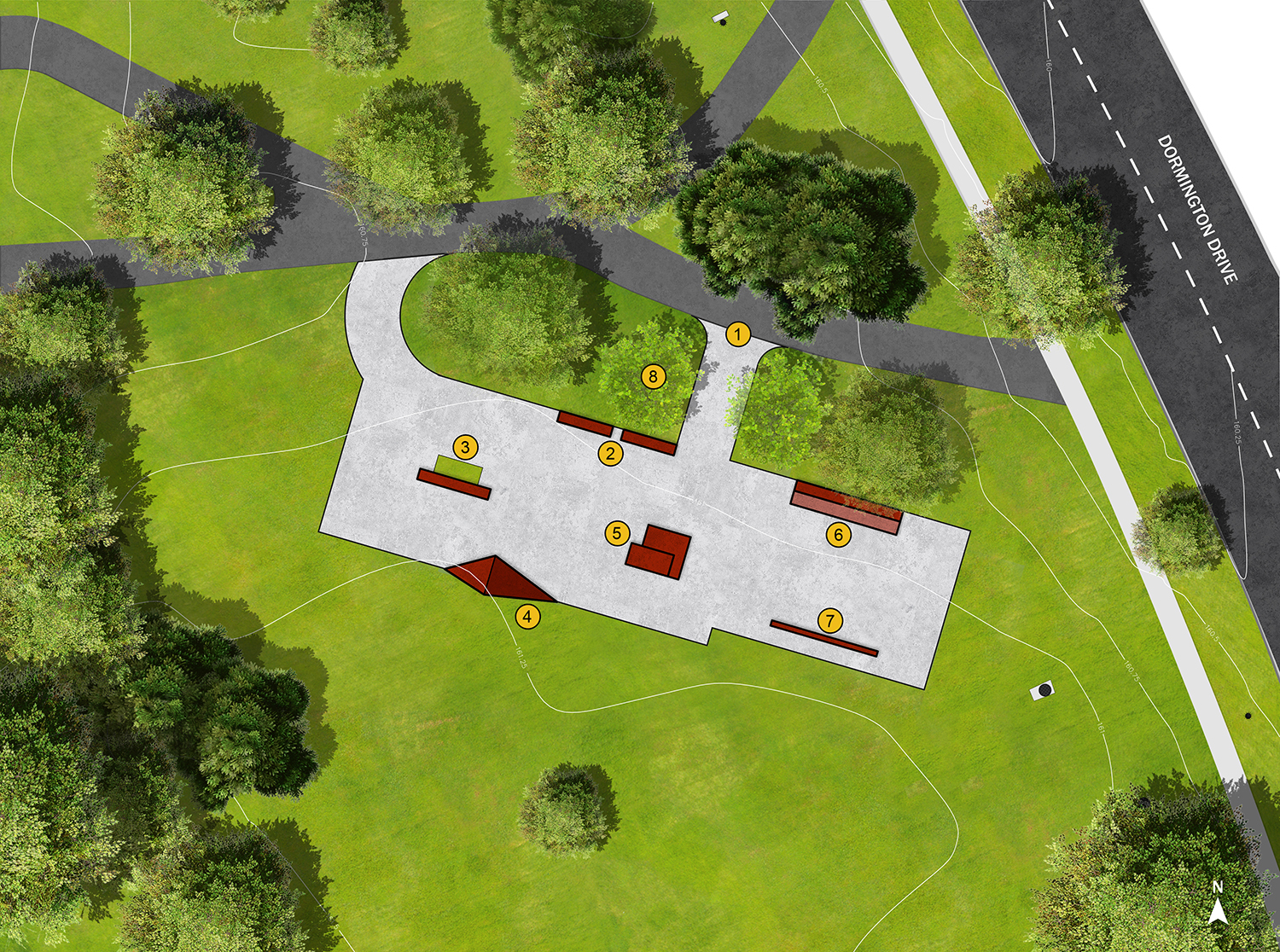
Site plan for Option 1 with rectangular shape and linear flow

  1. Walkway connection
  2. Straight ledge (doubles as seating)
  3. Gap with straight ledge
  4. Pyramid hip bank
  5. Two-Tiered manual pad
  6. Bank to ledge
  7. Slappy curb
  8. Proposed tree planting

Design Option 2

This design is a transition-inspired skate spot made for continuous flow. The skate spot is set further back into Woburn Park and nestled within the existing park canopy, providing a fun, surprising, and inviting space for users. Accentuated by the long ¼ bank with china bank ledge and the central volcano roller, this design has no defined way to experience it and welcomes any interpretation from beginner to advanced riders. Those on bikes and skateboards will equally enjoy this space for its variety, openness, and approachability. Keeping the street‑style elements—such as the ledges and the pyramid hip along the edges of the space—was an intentional choice to ensure the sightlines and travel lanes are open and focused on the ¼ bank.
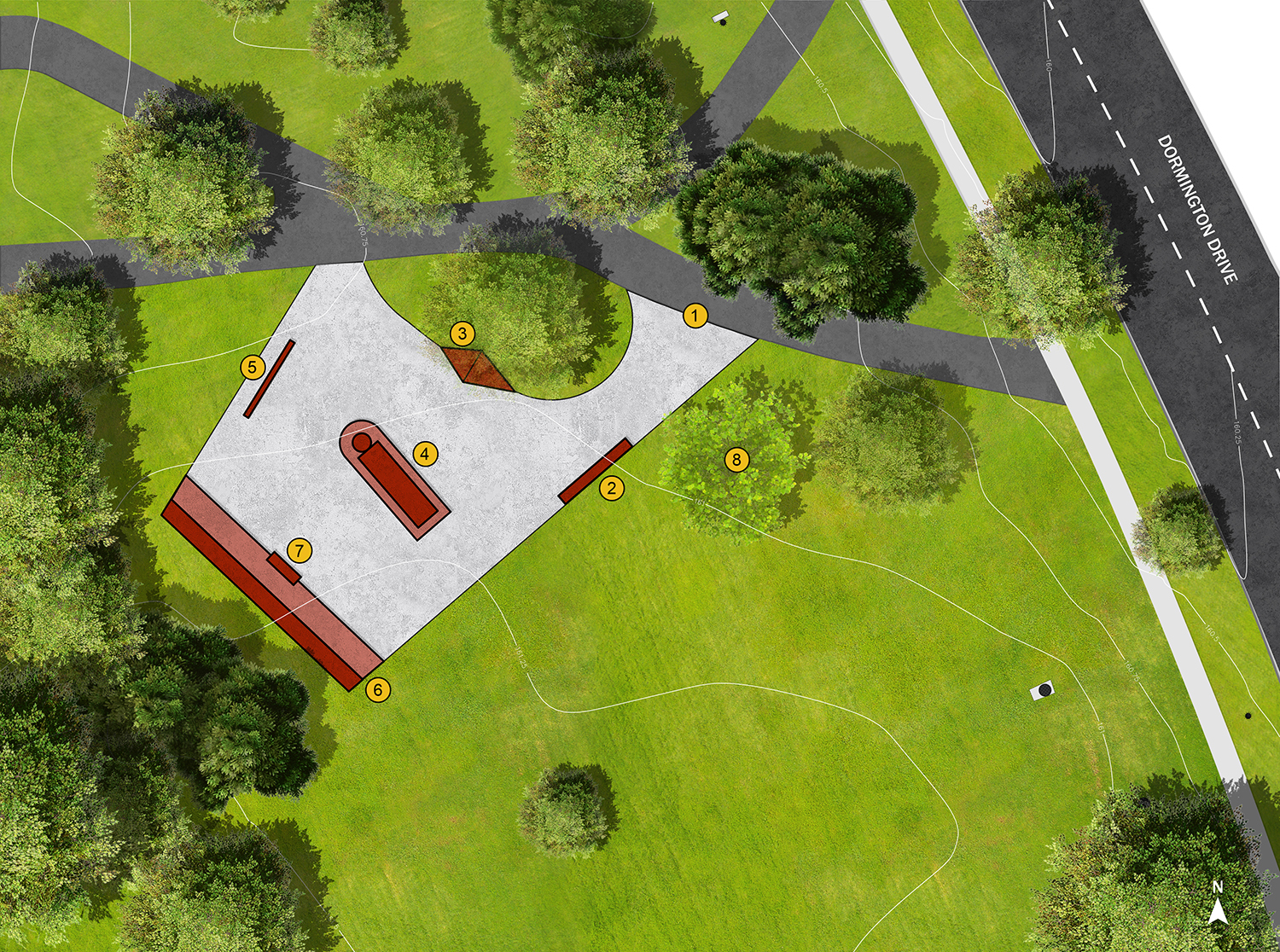
Site plan for Option 2 with square shape and circular flow

  1. Walkway connection
  2. Straight ledge (doubles as seating)
  3. Pyramid hip bank
  4. Volcano with box
  5. Slappy curb
  6. Flat bank
  7. China bank
  8. Proposed tree planting

The top five preferred features were:

  • Flat bank (14 per cent)
  • China bank (14 per cent)
  • Pyramid hip bank (12 per cent)
  • Two-tiered manual pad (12 per cent)
  • Volcano with box (12 per cent)

58 people (31 per cent of all survey respondents) contributed additional ideas for other features, if budget permits. The most common suggestions were for ramps, with quarter pipe as the most popular. Rails were the second most common suggestion. Multiple respondents commented about ensuring that features allow for flow and transition, and for beginner-friendly usage.

When asked how the flat open area and skate features should be organized, the top specific response was that the flat open area should be on one side of the skate spot with the skate features on the other side. 23 respondents (19 per cent) shared additional feedback about this topic, with the most common response being that flow terrain is more useful for a skate spot.

36 people (19 per cent of all respondents) shared additional general comments. Common feedback included:

  • Allow for riding progression, especially for beginners
  • Include features that allow for flow and transition (several suggested pump track, which would also allow for other roller sport use)
  • Include proper seating
  • Listen to skateboarders and use skateboarding experts to build the skate spot

The playground and skate spot will be designed using community feedback.

Playground

The playground is located at the northeast area of the park and includes:

  • two swing sets with:
    • four swings for ages two to five
    • four swings for ages five and up
  • a combined junior and senior play structure with:
    • a small sized double slide
    • a medium sized straight slide
    • a large curved slide
    • one bridge
    • five climbing options
    • three overhead climbing options
    • one balance option
    • two play panels
  • one teeter totter
  • two spring toys
  • sand under all play areas

The redesigned playground is proposed to include:

  • playground equipment for ages five to 12
  • improved seating
  • engineered wood fibre surfacing

The play equipment and pathway connecting to the playground area will comply with the AODA. Learn more about how playgrounds are made accessible.

Skate Spot

The Skateboard Strategy provides tools and recommendations for the Parks and Recreation Facilities Master Plan to help guide future investments in skateboarding infrastructure across the city.

A skate spot is less than 600 m2, services local users within walking distance and is suited for all skill levels, with a focus on beginner and intermediate users. West Lodge Park and Smithfield Park are examples of parks that have a skate spot.

The location of the skate spot in Woburn Park is to be determined.

Date modified: June 17, 2026