

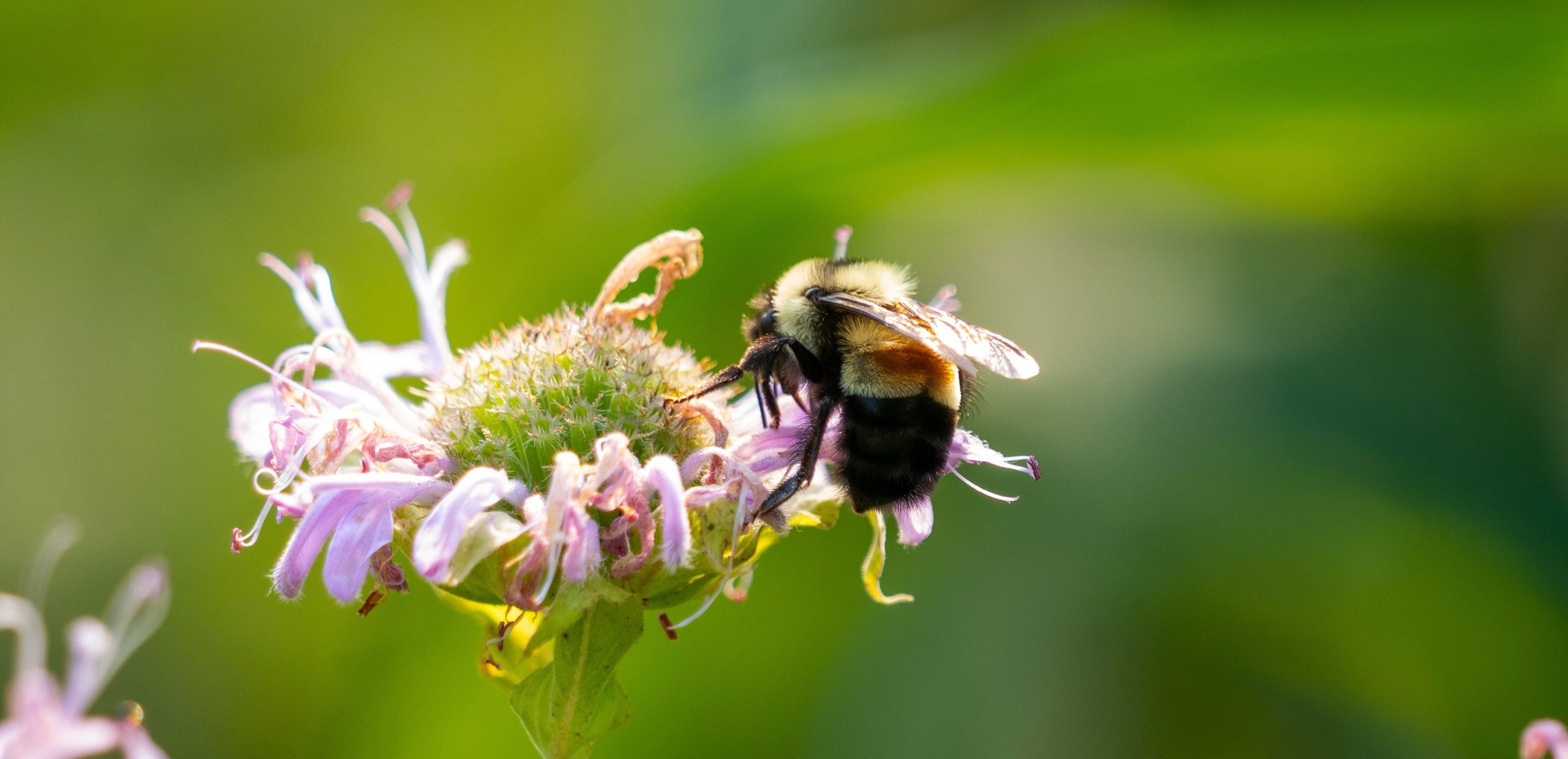
Toronto is home to over 360 species of bees. Learn more about what you can do to help native bees and other pollinators.
Pollinators, especially bees, provide the important ecosystem service of pollination, which allows plants to produce seeds, fruits, and new plants. This is essential for food production and creating our natural landscapes. Pollinators also support other wildlife – for example, butterfly larva (caterpillars) are a critical source of food for birds.
Pollinators contribute to the biodiversity in our city and hold intrinsic value as wildlife species with unique natural histories.
Helping pollinators is also a climate action. Pollinators support healthy and resilient ecosystems that clean the air and sequester carbon, which helps to reduce climate change, stabilize soils and absorb storm water.
Pollination occurs when a pollen grain moves from the anther (male part) of a flower to the stigma (female part). This allows plants to reproduce. The majority of flowering plants require help with pollination, which means they need pollinators, like bees, to move pollen for them.
Bees are the most efficient pollinators because they visit flowers to drink nectar or feed on pollen, and the hairs on their bodies transport pollen grains as they move from flower to flower. Toronto is home to a wide range of pollinators, including 364 species of bees and 112 species of butterflies.
Pollinators are under increasing stress due to:
Studies have shown that some species are in drastic decline, including the endangered Monarch butterfly and several species of bumblebees including the Rusty-patched bumblebee.
Pollinators are vulnerable to the negative consequences of climate change.
Biodiversity is a key component of helping ecosystems adapt to climate change. Healthy and diverse ecosystems are more climate-resilient. Abundant, well-connected and functioning habitat provides assurance for the future wellbeing of species and ecosystems. This is highlighted in the City’s Toronto Biodiversity Strategy.
Native pollinator gardens:
You’ve heard about the pollinator crisis and that bees are in trouble, and you want to do something to help. Interest in backyard beekeeping is growing, but is it the right thing to do? Keeping honey bees doesn’t help to save wild bees, much like keeping backyard hens doesn’t save wild birds.
Both native bees and honey bees are threatened by habitat loss, invasive species, diseases, pesticides, climate change and extreme weather. However, there are differences between native wild bees and European honey bees.
| Native Bees | Honey Bees |
|---|---|
| Native bees are the most specialized and efficient pollinators. It is through pollination that plants produce seeds, fruits and new plants. | Honey bees are a non-native species, introduced from Europe, used in agriculture to pollinate crops and managed, as livestock, by beekeepers to produce honey. |
| Some species of native bees are in drastic decline. | Honey bees are dying in large numbers but they are not an endangered species. |
| When native bees disappear, they disappear forever. | When a honey bee colony dies, more honey bees can be purchased and new colonies started. |
| More than 360 species exist in Toronto, over 600 in Ontario and over 800 across Canada. | A single monoculture species, Apis mellifera, is commonly farmed in Canada. |
| Once lost, they cannot be replaced | When a colony dies, bees can be purchased to start a new colony. |
| Wild. | Managed by humans. |
| Some species are endangered. | Not endangered. |
| Primarily solitary. | Social, live in colonies. |
| Nest in the ground or in cavities. | Live in hives. |
| Do not produce honey as they are dormant in winter. | Produce honey for overwintering. |
| Wide range of colours, including green, blue, red and purple. | Black and yellow. |
| Most species don’t sting. | Sting. |
| Have evolutionary, dependent relationships with native plants. | Have no evolutionary, dependent relationships with native plants. |
If you thinking of buying honey bees, here are some questions to ask yourself first from Pollination Guelph.
The easiest and most effective way to help native pollinators is to plant native plants. By planting native plants, you will be providing habitat that native bees need to survive. Native plants provide pollen and nectar which they use to feed themselves and their larvae, as well as places to nest and overwinter.
Explore the native plants, trees and shrubs interactive database to find species suited to your site and create a custom plant list.
You can create pollinator habitat in your yard, on your balcony, at your condo or apartment building, at your office, school, faith centre, community garden—everywhere.
An ideal pollinator garden will include the following:
Here are some tips to help you create a new pollinator garden or transform your existing garden to be more pollinator-friendly. The plants you choose and how you maintain your garden are important considerations.
Pollinator habitat includes the following:
Ideal pollinator habitat features native plants that are locally-grown and pesticide-free. Pollinator habitat can be created almost anywhere: in parks, yards, apartment buildings, schools, faith centres, community gardens and more.
Did you know that fallen leaves, dead stems and branches provide essential habitat for pollinating insects to overwinter?
Most native butterflies and moths do not migrate in the fall, but instead use the cover of leaves to overwinter until spring. Bumblebees also rely on leaves and dead stems for protection during the winter months. Some pollinators even camouflage as dead leaves.
To promote biodiversity, it is best in the fall season to leave the leaves (and stems). This means allowing fallen leaves, dead pithy stems and small branches to stand in your yard over the winter months, providing crucial habitat for pollinators to survive.
There are extra benefits to letting your yard stand, too. Fallen leaves help protect and add nutrients to your garden soil, insulate perennial plants from harsh winter weather, and can be used as mulch in your garden beds.
You also have options to leave the leaves in a way that works for you, depending on your yard care preferences.
You can:
Leaving the leaves supports the key priority of the Pollinator Protection Strategy to create, enhance and protect pollinator habitat in natural and urbanized areas.
Help keep bees and butterflies from being thrown out in a yard waste bag this year by leaving the leaves.
Protecting pollinators at home can take many forms: from planting native species and reducing lawn space to creating places for insects to eat, drink and rest. But some of the most effective actions involve doing very little.
As spring arrives, it’s tempting to tidy up early but resist. Cleaning too soon can harm overwintering pollinators. Avoid garden clean-up until temperatures, including overnight lows, stay well above 10°C for at least 10 days.
In early spring, insects remain in diapause, a hibernation-like state. They are inactive and vulnerable, and should be left undisturbed until they emerge naturally.
When it’s finally time to prepare your garden, these practices help protect pollinators.
Have you heard about No Mow May? Originally spearheaded in Europe, No Mow May is a campaign that promotes letting your lawn grow for the month of May to allow perennial plants and flowers to flourish, providing essential food and habitat for pollinators.
While No Mow May grows in popularity and geographic reach, reducing spring mowing is not a complete solution to the environmental stressors that are threatening pollinators in Toronto. No Mow May lacks recognition of some of the most crucial components of supporting pollinators and ecosystems. The most effective approach to nurturing declining populations of pollinators is to plant native plants, shrubs, and trees, and tidy up yard “waste” with intention.
Spontaneous plant species that pop up in turf grass are often non-native, or even invasive, which provide minimal support to wild pollinators. Plants native to Toronto provide the highest quality sources of food and shelter for wild bees, butterflies and moths. This is because wild pollinators in Toronto have co-evolved with native plant species, which do not include turf grass and dandelions.
May is an important time for pollinators looking for food, but so is earlier in the spring when some pollinators emerge from winter hibernation, and throughout the summer and fall when many pollinators are reproducing and preparing for hibernation. Pollinators need a continuous source of food from spring to fall. This requires us to go beyond the requirements of movements like No Mow May to ensure the survival of wild pollinators by landscaping in ways that strengthens biodiversity in the city.
Our tips on “Going Beyond” No Mow May:
Looking for a great plant to support pollinators? Consider goldenrod.
A hardy native plant with many different species adapted to a wide range of growing conditions, there’s a goldenrod that’s right for every garden. And when you plant goldenrod in your yard, on your balcony or in a community garden, the birds, butterflies, bees and other pollinators will all benefit.
To set the record straight: goldenrod does not cause hay fever. Ragweed, in bloom at the same time, is the hay fever culprit. Goldenrod is insect-pollinated. It has heavy, sticky pollen that doesn’t fly on the wind, so adding goldenrod to your garden will not cause discomfort to hay fever sufferers.
These species grow naturally in forests and are great for shady garden areas.
These adaptable species, from sun to part-sun, do well in the dappled conditions found under some types of trees.
These species are very drought-tolerant and thrive in open, sunny areas.
Download the Get to Know Goldenrod brochure which includes this information and photos of goldenrod species.
Text by Lorraine Johnson and Ryan Godfrey, Project Swallowtail
With climate change intensifying storm patterns and increasing the frequency of heavy rainfall in Toronto, homeowners, businesses and communities face growing challenges around flooding and stormwater runoff. Precipitation levels over this past summer season approached 500 mm, with 100 mm of rain falling within four hours on July 16, 2024.
A practical solution to attracting wild pollinators while managing the issues that arise with heavy rainfall is to build a rain garden. Rain gardens are specifically designed to capture, absorb, and redirect excess rainwater, mitigating interior flooding risks and reducing the load on the City’s storm sewer systems. Rain gardens harness and replicate organic stormwater management processes that occur in nature. Native plant species for rain gardens support pollinator populations while their root systems stabilize soil and absorb stormwater.
Rain gardens are like natural sponges designed to absorb and filter rainwater, which reduces runoff and improves water quality. By creating a shallow depression filled with well-draining soil, stones and native plants, runoff is captured from hard surfaces like shingle roofs and driveways. This allows for rainwater to be absorbed and filtered, which reduces the risk of flooding and soil erosion and prevents storms from overwhelming and polluting Toronto’s drainage systems and waterways.
Reduces the amount of stormwater and pollutants that enter the local storm drain system and waterways.