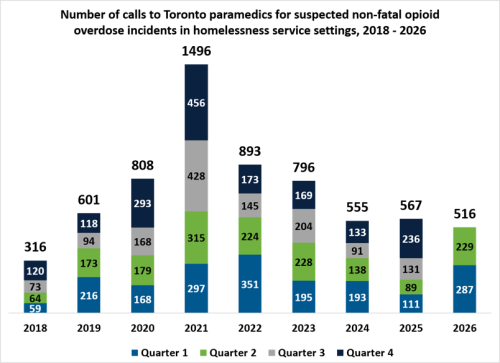
Toronto continues to experience a significant number of non-fatal and fatal opioid overdoses within the overall community, which is primarily due to the toxicity and unpredictability of the unregulated drug supply.
This page shares data that show the number of fatal and non-fatal suspected opioid overdose incidents in emergency shelters and 24-hour respite sites starting in 2018. Data related to non-fatal incidents are based on Toronto Paramedic Services emergency response data, and data about fatalities related to overdose are provided by the Ontario Office of the Chief Coroner.
This data is updated quarterly. The full dataset can be found on the City’s Open Data site.
For information on city-wide overdose activity, which includes this data specific to homelessness service settings, consult the Toronto Overdose Information System.
Key Points
- There were 229 calls to Toronto Paramedics from Toronto shelters and respite sites in Q2 2026 to respond to non-fatal overdoses, a 20% decrease from Q1 2026 (N=287).
- While the number of overdose calls decreased from 2022 to 2024, after peaking during the COVID-19 pandemic in 2021, this trend reversed in 2025 and into 2026.
- There were 567 suspected non-fatal overdoses in Toronto shelters over 2025, based on calls to Toronto Paramedics. This is a 2% decrease from 2024.
- The number of non-fatal overdose calls increased steadily between 2018 and 2021 and has shown a decrease starting in 2022.
- Non-fatal overdose calls increased from an average of 26 per month in 2018 to an average of 125 per month in 2021. Since then, monthly averages have declined to 46 per month in 2024, before rising to 47 per month in 2025 and 86 per month 2026 year to date.
- Non-fatal outcomes are the result of the quick action and response of shelter staff or other residents intervening to save lives by administering naloxone and oxygen and calling for emergency services. The true number of non-fatal overdose incidents is likely even higher than reported here given that paramedics may not be called if those responding on site are able to reverse the overdose and support and monitor the individual.
- Based on preliminary data, there were < 5 suspect drug related deaths of shelter residents in Toronto shelters in Q2 2026.
- In total, there were 13 opioid toxicity/suspect drug-related deaths in 2025, representing a 52% decrease from 2024.
- The City continues to take a horizontal, coordinated approach across TSSS, Toronto Public Health and Toronto Paramedic Services, where possible working together to align efforts, share information, and strengthen the collective response to overdoses within the shelter system.
About the City's Response
Toronto shelters deliver a continuum of person-centered strategies that save lives and reduce infectious disease transmission and other health risks for people experiencing homelessness who use substances, in line with a harm reduction approach.
Responding to an increase in non-fatal overdoses across the shelter system, in December 2020, the City established the Integrated Prevention and Harm Reduction Initiative (iPHARE), a multi-pronged effort by the City and community agencies to address opioid-related deaths in Toronto’s shelter system. Toronto Shelter and Support Services also updated the Toronto Shelter Standards (TSS) with enhanced requirements for supporting people who use substances, including overdose prevention and response strategies and developed resources, including policy templates, capacity building tools and enhanced oversight and assessment, to support service providers to implement the updated requirements.
Since then, the City has taken substantial action to protect those in the shelter system from the risk of overdose through direct service provision, shelter operators and community partners. These actions are informed by the Council-approved Toronto Shelter Standards, the Ten Point Plan for Harm Reduction in Shelters and the City’s Our Health, Our City: A Mental Health, Substance Use, Harm Reduction and Treatment Strategy for Toronto.
Non-fatal Suspected Opioid Overdoses
Suspected & Confirmed Opioid Overdose Deaths
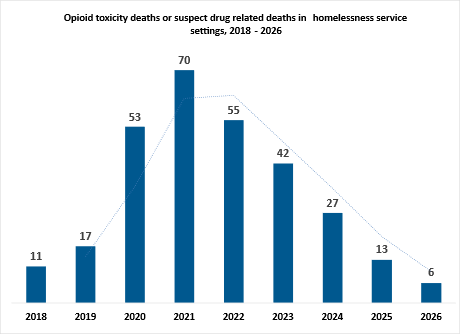
*Based on location of primary incident (includes deaths that occurred in hospital)
**Results are considered preliminary and are subject to change. Data is reported up to June 30, 2026. Includes probable and confirmed opioid-related deaths (toxicology positive for opioids) and suspected drug-related deaths. The Office of the Chief Coroner provides data on suspected cases while cases are still being processed. Once the case has been confirmed the status is changed to “confirmed.”
Data Notes & Limitations
- Non-fatal incidents are identified based on the expertise of Toronto Paramedic Services to diagnose an opioid overdose based on physical and incidental information.
- Only incidents where Toronto Paramedic Services are called are captured in the non-fatal suspected opioid overdose incident data set. Other incidents of non-fatal overdose may have been addressed through staff intervention through administering of naloxone.
- Some incidents may be duplicated in the fatal and non-fatal data sets because after Toronto Paramedic Services transports a patient to hospital, further outcomes are not recorded. A patient identified by Toronto Paramedic Services as experiencing a non-fatal, suspected opioid overdose who later dies in hospital will be captured in both fatal and non-fatal data sets.
- The Office of the Chief Coroner and Toronto Paramedic Services have identified cases of fatal overdose based on addresses of locations in the shelter system.
- The data set excludes individuals living in encampments or outside of the formal homelessness services system.
Date modified: August 28, 2026