

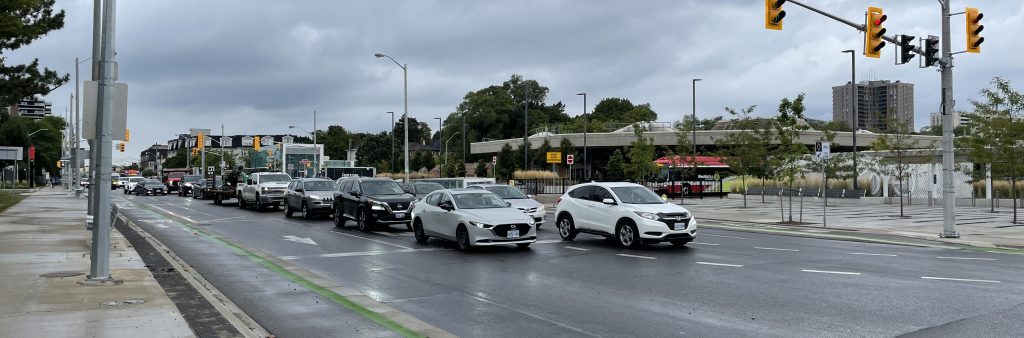
The City of Toronto is examining options to redesign the intersection of Eglinton Avenue West and the Allen Road Expressway. This study will explore ways to improve traffic congestion and safety for all road users both at the intersection and in surrounding neighbourhoods.
The study will:
Public feedback, along with technical considerations and City policies and guidelines will be considered in decisions to be made by staff and City Council.
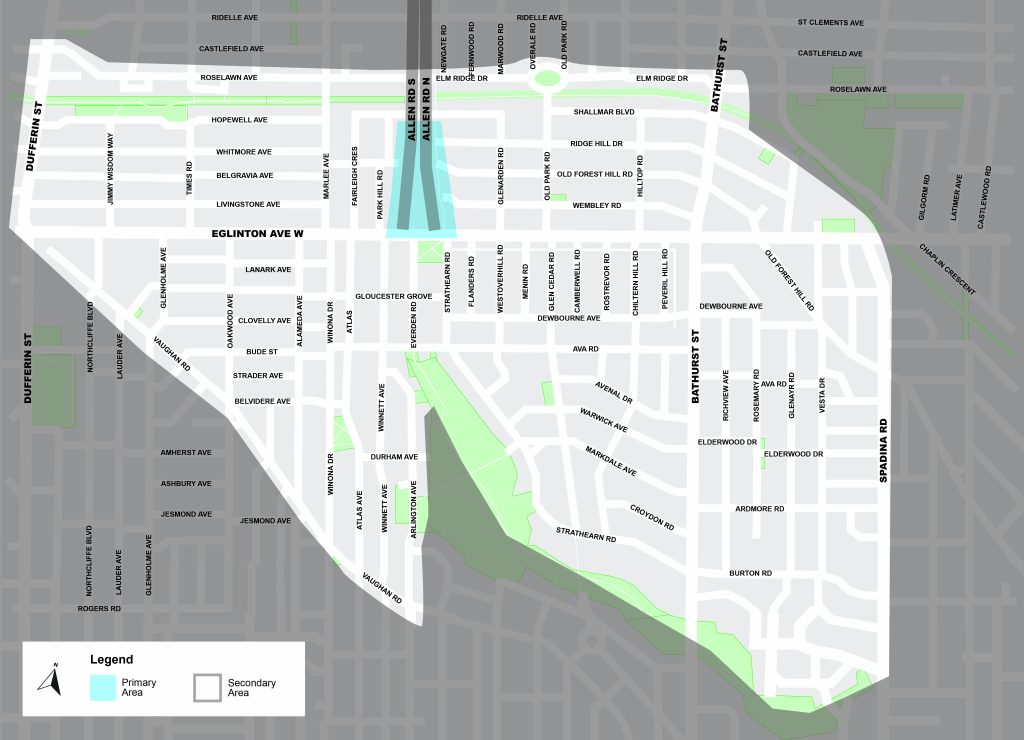
Primary Area (Intersection Redesign): Eglinton Avenue West and Allen Road intersection, extending 400 metres north along the Allen Road ramps
Secondary Area (Neighbourhood Mobility Strategy): Analyzed for traffic patterns and opportunities to implement neighbourhood mobility strategies
The Allen Road Expressway was first planned as part of the Spadina Expressway to connect the north end of Toronto to downtown. The project was cancelled in 1971 after strong public opposition, so Allen Road now ends at Eglinton Avenue West, a major city street.
The City was directed to undertake an Individual Environmental Assessment study in 2010 to address the state-of-good-repair, transportation function and urban design for Allen Road. The study Terms of Reference was completed in 2014 but was not advanced due to provincial concerns that the alternatives were too broad to be implemented without further land use planning, as well as the need for critical investments in infrastructure elsewhere in the city ( 2016.PW14.8 ). An initial review has been done of the previous study work to determine what can be carried forward to be considered as part of the Eglinton & Allen Intersection Study.
Prior to the construction of the Eglinton Crosstown LRT (ECLRT) the intersection of Eglinton Avenue West and Allen Road had a three-lane northbound on-ramp. From 2014 to early 2023, the intersection had long-term lane closures because of construction. In May 2023, Metrolinx reopened the intersection with a new design. It now has alternating dual eastbound left-turn lanes and dual westbound right-turn lanes, plus pedestrian crosswalks on the north and east sides.
Since reopening, the City has taken back jurisdiction of the intersection and made changes to signal timing and other operations to address traffic congestion. Even with these improvements, traffic problems remain. Congestion on Eglinton Avenue West and nearby streets has slowed travel times, and more drivers are using local streets to attempt to avoid delays.
In 2024, the City looked at short-term options to improve the intersection. The fastest changes have already been made. Medium-scale changes, like moving crosswalks, were assessed as not providing enough benefit to justify implementation.
In February 2025, City Council asked staff to study long-term redesign options to improve the operation of the Eglinton Avenue West and Allen Road intersection. This includes looking at a pedestrian tunnel or bridge, widening the northbound Allen Road on-ramp, and other physical changes (2025.MM26.12). Council also asked staff to keep working with the community to find short-term ways to reduce congestion while the study continues.
The redesign process involves four stages with three planned public consultation opportunities.
Potential improvements to the intersection include modifications to cycling and pedestrian crossings and redesign of the roadway, intersection and ramps.
Review the project materials (updated May 28), including diagrams on pages 18-33.
Public Consultation will take place in three phases. Phase 1 consultation took place in Spring 2026, and sought feedback on a long list of potential improvements to the intersection. A summary of comments received during this consultation will be shared on this page later in the summer.
Two Public Drop-In Events were held on May 30 and June 2, 2026, that included an opportunity to speak with project staff and view display boards. View the display boards.
The online survey asked for input on study priorities and the long list of proposed improvements to the intersection. The online survey is now closed.
Participants were invited to leave feedback on an interactive map to help identify areas of concern and potential improvements related to traffic and road safety in the area. The map is now closed, but the submissions can be viewed here.
An update on the trial traffic changes and the Eglinton & Allen Study was presented at a virtual community meeting on March 23, 2026.
A survey to collect resident input on a trial of traffic pattern changes for neighbourhoods around Eglinton Avenue West and Allen Road was open from January 19 to February 8, 2026. A Public Consultation Report is available.
A drop-in and in-person workshop was held on May 26, 2025 for neighbours and traffic experts to discuss options to mitigate traffic infiltration on neighbourhood streets around the Eglinton Avenue West/Allen Road intersection.
A Virtual Public Meeting was held on May 13, 2025, that included a presentation and Question & Answer period. View the presentation and recording below.
Consultation Report
The City has heard from residents about the need for urgent, near-term action to address the ongoing impact of traffic congestion caused by vehicles accessing the Eglinton Avenue West and Allen Road intersection from neighbourhood streets.
Following community input through consultations, the City conducted a trial of traffic pattern changes from December 2025 to February 2026, which included turn restrictions and ‘Do Not Enter’ regulations for the following intersections:
See Item - 2025.IE25.6 for details of the traffic changes made.
These changes were intended to help keep Allen Road-bound traffic on main streets (Spadina Road, Bathurst Street and Eglinton Avenue West), and address traffic congestion on neighbourhood streets around the Eglinton Avenue West and Allen Road intersection.
During the trial, traffic counts showed that the changes were effective, with an overall reduction of volumes on local and collector roads. However, many participants in the survey reported dissatisfaction with the trial, primarily due to increased travel times for local residents to get to and from homes. Following the monitoring, Council approved an amendment at the March 26-27, 2026 meeting to rescind the left turn and no-through restrictions at Bathurst Street and Strathearn Road. The remainder of the changes remain in place.
Review the full results:
Future changes to traffic patterns in the area to address ongoing congestion are expected to be addressed through the Eglinton & Allen Intersection Study Neighbourhood Mobility Strategy.
Over the last few years, the City has taken steps to address congestion issues at this intersection:
Prior to the beginning of construction on the Eglinton Crosstown LRT (ECLRT) in 2014, the northbound on-ramp to Allen Road operated as a three-lane ramp, with two westbound right-turn lanes and one eastbound left-turn lane. The intersection was redesigned during ELCRT construction and re-opened in 2023 in a two-lane design with alternating dual eastbound left-turn and dual westbound right-turn lanes with a new pedestrian north-south crosswalk. This design was selected to address concerns about eastbound capacity at the on-ramp intersection and to provide safer pedestrian and cycling infrastructure. The analysis of this design assumed that pedestrian demand to cross the Allen Road expressway would be mitigated by the opening of the Eglinton Cedarvale station entrances, but this opening was delayed until late 2025.
A four-lane design for the intersection was considered and studied prior to the re-opening, but was determined to be prohibitive due to complications in grading and would have required property acquisitions on the east side of the ramp. However, the current study will examine potential alternative configurations of a four-lane on-ramp.
The study will include an examination of feasible options to improve the functionality of the intersection. This could include a pedestrian bridge or tunnel, expanding the mouth of the Allen Road expressway on-ramp, and any other physical modifications to the intersection to improve traffic operations. The study will also examine short-term improvements to improve congestion in the neighbourhood while the study is underway.
The majority of the traffic at the Eglinton/Allen intersection is generated by travel to and from Allen Road, which the opening of the ECLRT itself will not eliminate. However, traffic counts have shown reduced pedestrian traffic at street level since the ECLRT tunnel entrances on either side of the Allen Road on and off-ramps opened in November 2025. Additionally, the opening of the ECLRT has reduced the demand for bus service along Eglinton Avenue, particularly for the 32 Eglinton West bus. Over time the opening of the LRT is expected to mitigate congestion as travel shifts from driving to transit use.
Traffic agents have been deployed to the Eglinton Avenue West and Allen Road area as resources and emergency needs permit to support enforcement. As the Eglinton Avenue West and Allen Road on-ramp traffic signals alternate between double eastbound and double westbound turns, pausing only for pedestrian demand, there is little time for agents to over-ride the signals to improve traffic flow. Agents have also been positioning themselves throughout the area as needed, often helping cars exit side streets onto Eglinton Avenue West to help ease neighbourhood congestion.
Many residents have requested better enforcement of existing restrictions before introducing new ones. While enforcement does have a temporary benefit, the Toronto Police Service is constrained how often and in how many locations officers can be stationed. The restrictions that have the highest degree of compliance are full day (as opposed to peak hour-only) turn restrictions, as well as the introduction of short segments of one-way streets. Peak hour-only restrictions are sometimes not recognized by navigation apps or drivers, therefore have lower compliance.
Residents can report illegal driver behaviour online when they see it occurring or request a TPS enforcement blitz.
While City Council endorsed the long-term Eglinton Connects plan in 2014 and the eglintonTOday Complete Street project in 2024 to address gaps in the bikeway along the 19 km Eglinton Crosstown LRT, the City is now unable to complete the project due to changes to the Provincial Highway Traffic Act.
RapidTO is Toronto’s Surface Network Transportation Plan to provide transit priority lanes on major corridors to improve transit service, which includes both Bathurst Street and Dufferin Street. Transit priority lanes have been installed on each corridor south of Bloor Street, and they are not currently being extended further north.
A bicycle detector was installed in 2025 for people cycling west at the Eglinton Avenue West and Allen Road on-ramp intersection. This detector ensures that when there are no people cycling, the bicycle signal will not get activated unless the pedestrian signal has already been activated. Previously, the bicycle signal would turn on for seven seconds every cycle, even if the pedestrian crossing was not activated.
A right-turn-on-red at this location has not been implemented primarily due to safety concerns.
There are two signal phases during which westbound right turning vehicles face a red light:
The most significant concern is the phase when the pedestrian walk signal is active. Sightlines to people crossing the ramp are limited when two vehicles turn simultaneously, particularly if a large vehicle is occupying the curb lane. This creates a higher risk of a pedestrian or cyclist being struck. Given the high volumes of vehicles and pedestrians at this intersection, the City does not consider permitting right turn on red during this phase to be a safe or realistic option.
While some drivers might be able to turn during the eastbound left turn phase when traffic volumes are low, visibility challenges remain, and the on ramp only provides two receiving lanes. It would also be difficult to clearly communicate to drivers that right turn on red is permitted during one red light phase but prohibited during another.
Under the Highway Traffic Act a double right-on-red is permitted unless otherwise signed, and this permits municipalities to restrict it in situations where it is deemed unsafe, as is the case here.
For these reasons, the project team has not trialled a right-on-red, and are focusing on other solutions that can reduce congestion while maintaining safety at this important transportation hub.
Closing crossings may result in pedestrians continuing to cross at the nearest available location, especially if that is the most direct path. Closing the crossing of the on-ramp for example would create a dead-end at the pedestrian plaza for pedestrians travelling eastbound, requiring pedestrians to double back to the underground tunnel. This is likely to result in some pedestrians attempting to cross the ramp during a break in traffic, posing safety concerns.
There is currently no 24/7 accessible alternative to the ground-level crossing, as the existing fare-free tunnel is not open overnight. There are also security and safety concerns about using the tunnel overnight when there is less foot traffic, and about the accessibility of this entrance should the elevator be out of service. This is one of the potential ideas being considered in the study, however, it would have to be implemented with the cooperation of the TTC and with consideration for how to make it a safe alternative.
Now that the Eglinton & Allen Intersection Study has launched, the City’s approach is to integrate any potential future changes to traffic regulations into the study through development of a neighbourhood mobility strategy. Potential changes as part of this strategy could include changes to traffic control signs and signals, safety improvements to slow traffic or enhance pedestrian and cyclist safety, changes to parking regulations, and turn restrictions or directional changes. To help inform this, staff have been capturing suggestions and concerns through the project inbox and during public consultation events. Residents are welcome to submit ideas to EglintonAllen@toronto.ca for consideration.
By reviewing possible adjustments as a coordinated package, the project team can better understand how one change may influence traffic patterns on nearby streets and ensure that solutions work together rather than in isolation. The community will be consulted on the mobility strategy before it is finalized as part of upcoming consultation events.
Many residents have requested “Local Traffic Only” signage to solve neighbourhood traffic infiltration. In Ontario “Local Traffic Only” cannot be regulated or ticketed as it is difficult to identify who is considered “local” (i.e.: residents, visitors or workers or customers to local shops). Also, navigation apps only acknowledge regulatory changes, and would continue to direct people down streets signed as “Local Traffic Only”.
Subscribe for e-updates to stay up to date on key milestones and opportunities to get involved. Your contact information will be kept private, and will only be used to share information about the Eglinton & Allen Intersection Study.