Grease interceptors (or grease traps) reduce the amount of fats, oils and grease entering the sewer system. The Sewers By-law requires that owners and operators of food service establishments properly install, operate and maintain a grease interceptor on any pipe that connects directly or indirectly to a sanitary sewer.
The mandatory grease interceptor requirement applies to facilities where food is cooked, heated, processed or prepared. This may include:
institutions with industrial kitchens or cafeterias (schools, daycares, hospitals, places of worship)
You will need a building permit to install or replace a grease interceptor at your establishment. The installation must follow the Ontario Building Code.
You may be required to replace or install a new grease interceptor if:
the City determines the existing grease interceptor is negatively affecting the sewer system (such as by interfering with water flow or drainage), or
there is a significant change in the operation of the food service establishment (such as a reorganization of infrastructure or expansion) or where a new business begins operating on the premises or a new building is built on the property
Choosing a Grease Interceptor
The table below provides a summary of the different types of grease interceptors and solids removal technologies and where they are used.
Device Type
Description & Use
Hydro-mechanical grease interceptor (grease trap)
A small, point-of-source unit typically installed under kitchen sinks; can also be installed in-ground (under the floor) in kitchens and basements
Solids interceptor
Prevents solids (such as food) from overloading the grease interceptor
Separates solids for easier access and removal from the interceptor
Can be a standalone unit or built into the grease interceptor
Grease recovery device
A type of hydro-mechanical grease interceptor that removes floating grease to a separate container
Private companies may pick up grease recovered from the device (also known as “yellow grease”) for recycling
Suited for kitchens with more concentrated or solid fat, oil and grease discharge and where the location is difficult to access by a pump truck
Requires regular, daily maintenance
Gravity grease interceptor
A large in-ground interceptor that holds wastewater for about 30 minutes to allow fats, oils and grease to float to the top and solids to settle to the bottom before moving water to the sewer system
Size ranges from 300 to 2,000 gallons
Used in large kitchens and industrial premises
Can accommodate discharges from multiple plumbing fixtures (dishwashers, sinks)
For point‑of‑source installation—where the grease interceptor is placed directly at the sink or other fixture producing fats, oils and grease—you must use an appropriately sized grease interceptor that meets the CSA Standard B481.1:22 Hydromechanical grease interceptors, as required by the Ontario Building Code.
There are no CSA standards for gravity grease interceptors, however, it must be the appropriate size as required by the Ontario Building Code.
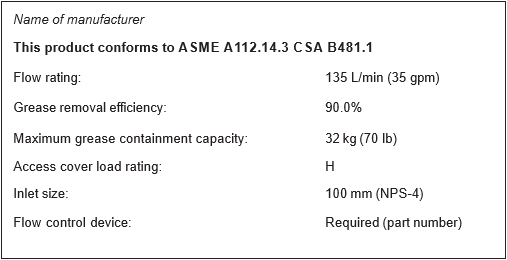
Grease interceptors that meet CSA Standard B481.1:22 will have markings that show the following:
flow rating
removal efficiency
maximum containment capacity
inlet size
Example of a grease interceptor label with markings listed above.
If the markings are not visible after installation, the food service establishment must keep the grease interceptor’s manufacturer and installation drawings on-site for inspection if requested by the City.
In addition, the grease interceptor’s inlet and outlet (where wastewater enters and exits) must be clearly labelled to show the direction of flow.
Where to Install a Grease Interceptor
The grease interceptor must be installed in a location that is easily accessible for maintenance and inspection.
You must connect a grease interceptor to the following plumbing fixtures:
sinks used for washing pots, pans, dishes, cutlery and kitchen utensils
drains for self-cleaning exhaust hoods installed over commercial cooking equipment
drains for commercial cooking equipment.
You may need to connect a grease interceptor to other plumbing fixtures if they send wastewater containing fats, oil and grease down the drain. This may include:
floor drains
mop sinks
garbage disposal drains
dishwashers
Alternatively, you may install a pre-rinse sink at the inlet to the dishwasher. In this case, you must connect the pre-rinse sink to a grease interceptor.
drains for garbage compactors where the garbage may contain food waste
Do not connect grease interceptors to the following plumbing fixtures:
toilets
urinals
hand sinks
food or garbage grinders, potato peelers and similar equipment discharging solids (unless they discharge to a solids interceptor before being connected to a grease interceptor)