

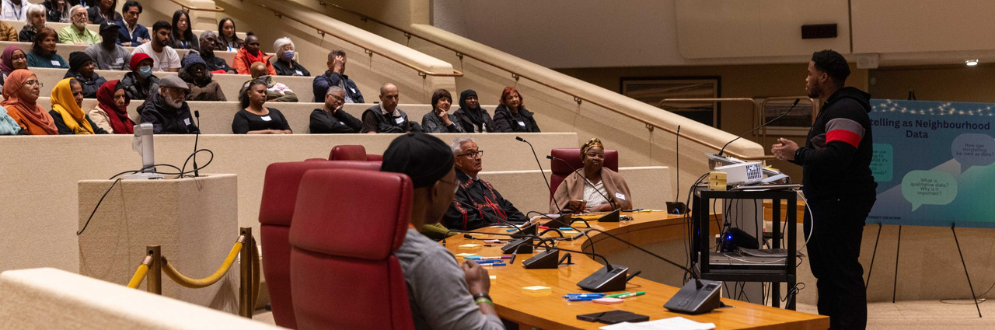
The Toronto Strong Neighbourhoods Strategy (TSNS) is the City of Toronto’s action plan for building partnerships in Toronto’s neighbourhoods so they can succeed and thrive. The strategy supports the engagement and capacity development of community-led groups and leaders across Toronto’s four district areas Etobicoke-York, North York, Toronto-East York and Scarborough. TSNS prioritizes the leadership and participation of Indigenous, Black and equity-deserving groups within Neighbourhood Improvement Areas (NIA), Emerging Neighbourhooods and other communities of focus. The strategy strengthens the social, economic and physical conditions and delivers local impact for city-wide change.
To achieve equitable opportunities across all Toronto neighbourhoods by:
No matter what neighbourhood Torontonians call home, there are equitable opportunities for well-being.
Engaging with community-led groups and leaders is a key area of focus for the Toronto Strong Neighbourhoods Strategy (TSNS). A number of different methods will be used to engage with community-led groups and leaders.
City staff are available to meet to learn more about your community-led group, priorities and your neighbourhood. Find the Toronto Strong Neighbourhoods Strategy Community Development Officer in your area.
To support a comprehensive understanding of the community-led groups and leaders working across the city, please complete this survey.
The Toronto Strong Neighbourhoods Strategy (TSNS) Advisory Group brings together resident leaders from across Toronto’s four district areas of Etobicoke-York, North York, Toronto-East York and Scarborough to contribute community perspectives to initiatives connected to neighbourhood wellbeing, equity and community resilience across Toronto.
The Advisory Group creates opportunities for collaboration, shared learning and resident leadership development while helping strengthen connections between local community priorities and broader city-wide initiatives.
Through this work, members have:
| Stage | Timeline |
| Applications Open | May 25, 2026 |
| Applications Close | July 12, 2026 |
| Application Screening | Mid-July 2026 |
| Interviews | Late July to Mid-August 2026 |
| Offers & Declines | Mid-August 2026 |
The Local Leadership Grant supports place-based, resident-led projects that focus on wellness, social inclusion and the promotion of civic engagement and education across all neighbourhoods. The Local Leadership Grant will prioritize the leadership and participation of Indigenous, Black and other equity-deserving groups within Neighbourhood Improvement Areas and Emerging Neighbourhoods.
Learn more about the Local Leadership Grant.

Every year on a Saturday in November, the City of Toronto hosts its annual Toronto Strong Neighbourhoods (TSNS) Summit.
Community‑led groups and leaders are invited to take part in a day of learning, connection and celebration.
Attendees can look forward to:
More information about the 2026 Summit will be available in early August.
Community Hubs are neighbourhood gathering places that welcome local residents to connect with each other and their community. They are places to relax, meet up or work. Hubs offer a wide range of spaces for local community groups to meet, hold events and workshops and can also include programs, supports and services from non-profit organizations. Learn more about Community Hubs.
In partnership with Social Planning Toronto, a selection of TSNS Advisory Group members developed a Resident Engagement Toolkit designed to support community-based organizations and City partners in deepening their understanding of the best practices for engagement, particularly with equity-deserving groups. This workshop toolkit was a collaborative project and is the outcome of community consultations carried out between August and December 2022. The consultations aimed to center resident leaders’ expertise, current realities, identify tools and approaches to facilitate meaningful engagement and partnerships and support enhanced community development outcomes for sustainable, resident-led neighbourhood work in Toronto. Everyone is welcome to review and use the Resident Engagement Toolkit to inform their ongoing work and engagement with equity-deserving communities.
City staff partnered with Social Planning Toronto to develop the Community Playbook to assist community leaders with concrete knowledge and tools they can use in their place-based community engagement work, as well as to support new Toronto Strong Neighbourhoods Strategy (TSNS) Community Networks. The Community Playbook serves as an interactive guide with more than 100 pages of resources for community leaders and residents involved in community engagement projects within their respective networks and neighborhoods to help them in their planning, engagement, funding applications, project coordination and more! Check out the Community Playbook and how you might be able to utilize this exciting new resource in your community development work.
The City of Toronto now has 158 social planning neighbourhoods. Neighbourhood designations help City staff collect data, plan, analyze and forecast City services. While these neighbourhoods may not fully encompass every historical, cultural, ethnic or economic neighbourhood area, they do provide a way for planners and researchers to track information about them over time. Learn more about updates to Toronto's social planning neighbourhoods.
In 2014, the City used the Urban Health Equity Assessment and Response Tool to score neighbourhoods under five domains of neighbourhood well-being. The five domains were:
The Urban HEART scores helped the City identify Neighbourhoods Improvement Areas for additional investment through the Toronto Strong Neighbourhoods Strategy.
The City is partnering with the United Way Greater Toronto to create a tool to help residents, community organizations, and City staff understand the unique needs, opportunities and assets of Toronto neighbourhoods and communities. The tool will be created through a community-informed process and will support evidence-based decision-making that advances equity in Toronto using quantitative and qualitative data.
Learn more about Toronto Neighborhood Assessment Framework.
Stay informed about updates, opportunities, resources and tools for community-led groups leaders across the city. Regular updates sent are bi-weekly. You may unsubscribe at any time.