

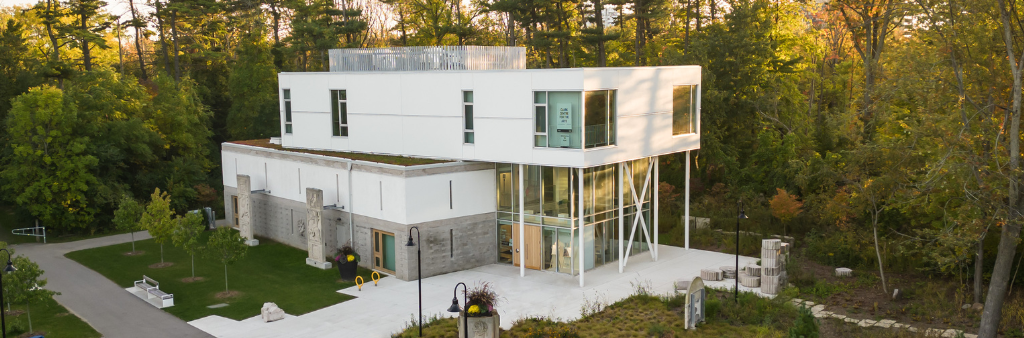
Located inside Guild Park and Gardens, the Clark Centre for the Arts is a stunning new cultural facility that houses specialized art studios and gallery spaces that Toronto residents and visitors can enjoy year-round. The Centre provides rental opportunities and delivers close to 85 accessible arts programs annually, including art courses, workshops and talks.
Guild Park and Gardens is a unique 88-acre site on the Scarborough Bluffs that includes forests, shoreline and a collection of architectural fragments, sculptures and buildings.
Free
Monday to Tuesday: 9 a.m. to 4 p.m.
Wednesday: 9 a.m. to 8 p.m.
Thursday to Sunday: 9 a.m. to 4 p.m.
Statutory Holidays: Closed
Limited free parking is available.
From Kennedy Station, take the 116 bus to Guildwood Pkwy at Guild Inn East Side.
For specific TTC route and schedule information call 416-393-4636 or visit the TTC website.
Clark Centre for the Arts offers a variety of visual arts workshops for children and adults. Browse the visual arts courses and workshops online or via the fall brochure.
Registration is required. In-person registration is possible with debit or credit. Cash payment is not accepted.
Learn how to activate and access your account or call 416-396-7378, option 1, Monday to Friday from 8 a.m. to 5 p.m.
Please email cca@toronto.ca, if you have any special needs requirements.
Clark Centre for the Arts is excluded from Parks & Recreation policies and procedures, including the Welcome Policy.
May 5 to September 30
View this community-engaged, living art installation of hard-cover books, which have been individually covered in Indigenous-inspired fabric and arranged on bookshelves. The names of lives lost, printed in gold letters, are placed on the spines of these books to individually respect and honour the thousands of murdered and missing Indigenous women, girls and children.
May 16 to November 12
Delight in this kinetic installation composed of dozens of delicate paper mobiles suspended in air, evoking the quiet poetry of spring trees swaying in the wind. Crafted by Paula Hartmann from featherlight paper and fine wire, each mobile captures a fleeting moment of bloom, movement and renewal.
September 2 to 30
Witness Katherine Takpannie's worldview through lens, using knowledge of her history, culture and language to convey her vision. Her gentle yet emotionally impactful artworks reveal the complexities and nuances of her urban Inuk story. Takpannie’s visual storytelling expands out from portraiture to include lush landscapes and urban scenes, honouring the multifaceted experiences of many Indigenous people.
October 3 to 29
Reception: October 4, 1 to 3 p.m.
Be inspired by Katharine Harvey's new body of work which explores the remarkable architectural fragments preserved at Guild Park. Historic stone carvings rescued from demolished Toronto buildings now coexist with forests, gardens and Lake Ontario. Through vibrant paintings, Harvey reveals layered stories that connect built heritage, nature and memory, inviting you to see the park with fresh eyes.
November 3 to December 3
Reception: November 7, 1 to 3 p.m.
Enjoy this photography exhibition by a diverse group of artists as they present their unique interpretations of our world, from realistic to abstract, including techniques such as macro photography, intentional movement and digital compositing. This collection promises a rich visual experience that reflects the wide-ranging creativity of Beach Photo Club members.
Chris Thomaidis (he/him) is a Toronto-based photographer working with a diverse range of subject matter and media. Contemplative observation best describes his process, with a strong graphic sensibility in both his pictorial and abstract work. His professional work has been recognized in American Photography Annuals, Communication Arts Design & Photo Annuals and many advertising and design awards competitions. He has lectured at OCAD and Toronto Metropolitan University and mentored youth in the Magenta Foundation Incubator program. Throughout his career, Chris made a conscious decision to make personal work that differed from his professional work. His personal work can be found in corporate and private collections throughout North America and Europe.
Negar Pooya is a multidisciplinary visual artist, originally from Iran and now based in Toronto. Her art practice encompasses photography, painting, printmaking and digital art. In recent years, Negar’s focus has been on exploring humanity’s relationship with nature and the environment, as well as themes of identity, self-awareness and freedom. Negar has exhibited internationally in solo and group exhibitions across Iran, Canada, Japan, Romania and the USA. Her art has been acquired by several esteemed museums and private collections, including the Contemporary Museum of Art in Iran, the Women’s Edge Coalition in Washington, the University of Maryland, Mobile Museum of Art, Florean Museum in Romania and the International Museum of Women in California.
The Clark’s Artist Residency program provides Toronto artists with opportunities to think, experiment, work and create in an artistic lakeside yet urban environment. The residency concludes with a one-month exhibition in Gallery 191.
Applications for 2027 artists in residence are now closed.
The Clark Centre for the Arts site has a long tradition of creativity and fine arts. In the 18th century, the land surrounding the Clark Centre for the Arts site had been divided into tracts that were granted to loyalists who had served in the American Revolutionary War. After changing hands a number of times, General Harold Child Bickford purchased the property in 1914, named it the Ranelagh Park Country Estate and built the well-known Bickford House. Today, the Bickford House is a Designated Heritage Property, and considered an excellent example of early 20th Century Period Revival style with Arts and Crafts detailing.
In 1932, Rosa and Spencer Clark founded the Guild of All Arts after Rosa purchased 450 acres of land. The Guild of All Arts contained shops, a tea room, and studios in fine art and craft, including painting, sculpture, hand-loom weaving, tooled leather, ceramics, metal work, wood carving and batik. After the Second World War, the Clarks expanded the hotel and restaurant operation and created formal gardens. The area became known as the Guild Inn or the Guild. During Toronto’s building boom that began in the 1960s, many historic 19th and 20th century downtown buildings were demolished. As an advocate for architectural preservation, Spencer Clark recovered many of these buildings’ facades and architectural features to display on the grounds of the Guild.
Architectural services were provided by Taylor Hazell Architects and the construction was undertaken by Atlas Construction Ltd.
The Sculptor’s Cabin is a small historic building located near the front entrance of Guild Park and Gardens. It was renovated in spring 2019 and serves the community as a meeting place and information centre.
Under a community partnership agreement with the Guild Park Stakeholder Group, comprising Friends of Guild Park, Guild Festival Theatre, Guildwood Community Village Association and Guild Renaissance Group, the Sculptor’s Cabin acts as a vibrant community resource to promote civic and cultural engagement.
Located south of the centre, the Log Cabin operates as a program resource to support the Clark Centre’s Artist in Residency and pre-registered programs.