

Toronto City Hall which opened in 1965, is the heart of the city and is recognized internationally as an architectural masterpiece.
Discover the architectural features, public art and highlights of City Hall through this virtual tour and explore web exhibits with historical images.
Learn about many features of Toronto City Hall, including a peek into the Mayor’s Office and views from the 27th Floor Observation Deck.
This exhibit explores the architectural history of the events leading up to and including the opening of City Hall in 1965.
This exhibit features a Civic Square page uncovering the history of Nathan Phillips Square and Toronto City Hall.
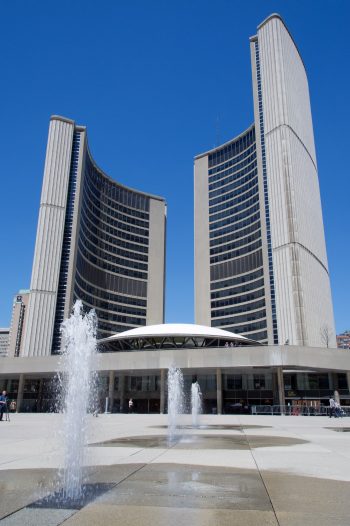 Toronto City Hall is the seat of municipal government for Canada’s largest city.
The building consists of two towers surrounded by an elevated podium. The East Tower has 27 floors; the West Tower has 20 floors. Nestled between the two towers is the round, dome-shaped Council Chamber where Toronto City Council holds its monthly meetings.
In addition to being the home of City Council, City Hall is an important public building where residents can take part in meetings, apply for permits, visit the library branch and even get married. Nathan Phillips Square, which sits outside the main entrance to City Hall, is also home to many special events year-round, from ceremonial flag raisings to festivals, concerts, celebrations and more.
Once inside City Hall, the public is welcome to visit a number of spaces on the first and second floors. The offices of the Mayor and the 25 City Councillors are on the second floor.
The two curved towers contain office space for City staff, who provide a wide variety of programs and services to the people of Toronto. Offices for additional staff are located at Metro Hall, at five civic centres, and at a number of other City facilities.
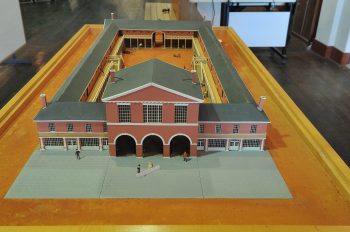
Over the years, the original City of Toronto has had a total of four City Halls.
From the time of the City’s incorporation in 1834 until early in 1845, the Council met in a building in a Market Complex at the intersection of King and Jarvis Streets. It was a plain orange-red brick building in the Georgian style, designed by James Cooper.
The building was destroyed by fire in 1849. St. Lawrence Hall stands on the site today.
From 1845 to 1899, the seat of City government was located at Front and Jarvis Streets, in the South St. Lawrence Market. The City’s Market Gallery now occupies the 19th century City Council Chamber on the second floor of the Market.
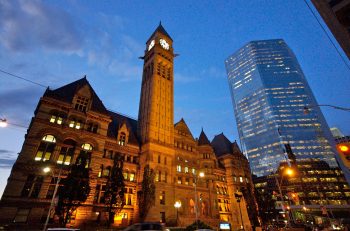
Toronto’s third City Hall, on the northeast corner of Queen and Bay Streets, was officially opened on September 18, 1899, by the mayor of the day, John Shaw. The building contained a Council Chamber, courtrooms and municipal offices. Old City Hall, as it is now known, was designed by Toronto architect Edward James Lennox, whose later projects included Casa Loma and the King Edward Hotel. When Toronto’s fourth City Hall opened across Bay Street in 1965, Old City Hall became a Provincial courthouse.
In 1957, then Mayor Nathan Phillips convinced City Council to hold an international design competition for a new City Hall on the northwest corner of Queen and Bay which would reflect a modern, growing city. A total of 520 designs were received from 42 different countries.
The winner of the competition was Finnish architect, Viljo Revell.
Because Mr. Revell was not registered as an architect in Canada, the Canadian firm John B. Parkin Associates assisted him with the City Hall project. Successors to that company still act as consultants on important architectural issues affecting the building.
Viljo Revell’s design was divided into three main parts: the podium, the convex circular Council Chamber and two office towers of differing heights. The entire City Hall complex had a sculptural quality that would make it a striking landmark and ideal symbol of a growing city.
Construction commenced on November 7, 1961, and the building was opened on September 13, 1965 by Governor General Georges Vanier. The final cost of the new City Hall was approximately $31 million.
Tragically, Viljo Revell died of a heart attack 10 months prior to the opening ceremonies. He was 54.
In 1998, seven former municipalities – the Borough of East York, the City of Etobicoke, the City of North York, the City of Scarborough, the original City of Toronto, the City of York, and the Regional Municipality of Metropolitan Toronto – were amalgamated to form one new city to be called the City of Toronto.
Following amalgamation, the City Council for the much-enlarged City of Toronto affirmed Toronto City Hall at 100 Queen St. W. as the seat of the new amalgamated municipal government.
When visiting City Hall, you will see a variety of important public art pieces outside and inside the building. Learn about the art inside below.
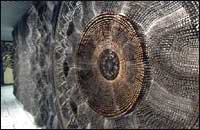 One of the most popular attractions at Toronto City Hall is the mural of nails located on the east wall inside the main entrance.
This mural, called Metropolis, was the winning entry in an art competition held in 1974 to select a permanent work of art to complement City Hall’s unique architectural style. Metropolis was installed in 1977.
The work is a symbolic interpretation of a great city (or metropolis), but not of any particular city. Created from 100,000 common nails, the mural is made up of nine panels, each weighing about 180 kilograms. The circle of massed copper nails in the centre represents the heart, or downtown core, of the city
The artist is David Partridge. Originally from Akron, Ohio, Mr. Partridge came to Canada in 1944. He studied at the University of Toronto, and also at Queen’s University in Kingston, Ontario.
The name of City Hall architect Viljo Revell has been etched into a large support column just opposite Metropolis. Mr. Revell passed away before the construction of Toronto City Hall was completed.
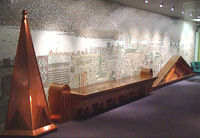
Created by local artists Brian Kipping and John McKinnon, Views to the City was the winner of a public art competition held by the City of Toronto in 1987. It was installed in City Hall in 1988.
Brian Kipping crafted copper and glass mosaic tiles to present a rooftop panoramic view to the east and west from the roof of City Hall. The “west” wall shows Lake Ontario, the Sunnyside Pavilion and, in the distance, Port Credit.
A crane on the “east” side of the mural belongs to the 1960s, when Toronto City Hall was under construction.
John McKinnon is a sculptor and furniture designer. He created copper, three-dimensional life-size architectural pieces that refer to the rooftops of buildings that were in existence in 19th century Toronto.
On the west wall, a pediment recalls part of the old City Hall, a spire from St. George the Martyr Church in Grange Park and a cornice that was borrowed from the past to make a comfortable bench.
Visitors entering City Hall from Nathan Phillips Square walk directly into a large and distinctive rotunda.
The floor is made of Carrara marble imported from Italy, cut in Canada and laid by hand.
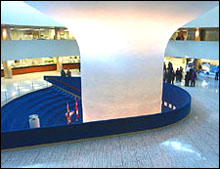 In the middle of the rotunda, a massive, reinforced concrete column, measuring six metres across and one metre thick, goes down 16 metres into the bedrock beneath the building’s foundation. It supports the 4,000 tonne Council Chamber above. The core of the column is actually hollow. It contains electrical cables, plumbing, and heating and air-conditioning equipment that service the Council Chamber.
The Hall of Memory is located at the base of the column. Down a few steps, there is a glass book case that, on occasion, contains either the “Great War Book of Remembrance” or the “Golden Book of Remembrance” which includes the names of servicemen and women from Toronto who died serving their country during the two world wars. The flags which flank the display case are the Canadian flag and the Royal Union Flag, the latter under which many Canadians fought until Canada adopted its own flag in 1964.
On Indigenous Veterans Day (November 8) in 2023, the City permanently recognized Indigenous contributions, so that the walk around the Hall of Memory now begins and ends with the recognition of Indigenous peoples in our city’s history. The first panel features symbols important to the First Nations, Métis and Inuit peoples: Indigenous defenders of these lands over time. The final panel on the east side of the Hall honours the defenders of York (the name of this community prior to Toronto) on April 27, 1813, during the War of 1812, including several of the city’s treaty partners. In between these panels around the column are the insignia of military units from the Royal Canadian Navy, Army and Royal Canadian Air Force that have at some point, been headquartered in Toronto since 1793.
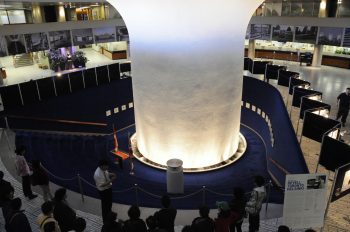
Part way down the short staircase, positioned in the actual centre of City Hall, is a cylinder containing a leaden time capsule. Inside the time capsule are municipal handbooks, coins, stamps and the three daily newspapers printed on the day of City Hall’s dedication when the time capsule was installed: November 7, 1962.
A scale model of the downtown area of Toronto is on view on the west side of the rotunda near the front door.
Originally built in the late 1980s, the scale model known as ‘TinyTO’ is bordered by Dufferin Street to the west, Bloor to the north, the Don River valley and west edge of Riverdale to the east, and Lake Ontario to the south. It was designed in such a way that visitors can readily pick out historical buildings and key landmarks.
As the city has grown and changed over the years, so has the model. The sections of the model that are white have been updated to reflect the significant changes to the built form of those neighbourhoods, particularly downtown and along the waterfront where many new buildings have been constructed since the model was first created.
In the hallway that leads to the City Hall library branch are a number of historic photographs curated by Toronto Archives which show City Hall and the neighbourhood that existed here before City Hall was built.
At the end of the corridor is the City Hall library branch – one of 100 Toronto Public Library branches which are found in neighbourhoods across the city.
The second floor is the Executive Floor of City Hall. Several committee rooms and the Offices of the Mayor and the City Councillors are arranged in a circle around a mezzanine that overlooks the rotunda below.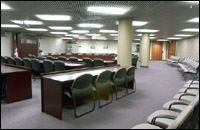
Toronto City Council is the main governing and legislative body for the City. Many of the decisions made by City Council are based on preliminary work and discussions that take place in committee meetings held in the second floor committee rooms. These meetings are open to the public and are streamed live on the City's YouTube channel.
The City of Toronto’s Coat of Arms hangs on the wall just outside the Mayor’s Office. In addition, photographs of the Mayors of Toronto since amalgamation in 1998 are also hanging there, along with the photo portrait of the current Mayor.
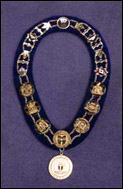 In the adjacent reception area, the Mayor’s ceremonial chain of office is on public view in a glass display case.
A striking mosaic, called Views to the City, is located in one of three reception areas for the Councillors’ Offices. It is the creation of Brian Kipping and John McKinnon, both residents of Toronto.
When viewed from above, the Council Chamber, positioned between the two curved towers of City Hall, resembles an eye between two eyelids.
It is 46 metres wide and 12 metres at its highest point. It is supported solely by a circular column which extends below the Chamber and into the rotunda. The roof of the Chamber is supported by 23 pairs of v-shaped concrete struts located outside the windows.
The ceiling, which weighs over 2,000 tonnes, was made by pouring concrete into a single plywood mould. It took 40 days for the concrete to dry.
To absorb sound, the Council Chamber is carpeted and the ceiling is sprayed with a carpet fibre.
Meetings of Toronto City Council are held in the Council Chamber, generally once a month. Meetings typically last two to three days and can cover a wide range of topics, from local matters to important, city-wide issues. For more details, please check the schedule of Council meetings, available online.
All meetings of Council are open to the public and are streamed on the city's YouTube channel. The public seating gallery can accommodate as many as 250 people at any given time.
When Council is meeting, Members of Council sit in the horseshoe-shaped seating area facing the elevated desk at the centre of the room known as the Speaker’s Dais. The Speaker is a Member of Council chosen by their peers to preside over Council meetings. The Mayor may also chair Council meetings if they wish. Seating assignments for individual members of Council are determined by lottery.
The City Clerk, who provides administrative support for Council, sits with staff at a table in the middle of the horseshoe, directly in front of the Speaker’s Dais. Senior city staff such as the City Manager, City Solicitor, and Deputy City Managers sit to the left and right of the Mayor to help answer any questions that Council might have about reports on their meeting agenda.
To the right of the speaker is a display case containing a silver teapot that was gifted to the city by the city’s Treaty 13 partner, the Mississaugas of the Credit First Nation. It symbolizes the city’s relationship with Indigenous communities.
A seating area for the City Hall press is situated behind the public gallery at the back of the Council Chamber.
The Members’ Lounge, located behind the Council Chamber, provides City Councillors with a place to hold informal discussions and is also used as a venue for official receptions.
The Members’ Lounge overlooks Nathan Phillips Square and also provides an excellent view of the Podium Green Roof at Toronto City Hall.
In addition to meetings of City Council, the Chamber is also an important space used for ceremonies, conferences, presentations and staff meetings.