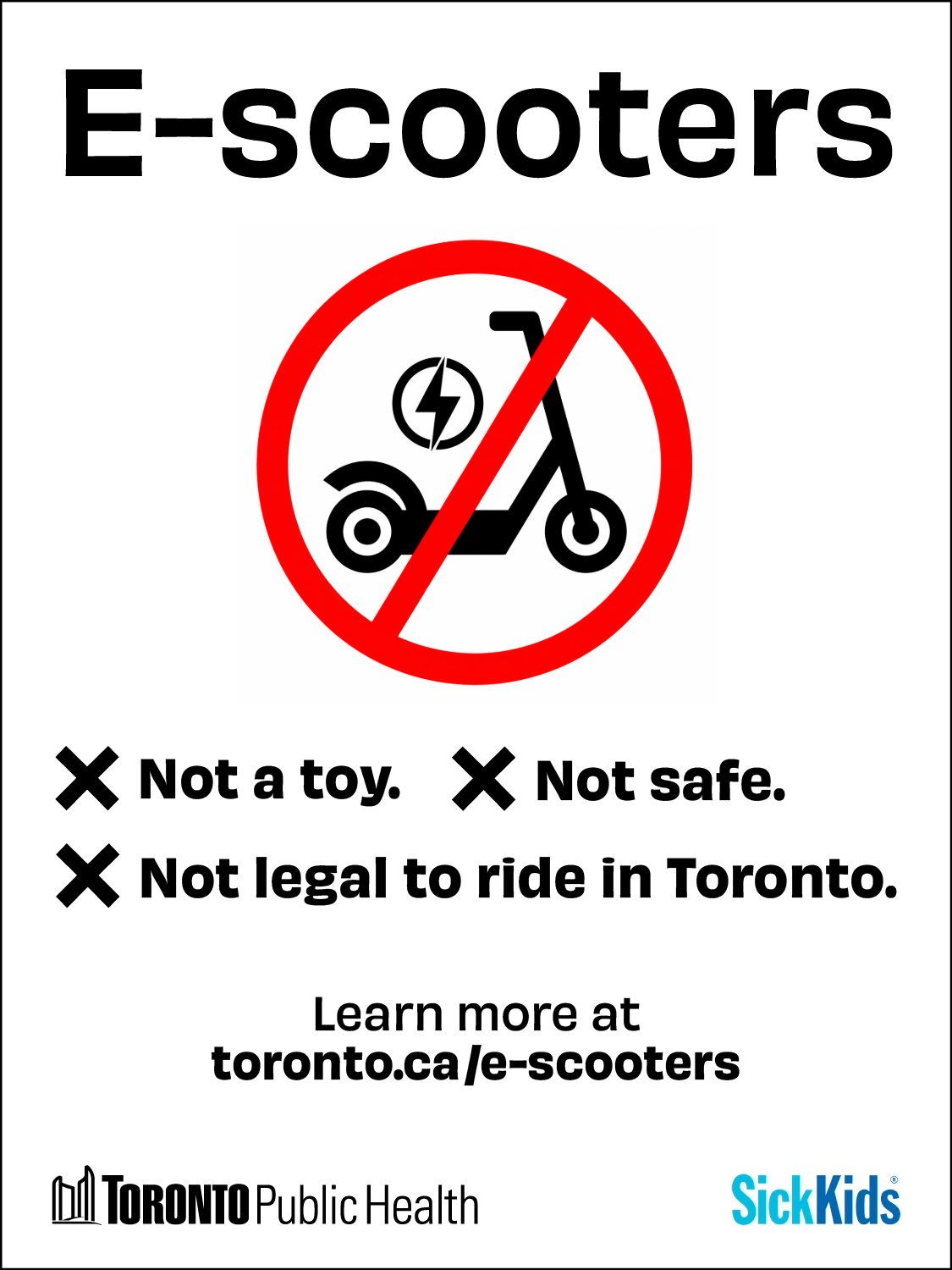
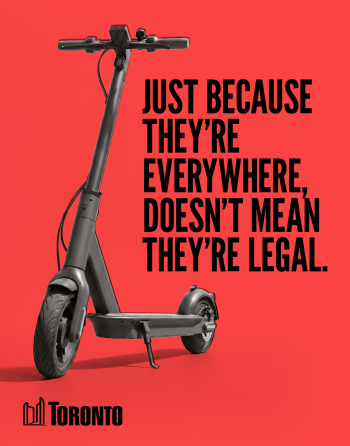
 An electric kick scooter (e-scooter) is a two-wheeled, battery-powered vehicle with handlebars and a platform to stand on.
E-scooters are not permitted to be operated on any public street in the City of Toronto, including bicycle lanes, cycle tracks, trails, paths, sidewalks, or parks.
E‑scooter injuries in Toronto are rising rapidly, with many requiring urgent medical care. In response, the City is taking a precautionary, safety‑first approach.
Instead of an e-scooter, choose to ride a manual kick-scooter, a traditional bicycle, or a legal e-bike. Learn more about where different types of Micromobility are permitted to operate in the City.
Electric kick-scooters cannot be operated, left, stored or parked on public property in Toronto.
This includes:
These restrictions are set out in Municipal Code Chapters 950, 886 and 608.
The Government of Ontario launched an e-scooter pilot program that allows municipalities to decide whether to permit e-scooter use on their roads. While some municipalities have opted into the pilot, the City of Toronto has not. Further, the Ontario pilot program prohibits the use of e-scooters for children and youth age 15 and under, even in municipalities where e-scooters are allowed.
In May 2021, and again in May 2024, Toronto City Council decided not to participate in the pilot program. As a result, e-scooters cannot be legally operated in Toronto.
Fines and penalties may apply.
The Toronto Police Service may enforce violations of the Highway Traffic Act and Toronto Municipal Code by-laws when an infraction is observed.
E-scooters may still be sold in stores.
E-scooters can be purchased in stores but cannot be operated in public spaces in Toronto. The City does not have the authority to regulate the sale of e-scooters and can only regulate how and where they are used in public spaces. The City has request the Federal Minister of Transport and the Federal Minister of Health to introduce stronger regulations and enforcement addressing public safety risks posed by unregulated and uncertified electric micromobility devices (See Council item 2025.IE24.1)
E-scooters present a significant safety hazard and can cause serious injuries, particularly among children and youth. Since 2020, the SickKids Hospital Trauma Registry has reported a significant increase in the number of serious injuries related to battery-powered mobility devices, especially e-scooters. In Ontario it is illegal for youth age 15 and under to ride an e-scooter, even in municipalities where e-scooters are allowed for adults.
More information is available in the SickKids report, “SickKids seeing growing number of injuries from e-scooters and e-bicycles.”
The Hospital for Sick Children (SickKids) reported that among the injuries treated by its staff:
The availability of e-scooters in stores does not mean they are safe or allowed for children to operate across Ontario.
The City does not have the authority to regulate the sale of e-scooters and can only regulate their operation in public spaces. As a result, e-scooters may be available for purchase or rent in stores and are often marketed to youth under the age of 16.
International research has found that the rate of injury from e-scooters to be dramatically higher than bicycles (source: European Transport Safety Council “Recommendations on Safety of E-scooters” February 2023). Falls from e-scooters are all too common. Their small wheels and upright rider position make e-scooters intrinsically less stable than bikes. They are vulnerable to uneven surfaces where minor obstacles like cracks and bumps, potholes, streetcar tracks, or debris can lead to sudden loss of control and serious crashes.
E-scooter injuries are increasing rapidly in Toronto, particularly among youth. Most injuries require urgent medical attention. These trends are one of the reasons the City is taking a precautionary, safety-first approach to e-scooter use.
Between 2022 and 2024, Toronto Public Health analysis has found:
Source: Toronto falls-related injury data, 2022–2024. National Ambulatory Care Reporting System (NACRS). Ontario Ministry of Health; data extracted from IntelliHEALTH Ontario, July 10, 2025. Toronto Public Health, Epidemiology and Health Analytics Unit. Note: Data for 2022 are based on partial-year reporting, as new medical coding for e‑scooters was introduced in April 2022.
There are safe and legal micromobility options available in Toronto. Learn more about where different forms of e-bikes and micromobility are allowed to operate in the City.
Lithium-ion batteries are found in many common devices, including e-scooters. Certified lithium-ion batteries that are properly charged, used, and disposed of are generally safe. Overcharged, modified, or damaged batteries are not safe and can cause a fire or even explode.
Visit Toronto Fire Services for more for more information on lithium-ion battery safety Lithium-ion Batteries – City of Toronto and Lithium-ion Batteries - Safety Tips - Toronto Fire Services.
The City of Toronto, in partnership with Toronto Public Health and The Hospital for Sick Children, are requesting youth serving organizations to share this message with their community.
Below are versions of this message in various sizes and layouts for downloading.
Please share this message widely in your communication materials, bulletin boards and social media, to help us encourage parents and guardians to decide against e-scooters for their children.
Learn more about the Micromobility Strategy for Toronto.