

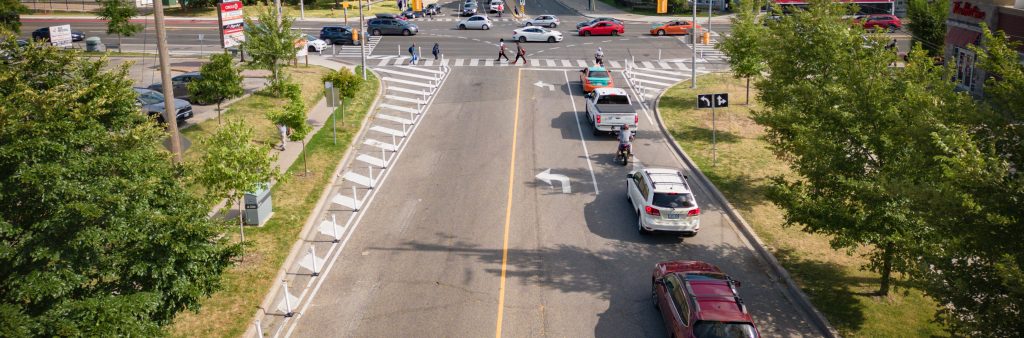
Pavement markings play an essential role in guiding drivers, cyclists, and pedestrians safely through Toronto’s streets. They communicate critical information such as lane boundaries, turning movements, crosswalks, stop lines, and bike lanes to help reduce confusion and prevent collisions. As an integral part of the City’s road safety infrastructure, pavement markings work alongside street signs and traffic signals to create a clear, consistent, and well-organized road network for everyone who travels through the city.
Pavement markings include longitudinal lines (such as lane lines, centre lines, and edge lines), transverse markings (such as crosswalks, stop lines, and yield lines), and symbols and words (such as arrows, bike lane markings, and “SCHOOL” text). Yellow markings generally separate traffic travelling in opposite directions, while white markings separate traffic travelling in the same direction or delineate other features such as parking lanes and bike lanes.
The City uses a range of materials for pavement markings depending on location, durability needs, and budget, including waterborne paint, field reacted polymeric material, and Preformed Thermoplastic materials. All materials and installation practices conform to the applicable Ontario Provincial Standard Specifications (OPSS) and the guidelines set out in the Ontario Traffic Manual (OTM).
The City runs an annual repaint program during the paint season (June 1 – October 31st), during which existing pavement markings receive two coats of paint to restore visibility and ensure markings remain clear and effective for all road users.