

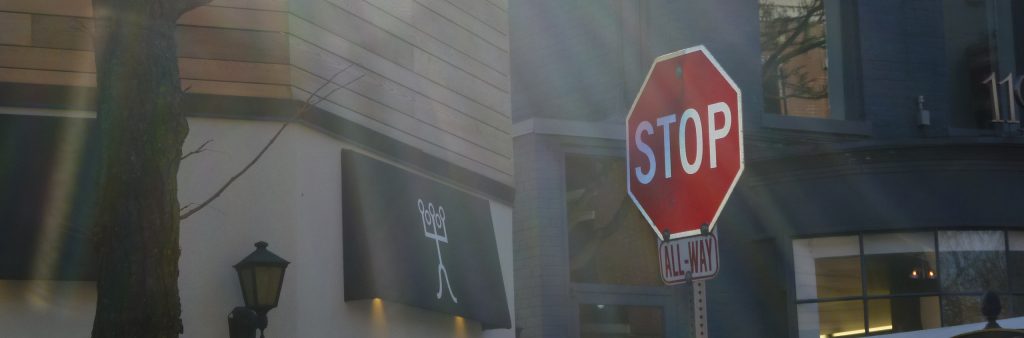
Traffic signs regulate, warn and guide road users to help keep Toronto's streets safe and efficient for everyone. They provide important information to drivers, people walking, people cycling, and other road users using standardized colours, shapes and symbols that are consistent across Ontario.
The City of Toronto installs and maintains traffic signs on public roads in accordance with provincial legislation and the Ontario Traffic Manual (OTM).
Traffic signs communicate rules of the road, identify potential hazards and provide navigation information. They are designed to help road users make informed decisions and improve safety for all road users.
Traffic signs may be installed to:
Traffic signs communicate important information to road users using standardized colours, shapes and symbols. The most common types of traffic signs are regulatory signs, warning signs and guide/information signs.
Regulatory signs indicate traffic laws and regulations that road users must obey. They tell drivers, people walking and people cycling what is required, permitted or prohibited.
These signs are typically white with black text or symbols. Some, such as Stop signs, are red and octagonal, while Yield signs are white with a red border and triangular in shape.
Examples include:
Failure to obey regulatory signs may result in penalties under the Highway Traffic Act.
Note: U-turns are generally permitted at signalized intersections unless prohibited by a by-law or a posted “No U-turn” sign. At some locations, a regulatory sign indicates that U-turns are permitted.
Warning signs alert road users to hazards or changing road conditions ahead. They encourage drivers to slow down or adjust their driving before reaching a potential hazard.
These signs are typically diamond-shaped with a yellow background and black symbols or text.
Examples include:
Guide or information signs help road users navigate the transportation network by providing directions and identifying routes, destinations and services.
These signs are typically green, or blue with white text or symbols, depending on the type of information they provide.
Examples include:
To request an information/directional sign (i.e. religious institutions, community, recreation centre) contact: signsandmarkings@toronto.ca
For a complete list of Ontario traffic signs and their meanings, visit the Province of Ontario's Official MTO Driver's Handbook.
Traffic signs installed on City roads follow standards established by the Province of Ontario. The Ontario Traffic Manual (OTM) provides technical guidance on the design, application and placement of traffic control devices to promote consistency across municipalities, while Ontario's Highway Traffic Act. establishes the legal requirements for many traffic signs.
For a complete list of Ontario traffic signs and their meanings, visit the Province of Ontario's Official MTO Driver's Handbook.
The City installs traffic signs to improve road safety, support traffic operations and meet provincial standards.
When considering the installation or modification of a traffic sign, the City may evaluate factors such as:
Depending on the type of traffic sign or traffic control being considered, engineering studies or City Council approval may be required before changes can be made.
Street name signs identify streets and help people navigate the city. They typically include the street name, street number and other information to help identify the location.
Toronto’s current street name sign design was approved in 2007 to create a more consistent and standardized system across the city. The design addressed differences inherited from the former municipalities, including variations in colour, font, legibility, placement, size and shape.
The standardized design also supports the City’s goal of creating a coordinated and well-designed public realm. Street name signs are an important part of the streetscape and help residents and visitors find their way around Toronto.
The street name sign design has three main components:
The central component is common to all signs and is covered on highly reflective blue sheeting, with upper and lower case reflective white lettering. The upper “blade” provides an area on which to brand the identification of Business Improvement Areas, neighbourhoods and communities. The lower “blade” is used to show the closest address number to the intersection and former city label.
That the upper and lower blades of the signs to be used will be white in colour with blue lettering, while the blades of the signs to be specifically branded will be finished in brushed aluminum.
The City installs oversized street name signs at signalized intersections to give drivers more time to see, read, and react before making a turn. Larger letters and signs are easier to spot in visually busy areas and can be read from a greater distance, helping drivers slow down and change lanes safely.
Oversized signs are typically installed in addition to standard-size signs. This approach is part of the City’s broader effort to maintain a consistent, high-quality, and easy-to-navigate street sign system across Toronto.
Contact 311 to report a problem, request an investigation or ask questions about traffic signs.
Submit a service request to investigate the installation, modification or removal of:
The City will review each request to determine whether it meets provincial standards and City requirements.
Submit a service request to report:
Submit a service request to report graffiti on a traffic or street name sign. Graffiti includes drawings, paint, stickers or anything else attached to the sign.