A free Tree of the Year will be made available to schools interested in planting a tree on school property. Read below for more details.

More than 10,000 young voters cast their ballots during the first-ever Kids Vote Weekend, held during advance voting for Toronto’s municipal election.
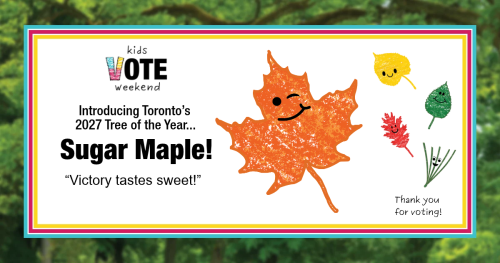
A graphic to the left reads Kids Vote Weekend Introducing Toronto's 2027 Tree of the Year...Sugar Maple! with text below reading victory tastes sweet! To the right are five leaf icons representing the five candidates with text that reads thank you for voting!

Known for its vibrant red, orange and yellow fall colours, the Sugar Maple is native to Toronto and plays an important role in the city’s urban forest. The Sugar Maple came out on top with 4,549 votes. Read the official results.

The Tree of the Year helps celebrate Toronto’s urban forest and supports the City’s goal of planting up to 120,000 trees each year and achieving 40 per cent tree canopy cover by 2050.

The five Tree of the Year candidates are large, native to Toronto and play an important role in our urban tree canopy and can be easily found in parks and forested areas. Learn about the five tree candidates.

The Sugar Maple was celebrated with a planting event in Elm Park on November 3.

The Sugar Maple will be featured in tree planting events and activities in 2027, including:

  • 1,000 plantings of the Tree of the Year on public land across Toronto.
  • Tree of the Year trees offered to Toronto schools to plant on school property.
  • Free Tree of the Year trees available at all public tree giveaway events.

More information on planting events and giveaways will be available in early 2027.

If you are unable to attend a planting event or do not have space to plant a tree of your own, you can still see the trees in person. Visit Toronto’s parks and use your identification knowledge to spot your favourite candidate.

A free Tree of the Year will be made available to schools interested in planting a tree on school property. See below for more information on how you can request a tree and what you can do to make your tree planting a success.

Planting the Tree of the Year at Your School

You can request a tree to plant at your school by filling out the form by December 11. Please read the information below to ensure your school can support a happy and healthy tree.

We recommended planting trees in the fall since the weather is cooler and rainier, making it easier for trees to take root. Having a watering plan is essential for the first year following planting.

Complete Form

Selecting a Spot for Tree Planting

When selecting a spot to plant a tree, it’s important to think about the long-term growth and health of the tree. What starts as a little tree can turn into a big tree over the years.

Consider the following when choosing your tree’s new home:

  • Avoid planting too close to buildings or other structures. An approximate minimum distance of 10 metres from buildings and five metres from other structures (paved surfaces and pathways, hydrants or playgrounds recommended).
  • Give the tree’s roots room to grow. Look for locations with good soil and an approximate minimum of three metres by three metres of open ground. This provides soil, water and enough space for the trunk to expand.
  • Avoid utilities or access points (hydro lines or maintenance gates).
  • Avoid locations where snow and road salt may be piled in the winter.
  • Avoid high-traffic areas (the bottom of playground slides or open playing fields).
  • Plant near a water source such as an outdoor faucet, which will make it easier to water the tree, especially in the first year following planting.
  • Ensure the location is on school property (not a park or the road allowance). Explore Toronto Maps to find property boundaries. Also see Toronto Maps - Help Guide.
  • Ensure it is safe to dig in your selected location. Underground utilities should be checked before you plant. Visit Ontario One Call for more information on digging and buried infrastructure.

How to Plant a Tree

  • Use mulch (highly recommended but not required).
  • Dig the planting hole as deep as the tree’s pot and wider. For many potted trees, the width of an adult foot can be a useful guide for a minimum distance between the edge of the hole and rootball.
  • Scratch the bottom and sides of the hole to loosen some soil and create a rough surface to help the roots establish.
  • Remove the tree from the pot. Gently scratch the edges of the rootball to slightly loosen the soil and roots to encourage the roots to grow outward into the surrounding soil.
  • Place the tree in the hole and ensure the soil at the top of the rootball is level with the soil of the surrounding ground. If you plant too deep or too high, this may harm the tree.
  • Add soil back into the hole, firming it in gently to eliminate air pockets and help stabilize the tree.
  • Water the tree thoroughly. Make sure you apply enough water that the whole rootball gets wet and reaches the bottom of the planting hole.
  • Add mulch to cover the exposed surface of the rootball. Both loose mulch or mulch mats help protect the roots and retain moisture. Do not pile the mulch against the trunk as this harms the tree.
  • Install the tree guard around the base of the tree, loose enough to expand as the tree grows.

Watch a video of How to Plant a Tree.

Caring for Your Tree

Trees need regular care for the first one to three years after planting.

Establishing a care plan for your tree is essential for its success:

  • Make sure you have a watering plan for the growing season (April to October).
  • Water your tree’s roots thoroughly two to three times a week. You may need to water more or less frequently, depending on temperatures and rainfall.
  • Pack a fresh layer of mulch each spring to protect the roots and conserve moisture while the tree establishes.

Your Tree of the Year sign will include a watering calendar to help track watering and encourage students to help.

Remember to treat the tree with care. Avoid pulling leaves and bending or snapping branches.

Form

To ensure your tree is in the right location and receives appropriate care throughout its lifetime, location details indicated in the online form may be shared with school staff for approval and inventory purposes. Please be as detailed as possible when describing the location of the tree.

The form will be available soon. Please email forestry@toronto.ca for questions.

Next Steps

Once your information has been received, it will be shared with school staff. Submissions that are approved will be contacted in early 2027 with additional information. Submissions that are not approved will be contacted with information on other options to engage in school- and City-hosted tree planting efforts.

Trees improve air quality, minimize noise and dust, reduce storm water runoff, and enhance the urban landscape. Trees also  provide privacy, shade and reduce heating and cooling costs.

The City plants up to 120,000 trees on City-owned land every year and supports tree planting on private property through the Toronto Free Tree Program, the Neighbourhood Planting Program , Urban Forestry Community Grants and a partnership with Local Enhancement and Appreciation of Forests (LEAF).

Date modified: November 6, 2026