

City of Toronto public art opportunities and updates on commissions, installations and unveilings.
The City of Toronto invites artists to apply for the opportunity for their work to be included as part of the custom art hoarding to be installed along the 309–345 George St. construction. This is a two-stage competition for practicing artists who work in two-dimensional media. Priority will be given to artists that have lived experience or a connection to the Moss Park and Garden District Heritage Conservation District neighbourhood. One artist will be selected to have their work reproduced and printed on aluminum composite material that will be installed along the construction site. The custom art hoarding will enhance the overall public environment and pedestrian streetscape experience for as long as the George Street construction is ongoing.
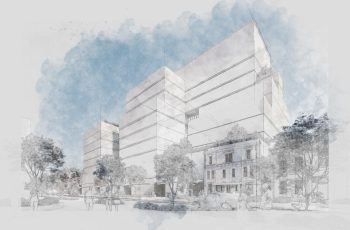
The George Street Revitalization (GSR) project is a transformative initiative that will replace the existing Seaton House men’s shelter with a modern, purpose-built facility that integrates essential services, including a long-term care home, shelter services, supportive homes and a community service hub. The project advances the City’s commitment to addressing systemic barriers and supporting equity-deserving groups who rely on services in Toronto’s downtown east. Through a continuum of care model, the GSR will promote stability, dignity, healing and long-term well-being while strengthening connections within the surrounding community.
The project honours the site’s longstanding role as a place of refuge and care. For nearly a century, beginning with Seaton House’s origins in 1931 and its operation at 339 George St. from 1959, the site has provided shelter, support and dignity to thousands of people experiencing homelessness. The redevelopment will also incorporate the historic Allan School, a designated heritage building with important connections to education, social services and community care in the downtown east.
The Moss Park neighbourhood is situated within a broader landscape of longstanding Indigenous presence and contemporary Indigenous community-building in downtown Toronto. The area forms part of Toronto’s emerging Indigenous District, with the Indigenous Centre for Innovation & Entrepreneurship at the southern end of George Street serving as an important cultural, institutional and economic anchor. Allan Gardens and the surrounding historic urban landscape provide an important civic context to this evolving district. Looking forward, the redevelopment of the streetscape along George Street will reflect this history through Indigenous-led placemaking, public art, planting and gathering spaces integrating Indigenous identity and presence into the neighbourhood’s public realm.
The project reflects the site’s historic commitment to reconciliation, inclusion, and community-building by providing homes and services that respond to the evolving needs of Downtown East residents. Learn more about the GSR project.
An external selection panel will be convened for this competition. Four shortlisted artists will be selected based on artistic excellence and demonstrated/perceived ability to develop an engaging and site-specific public artwork. Priority will be given to artists that have lived experience or a connection to the Moss Park and Garden District Heritage Conservation District neighbourhood.
Shortlisted artists will receive a Terms of Reference document to guide their next steps. Each shortlisted artist will be paid an artist fee of $1,000 to design a custom concept for the hoarding, preferably artwork that references the character and history of Moss Park and the Garden District Heritage Conservation District.
One artist will be commissioned for this opportunity. The selected artist will be awarded an artist contract and will be paid a fee of $8,000 plus HST for design and consultation services (including contract administration, project management, travel and other incidental expenses) working closely with staff of Economic Development & Culture and the project team to refine their concept proposal to the requirements of the site and other conditions for project realization.
The selected design will need to be approved by City staff, the project team and the local Councillor. Collaborating with the selected artist, City staff will manage all aspects of the production of the work, including budget, scheduling, coordination with the general contractor and installation.
The commissioned artist must submit their designs in a format that can be reproduced and printed on aluminum composite material for the site (i.e. print-ready files). Artists will not be permitted to paint directly on or alter the custom art hoarding surfaces once installed.
September 9 at noon: Deadline for call for artists submissions.
September 25: All artists are notified of the results.
September 30: Shortlisted artists are provided with Terms of Reference document/instructions for developing their designs.
October 28: Shortlisted designs due.
November: Selected artist contracts issued, approvals attained, hoarding installed.
Interested artists may apply using online application below. The deadline to apply is September 9 at noon. Late submissions are not accepted.
Be prepared to provide a one-paragraph artist biography and images of five recent projects and note if you have lived experience or a connection to the Moss Park neighbourhood and if you utilized AI in developing your application.
If you have any questions about submitting your application or require the application in a different format please contact Katriina Campitelli, Public Art Officer at publicartcompetitions@toronto.ca.
The Dundas-Islington public art competition was originally initiated in 2013 and secured by artist Noel Harding with his artwork Mimico Crossing. However, with Harding’s passing in 2016, the proposed artwork was never actualized.
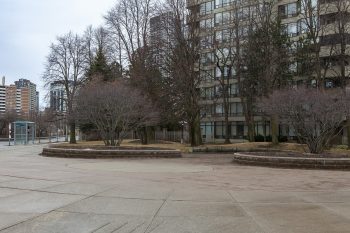
The intent of the public art project is to define an entry point to the area of Islington Village, creating a pedestrian-friendly environment. Islington Village is frequently cited as an outdoor art gallery that features more than 25 murals showcasing the history of the area. It is a key commercial area in the west end with connectivity to Kipling subway station and GO station.
The total available area for the installation is approximately 660 metres square with some restrictions to be outlined in the Terms of Reference.
View the five shortlisted artists’ concepts for the Dundas-Islington Public Art Competition and provide your input on which ideas best reflect the community, history and character of the area. Share your feedback by September 21.
This is a two-stage, open, national competition for professional artists born or living in Canada. They must meet the Canada Council’s definition of a professional artist.
The Selection Panel reviewed all submissions and identified a shortlist of five artists, based on artistic excellence and demonstrated or perceived ability to create and execute an innovative, engaging public artwork that is complimentary to the site and context.
The artists shortlisted for this project are:
Shortlisted artists will attend an interview and present their proposals to the selection panel on Friday, October 12. The panel will receive evaluation criteria specifically tailored to this site. They will choose a finalist whose vision for the site best suits the overall scope of this project and has the ability or perceived ability to conceive and realize a public artwork on this site.
March 20 to May 15: Accepting EOI submissions (8 weeks)
May 15 at noon: EOI Deadline
Week of June 8: Artists notified
June 15: Terms of Reference to shortlisted artists
June 15 to August 10: Artists designing proposals (8 weeks)
June 19: Design meeting with shortlisted artists
July 15: Halfway point meeting (optional)
August 10 at noon: Deadline for artists proposals
October 12: Presentations and jury
For questions, please contact Catherine Machado, Public Art Officer at publicartcompetitions@toronto.ca.
The New Etobicoke Civic Centre Project will be a mixed-use building comprising a wide range of community focused program and services. The building is arranged in a series of tall volumes towards the north, housing the municipal offices while the lower floors towards the south contain all the public functions. The centre will include an event plaza, a filter garden, large erratic (boulders) landscape elements, a water feature, a sacred fire vessel, bike share, a café terrace and public art.
Jordan Sook / Jordan Sook Studios has been selected to provide a suspended sculpture in the multi-story lobby atrium of the new ECC. The public artwork, entitled love is the space between us & infinity, is a large, red rollercoaster sculpture that reflects the area’s past life as Spaghetti Junction.
Commissions for the following locations are to be announced in the fall:
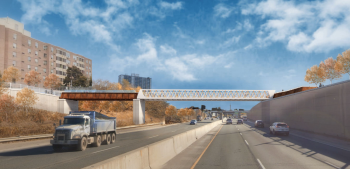
Three bridges in Parkdale neighbourhood – Dowling, Dufferin and Dunn – are scheduled for upcoming replacement. The three bridges are highly visible, viewable to those traveling through the rail corridor, Gardiner Expressway or Lakeshore Boulevard. They act as a visual gateway and welcome those entering downtown Toronto.
The successful artist will work with the design team to identify public art opportunities and recommend feasible ways to integrate permanent public art into the design features of all three bridges, as well as the adjacent parkettes, landings or lookouts. Some examples could include sculptures, benches or seating, specialized railings or bridge elements, landscaping or planters, lighting design, pavers or hardscaping design, or other public realm elements. Construction begins in 2028 at the earliest. Once installed, the public artwork(s) will join Toronto’s Public Art & Monuments Collection.
The peer review panel, comprised of local Parkdale community members and art experts, has selected Ry Van Der Hout as the successful artist for this commission.
Ry Van Der Hout (b. 1987, Canada) is a Parkdale-based interdisciplinary artist whose practice investigates transformation, fragmentation, queer experience and becoming. Their work challenges conventional ways of seeing ourselves and our surroundings, inviting viewers to engage in new possibilities. Van Der Hout will be joining the Parkdale Bridges design team, where they will begin developing their public art concepts collaboratively and with ongoing engagement in the Parkdale neighbourhood. Van Der Hout holds an MFA from Parsons at The New School and a BFA in Photography from Toronto Metropolitan University. They have created public art for NYC Parks, the City of Toronto, and Nuit Blanche. Van Der Hout is the 2026 recipient of the Barbara Spohr Fellowship at Banff Centre for Arts and Creativity and has been awarded residencies at La Napoule Art Foundation (France) and Mass MoCA.
The new Etobicoke Civic Centre (ECC) at 3755 Bloor St. W. will be located within the newly redeveloped ECC Precinct (formerly the Westwood Theatre Lands). As the first civic centre to be built in 50 years, the ECC is designed as a mixed-use building comprising office spaces, municipal offices and a multi-purpose council chamber, a child care centre, library, public health clinic, recreation centre, retail spaces and a civic square located steps away from a new affordable housing community.
The custom art hoarding, to be installed around the construction site of the new ECC, will enhance the overall public environment and pedestrian streetscape while work is ongoing. Three artists have been commissioned for this opportunity: Kathryn Doner’s work will be shown along Bloor Street West, Aline Setton Caliman along Kipling Avenue, and Kiki Hamazaki along Dundas Street West.
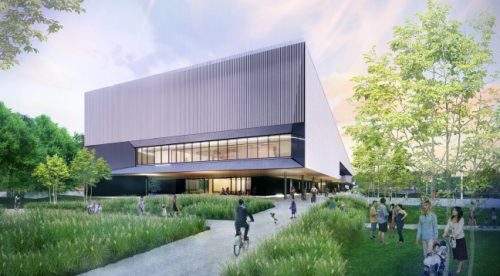
Western North York Community Centre is a project by the City’s Parks, Forestry and Recreation Division and Children’s Services, and is being designed by the collaborative team of Maclennan Jaunkalns Miller Architects as the prime consultant and landscape designer, and architectural sub-consultant Bortolotto, responsible for the Child Care Centre. The new WNYCC will provide residents with a state-of-the-art community and recreation facility, a licensed daycare and a new park. It will include an aquatic centre, a gymnasium with a walking track, a fitness centre with dance and aerobic studios and flexible multi-purpose rooms. It will be a place for the community to gather and socialize; a place that cultivates creativity, health and well-being, inclusivity and accessibility for all ages.
The City of Toronto intends to design and construct a Net Zero Energy Building to attain Net Zero Energy operations through incorporating strategies to deliver energy, water and waste reduction.
The site is in close proximity to the Humber River and the project aims to make connections with the surrounding neighbourhoods and parks, including the Humber River Trail.
Ward 7 – Humber River-Black Creek
The following artist teams have won the three public art commissions for the Western North York Community & Child Care Centre public art competition:
The commissions will include several outdoor sculptural works including a water feature and site furnishings as well as photographic artworks integrated into the interior of the building.
A new Community Recreation Centre and Child Care Centre (CRC) is coming to the Lawrence Heights neighbourhood as part of the Toronto Community Housing Lawrence Heights Revitalization project. Once built, the new CRC will be one of the City’s largest recreation centres. It will replace the existing Lawrence Heights Community Centre, which will remain open until the new facility is complete.
Two new public artworks will accompany the forthcoming CRC, one outdoors and one indoors.
Residents and community members participated in surveys, workshops and consultations led by Oddside Arts. Participants provided their preferences for the forthcoming public artwork and three major themes emerged: Black/African/Caribbean culture; togetherness, multiculturalism and connectivity; and nature. The Peer Review Panel, comprised of local community members and art experts, shortlisted the following artists for the public art opportunities.
Jacquie Comrie was selected for her proposal, Jumbie Forest. Healing through colour, this work honours the Moko Jumbie, a guardian spirit and symbol of protection, healing and resilience in Afro-Caribbean culture. It is a tradition that survived the Trans-Atlantic Slave Trade and continues to represent cultural regeneration, community, and ancestral memory across the Caribbean diaspora and beyond.
Comrie is an Afro-Panamanian multidisciplinary artist, mother and mental health advocate. Her work intersects art and wellness, exploring colour psychology and its benefits to the human body, and overall wellbeing. With our current crisis in mental health across the globe, Comrie seeks to reimagine public art while creating therapeutic spaces of colour healing accessible to everyone.
Rodrigo Moreno, Coryn Kempster and Julia Jamrozik were selected for their proposal, Reflections. The work will feature more than 100 photographs of Lawrence Heights over many decades by Rodrigo Moreno. The resulting works document friends and neighbours, buildings and greenspaces. The photographs will be etched into stainless steel and interspersed with mirror-polished panels so visitors can see themselves literally reflected in the Lawrence Heights community.
Rooted in community-based storytelling, Moreno was raised in Lawrence Heights and has spent more than thirty years documenting life in this neighbourhood. Jamrozik and Kempster are a Toronto-based multi-disciplinary artist team who creates spaces and objects that interrupt everyday situations in critically engaging and playful ways.
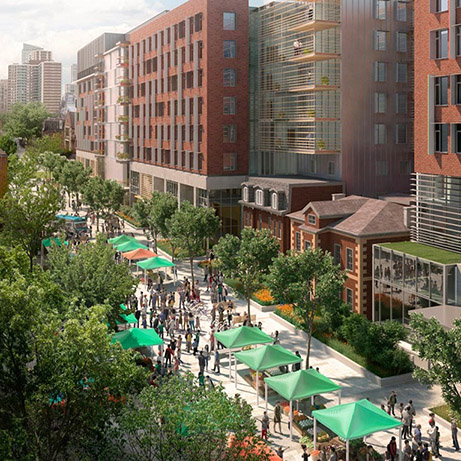
The George Street Revitalization Project (GSRP) will replace the Seaton House emergency shelter and renew a number of vacant heritage residential sites on George Street with a new facility that will contain a City-operated long-term care home, transitional housing with supports, a transitional shelter for women and men, an emergency shelter for men and a community hub for residents and neighbours.
The public art plan was led by Helena Grdadolnik, Director of WORKSHOP with curators, Jenifer Papararo and Lisa Myers. Collaboratively, they designed a structure, under the theme Accommodations, in consideration of those served by the new facilities, and to provide the selected artists’ time for research and development in this unique context. Local and International artists were selected through an open competition that sought artists who use socially engaged approaches within their art practices. The GSRP Public Art Program includes a mentorship component to build a future generation of artists with experience producing art in the public realm.
Construction is anticipated to start in summer 2022 and end in 2026.
Ward 13: Toronto Centre
Each of the final selected artists is working with a mentee artist.
Established Nehiyaw Cree/Métis artist, Rebecca Baird’s artistic practice explores themes of Indigenous history, identity and culture, re-articulating and re-visioning Indigenous narratives while striving to engage a contemporary intersection of memory and meaning. Baird has worked with many prominent art institutions in presenting public artworks in the Art Gallery of Ontario and the Royal Ontario Museum. She has completed numerous public art works, including major projects for Toronto’s CAMH Queen Street facilities and Lester B. Pearson International Airport.
Rebecca will be assisted by Cotee Harper, an Indigenous collaborative dance artist (Ballerina, Traditional Jiggle Dress Dancer recognized as a member of the Ontario Jiggle Dress dancers, and a Shawl dancer). She is a bead work artist and also works for Seeds of Hope Foundation pilot project (H2H Hear to Help) and is a Dixon Hall relief peer worker for the Warming Centre on George Street.
Sandra Brewster works in drawing, video, photo-based works and installation. Her themes focus on identity and representation, and movement in the depiction of gesture resulting in a re-presentation of the portrait. Born to Guyanese parentage, her work often refers to the migration of Caribbean people from the region, suggesting a formation of identity that encompasses multiple geographies and temporalities, and a sense of identity that exists within the diaspora. Recent exhibitions include the Musée d’art Rouyn-Noranda (2023), the Museum of Contemporary Art Chicago (2022-23), The Power Plant Contemporary Art Gallery, Toronto (2022), Les Rencontres d’Arles (2022), Hartnett Gallery, Rochester (2022) and Art Gallery of Ontario, Toronto (2018–2022). Sandra will be assisted by Ehiko Odeh, a multidisciplinary artist from Lagos, Nigeria, currently residing in Toronto. With a rich artistic background, Ehiko’s creative journey is deeply rooted in her spiritual practice and fueled by the essence of play. Notably, her first solo exhibition in Canada was presented by BAND (Black Artist Network In Dialogue) in 2019, marking a significant milestone in her artistic career.
Cheryl L’Hirondelle (Cree/Halfbreed) is an award-winning interdisciplinary artist, singer/songwriter and critical thinker whose Indigenous family roots are from Papaschase First Nation and Kikino Metis Settlement, Alberta. Her work investigates and articulates a dynamism of nêhiyawin (Cree worldview) in contemporary time-place incorporating Indigenous language(s), audio, video, VR, the olfactory, sewn objects, music, audience/user participation and community engagement to create immersive environments and events towards “radical inclusion.” In 2021, Cheryl was awarded a Governor General’s Award in Visual and Media Art. Cheryl will be assisted by Samay Arcentales, a Toronto-based, queer Kichwa digital media artist and video designer exploring human-land relations, the new media dimensions of indigenous cosmology and immersive art as a site of liberation. Her works have been shown at ImagineNATIVE, Xpace Cultural Centre, Mayworks Festival, Tarragon Theatre, TQFF, SoulPepper, among others.
Joar Nango is a process-based artist working within the provisional nature of sculpture, performance, and architecture. Nango is Sámi, belonging to the Indigenous peoples from Sápmi, the traditional Sámi territory. He has exhibited widely, recently presenting a large-scale solo exhibition at Bergen Kunsthall, Norway. He has participated in exhibitions at the National Gallery of Canada, Tensta Konsthall, the Chicago Architecture Biennial, and Documenta 14 in Kassel and Athens. Girjegumpi, the Sámi Architecture Library, is his contribution to the Nordic Pavilion at the Venice Biennale. Joar will be assisted by Mark Bennett, a mixed-identity Inuk designer based in Toronto, originally from western Ktaqmkuk (Newfoundland). Bennett considers his primary area of focus to be in graphic design collaborating with artists, galleries and cultural organizations. His latest personal design work is an exploratory process looking at how design can be reconfigured with collaborative inputs and community involvement. Select clients include: National Gallery of Canada, Art Gallery of York University, Winnipeg Art Gallery/Qaumajuq, Gallery 44, Inuit Art Foundation and the Bonavista Biennale.
Rolande Souliere explores the interconnectedness, and complexities involved in social, political and or cultural systems and how systems have impacted individual and collective histories. She was born and raised on Turtle Island (North America) and lives and works on Gadigal Land, (Sydney) Australia. She is a member of Michipicoten First Nation and has a PhD and MVA from Sydney College of the Arts, University of Sydney. Recent exhibitions include, Canada, 52 Artists 52 Actions, Wangarrata Art Gallery, Australia, Scents of Movement, Scents of Place, Art Gallery of Alberta, Canada and States of Collapse, Dunlop Art Gallery, Canada. Rolande will be assisted by Laura Kay Keeling, a self-taught visual artist based in Hamilton, Ontario. Her practice is rooted in a process-centred approach that integrates analog photography, video, digital collage and installation. Keeling has exhibited work across Ontario, in the United States and in South Korea. Highlights include, recently completing her first solo exhibition titled Untitled Portals at Smokestack Gallery in Hamilton, showing work at DesignTO, CONTACT, the NAC, The RMG, as part of BigArtTO and more.
The following artists were selected for six-month solo exhibitions in the Toronto Sculpture Garden:
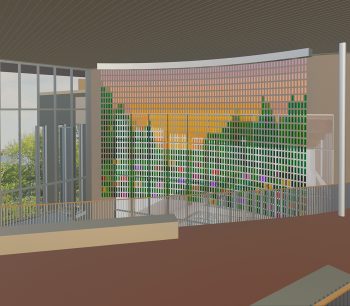
Artist Shellie Zhang has been commissioned for the Wabash Community Recreation Centre public art project. Her proposal, Part of the Whole, was selected through a competitive public art process and was favoured by the community. Inspired by stories of the surrounding neighbourhood rallying together to create public greenspace, the artwork is a large hanging beaded curtain sculpture featuring the image of a sunset against a green landscape with wildflowers. The sculpture will be suspended in the multi-story lobby of the new Wabash CRC. This will be the artist’s first permanent public art commission.
Shellie Zhang (b. Beijing, China) is a Toronto-based multidisciplinary artist. By uniting both past and present iconography with the techniques of mass communication, language and sign, Shellie explores the contexts and construction of a multicultural society by disassembling approaches to tradition, gender, the diaspora and popular culture. She creates images, objects and projects in a wide range of media to explore how integration, diversity and assimilation is implemented and negotiated, and how manifestations of these ideas relate to lived experiences. Shellie is interested in how culture is learned and sustained, and how the objects and iconographies of culture are remembered and preserved. For most of her time in Toronto, the neighbourhood of Parkdale was her home.
The Wabash CRC, designed by Diamond Schmitt Architects, will be a four-story community space located at the southeast corner of Sorauren Park, adaptively reusing the existing former Canadian Linseed Oil Mills Ltd. building. Learn more about Wabash Community Recreation Centre.
The successful artist team for the new park at 254 King Street East is Oluseye Ogunlesi, Odudu Umoessien, Ogbe David Ogbe, Chukwuebuka Stephen Idafum, Abel Omeiza and Folusho Afun-Ogidan. The park design is inspired by the histories of Black migration that have shaped Toronto and will include public art, seating and a water feature.
The eastern segment of Overlea Boulevard from Don Mills Road to Thorncliffe Park Drive is planned for upcoming road work. This includes the Charles H. Hiscott Bridge (“Overlea Bridge”), Don Mills Road/Gateway Boulevard intersection and Thorncliffe Park Drive East intersection. The bridge and sidewalks will be widened and redesigned to address concerns about personal safety.
The Overlea Bridge superstructure is planned for replacement in the next five years. This level of construction hasn’t happened since the 1960s when Don Mills Road was last reconstructed and the Overlea Bridge was first built. This part of Overlea Boulevard is a key link between Thorncliffe Park and Flemingdon Park neighbourhoods.
Led by the City’s Transportation Services and Engineering & Construction Services Divisions, the Overlea Boulevard and Bridge Renewal is located across two of the City’s 31 Neighbourhood Improvement Areas (identified in the Toronto Strong Neighbourhoods Strategy 2020), where the City works with residents, businesses and agencies to make the changes the neighbourhood needs so that it works well for all its residents. The area is densely populated and home to a high number of residents born outside of Canada who speak Farsi, Urdu, Mandarin, Arabic, and Slovak.
The Flemingdon Park and Thorncliffe Park neighbourhoods, while characterized by clusters of high-density high-rise apartment buildings, are also rich in open urban and green spaces. The bridge is adjacent to the Marc Garneau Collegiate Institute and Valley Park Middle Schools, and therefore many students cross the bridge on foot at least twice per day. Over the past several years, professional public consultations, workshops and Pop-up Citizen Forums seeking input from the community for desired design interventions, resulted in building successful partnerships with residents. The Thorncliffe Park and Flemingdon Park Neighbourhood Plan that emerged from this process contains a series of recommendations grounded in the ideas of community members, with strategies to work towards implementation. Residents support several enhancements to make the infrastructure safer for pedestrians, cyclists, and promote a sense of neighbourhood identity. This would include interventions at Overlea and Thorncliffe Park Drive West to widen sidewalks, protect vulnerable road users, add vegetation, and incorporate beauty and identity through public art and streetscape design.
The bridge design is currently underway, led by the City’s Engineering and Construction Services Division. It is anticipated to be completed by Q2 2024 and tendered in Q3 2024. The roadworks design competition is currently ongoing. Construction under one contract (both road and bridge) is planned for 2024-2026. Public art funding is provided by the City of Toronto’s City Planning-Urban Design and Transportation Services divisions.
The communities of the Williams Treaty First Nations, Mississaugas of the Credit First Nation, the Huron-Wendat, Six Nations of the Grand River Territory, Kawartha Nishnawbe First Nation and the Metis Nation of Ontario all have connections to this territory.
Learn more about renewing Overlea Boulevard.
Artist Roda Medhat has won the Overlea Boulevard public art competition. The commission will include sculptural and two-dimensional artworks integrated into the public realm along Overlea Boulevard between Thorncliffe Park Drive and Don Mills Road. Medhat is a Kurdish-Canadian artist who seeks to use sculpture to bridge cultural divides and promote a sense of shared human experience.
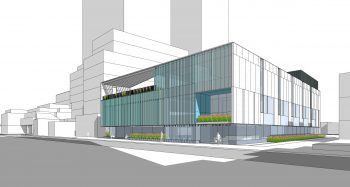
The Davisville CAC is a capital project of the City’s Parks, Forestry and Recreation Division, in partnership with the Toronto District School Board. The new City facility is located on the Davisville Junior Public School site and will share space with the new school. The school will have access to the City swimming pools and the City will have access to the school’s gymnasium and underground parking garage.
The new City aquatic centre will be located in the Davisville Village neighbourhood, near the intersection of Yonge Street and Davisville Avenue. Designed by CS&P Architects, the centre will provide residents with a three-storey recreational aquatic facility, including a 6-lane, 25-metre lane pool, a leisure/tot pool with gender neutral washrooms and change rooms, multi-purpose spaces and an active roof.
It will be a valued community space, inclusive and accessible to multi-generational residents that encourages health and well-being through its sports and recreational programming, informed by community consultation to date.
The City of Toronto intends to design and construct a Net Zero Energy Building to attain Net Zero Energy operations through incorporating strategies to deliver Energy, Water and Waste reduction.
Artist Kellen Hatanaka has been selected for the Davisville Community & Aquatic Centre (CAC) public art competition. Hatanaka is an artist, designer and illustrator based out of Stratford, Ontario.
The commission will include a new public artwork in the two-story atrium and custom mosaics throughout the building’s stairwells.