Main Navigation


Shared Lane Pavement Markings (“Sharrows”)

Use these features at your own discretion. Personal info you provide is not collected by the City of Toronto.

Content on this page requires a newer version of Adobe Flash Player.

Get Adobe Flash player


Get the Flash Player to see this content.

To view all our cycling videos, visit the City of Toronto YouTube Channel.

Frequently Asked Questions

  1. What is a shared lane pavement marking, or “sharrow”?
  2. What do these sharrow markings mean for cyclists?
  3. What do these sharrow markings mean for motorists?
  4. Where can I expect to see these sharrow markings?
  5. Why are some sharrows in the middle of the travel lane? Aren’t cyclists suppose to move to the right?
  6. Why are some sharrow markings in traffic lanes that have part-time parking? Can I park my car on top of sharrows?
  7. How are these sharrow markings different from a bike lane?
  8. If I see these sharrow markings, is the lane for bikes only?
  9. Should cyclists and motorists only share the lane when there are sharrow markings?
  10. Are these markings going to be on every street that does not have a bike lane?
  11. Why not just stripe bike lanes instead of sharrows on city streets?
  12. Since sharrows don’t require removing parking or travel lanes for motor vehicles, why not just use sharrows instead of bike lanes on city streets?
  13. Will there be any signs used with these sharrow markings?
  14. Why is the City painting these sharrow markings on our roadways?
  15. Do sharrow work?

Download the Sharrow FAQ as a PDF.

1. What is a shared lane pavement marking, or “sharrow”?

A "sharrow" is a shared lane pavement marking. This pavement marking includes a bicycle symbol and two white chevrons.

Back to top

2. What do these sharrow markings mean for cyclists?

Sharrows are used to indicate where cyclists should ride in a travel lane.

  • For safety reasons, cyclists should ride one metre from the curb to avoid debris and sewer grates.
  • In lanes that are too narrow for cyclists and motorists to travel side-by-side, cyclists should ride in the centre of the lane to discourage motorists from passing too closely.
  • Where there is on-street parking, cyclists should ride one metre from parked cars to avoid the “door zone”.

Although it is the motorist’s and/or passenger’s responsibility to look first before opening their door, riding too close to parked cars can lead to serious injuries that can be avoided.

Sharrows are also used through intersections and some merge zones to support straight-line cycling and to increase the visibility of cyclists.

Back to top

3. What do these sharrow markings mean for motorists?

Sharrow markings are used to remind drivers to share the road with cyclists. Sharing the road means you should:

  • only pass a cyclist where there is enough room to to do safely (at least one metre between motorist and cyclist),
  • reduce your speed when passing a cyclist, and
  • watch for cyclists when making lane changes and turns.

Be aware that cyclists are vulnerable to different hazards than drivers (e.g. minor pot holes and debris), so give them space to manouvre. Even where there are no sharrows or bike lanes, motorists should always share the road.

Back to top

4. Where can I expect to see these sharrow markings?

Sharrows are used in curb lanes, either adjacent to the curb or parked cars. You will also see sharrows painted in the middle of narrow lanes where there is not enough room for a cyclist and motorist to travel side-by-side. Sharrow markings are also used through intersections and areas where traffic merges, such as at highway on-ramps or intersections with multiple turning lanes. Sharrows are mostly found downtown where there are the greatest number of cyclists.

View the list of sharrow projects.

Back to top

5. Why are some sharrow markings in the middle of the travel lane? Aren’t cyclists suppose to move to the right?

According to the Highway Traffic Act, cyclists travelling at less than the normal speed of traffic should ride in the right-hand lane when practicable, and as close as practicable to the right hand curb or edge of the roadway (Section 147.1). In some situations it may not be practicable or safe for cyclists to ride adjacent to the curb. For example, there may be debris or poor pavement in the curb area that poses a hazard to cyclists; or the lane may be too narrow for cyclists and motorists to travel side-by-side, so the cyclist may “take the lane” to discourage the motorist from passing too closely. In locations such as these, where the lane is too narrow for cyclists and motorists to safely travel side-by-side, the City has painted sharrows in the middle of the lane to encourage cyclists to take the lane and to make drives aware that cyclists are entitled to ride in the centre of the lane.

Back to top

6. Why are some sharrow markings in traffic lanes that have part-time parking? Can I park my car on top of sharrows?

Traffic signsAs part of a pilot project, sharrows are being used on College Street in locations where there there is part-time parking, and the parked cars cover the sharrow markings for parts of the day. During the time periods when there is no parking (typically during rush hour) the sharrows are visible to motorists and cyclists. Sharrows are being used in this way to improve cycling conditions during the busiest times of the day. In general, these “rush hour sharrows” will be used on streetcar routes where cyclists ride, but where there is not enough space to provide full-time sharrows or bike lanes.

As always, parking and stopping is regulated by the signs you see on the street – not by pavement markings. You may park your car on top of sharrows during the time periods when parking is permitted, as indicated by the signs (typically during off-peak hours such evenings and weekends). If you stop, stand or park illegally you may receive a ticket and your vehicle will be subject to towing.

The effectiveness of this “rush hour” sharrow marking design is being evaluated before it considered for use on other streets in Toronto.

Back to top

7. How are sharrow markings different from a bike lane?

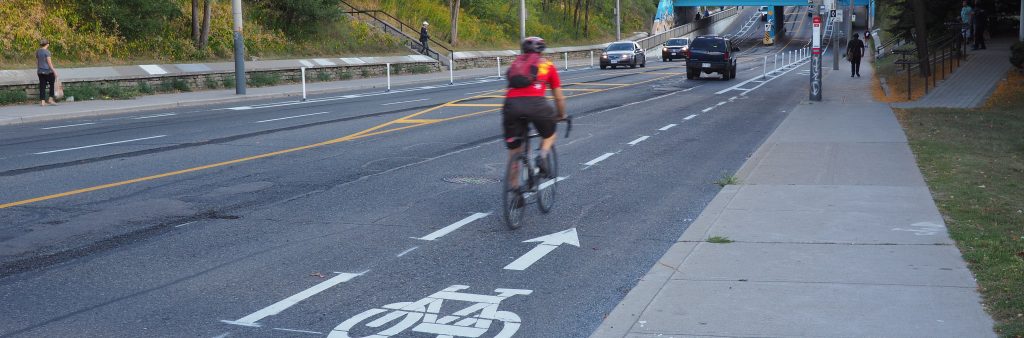
Bike lanes are a dedicated space for cyclists where motorists are not allowed to park, stop or drive. Bike lanes are painted on the road with bicycle symbols and a solid white line.

In comparison, sharrows are used in lanes that are shared by motorists and cyclists. Travel lanes with sharrows do not have a separate white line indicating a dedicated cycling area. Instead, chevrons and a bicycle symbol are used to indicate where cyclists should ride, and where motorists should expect to see cyclists.

Back to top

8. If I see these sharrow markings, is the lane for bikes only?

No. Sharrows are used to in lanes that are shared by motorists and cyclists.

Back to top

9. Should cyclists and motorists only share the road in lanes with sharrow markings?

No. In Toronto, cyclists can ride on any street that has a speed limit of 60 km/h or less. Cyclists and motorists should share the road on all these streets regardless of whether there are pavement marking or signs encouraging them to do so.

Back to top

10. Are these markings going to be on every street that does not have a bike lane?

No. The sharrow markings will be used primarily on arterial and collector streets used by cyclists, but where the City cannot provide a dedicated bicycle lane. In general, sharrows will not be used to indicate bike routes along local streets, which are comfortable for cyclists to use without the addition of pavement markings. Signed routes will continue to be installed on local streets to help cyclists navigate these routes.

Back to top

11. Why not just stripe bike lanes instead of sharrows on city streets?

Bicycle lanes are preferred to sharrows as a bikeway design treatment, but not all streets have enough room for bicycle lanes due to high demand for on-street parking and/or the inability to eliminate or narrow regular traffic lanes. As a general principle, widening roads to provide bike lanes is not practical in the downtown core or in residential areas. However, on some roadways, minor widenings may be feasible at the time of reconstruction. On streets where bicycle lanes cannot be accommodated, the City will be using sharrow markings instead.

Back to top

12. Since sharrows don’t require removing parking or travel lanes for motor vehicles, why not just use sharrows instead of bike lanes on city streets?

Where bicycle lanes can be accommodated they are preferred to sharrows because they provide a higher level of service for cyclists. Most cyclists also prefer bicycle lanes over sharrows, as shown in the Toronto Cycling Survey.

Back to top

13. Will there be any signs used with these sharrow markings?

Bikeway Network Information System signs will be used to incorporate sharrow routes in as represented in the Toronto Cycling Map and other materials. “Share the Road” signage may also be used, but to avoid clutter this signage will not be standard.

Back to top

14. Why is the City painting these sharrow markings on our roadways?

The City is working to improve cycling conditions, and sharrows are one way to encourage more people to consider cycling as a safe, effective method of travel.

Back to top

15. Do sharrows work?

Yes. Study results in San Francisco and Florida have shown that sharrow pavement markings do work. Sharrow marking are effective at encouraging cyclists to ride further from parked cars (outside of the “door zone”) and the curb.  On streets with sharrow markings, studies have found that cyclists are more likely to ride in the street (versus on the sidewalk) and with traffic (as opposed to the wrong way). Surveys have found that cyclists report they feel more comfortable riding on streets with sharrows than streets without sharrows. Toronto’s own evaluation of sharrows supports these findings.

Back to top